
- Dr. Friedhelm Deerberg, Consultancy & Project Management for Organic Farming
- Susanne Gäckler, DLG e.V.
- Dr. Peter Hiller, Lower Saxony Chamber of Agriculture
- Dr. Falko Kaufmann, Osnabrück University of Applied Sciences
- Dr. Christiane Keppler, Hesse State Agricultural Agency
- Gesa Krone, FiBL Deutschland e.V.
- Dr. Annika Lange, German Animal Welfare Association e.V.
- Prof. Dr. Stephan Schneider, Nürtingen-Geislingen University of Applied Sciences for Business and the Environment
- Dr. Dieter Schulze, Praxis Am Bergweg GmbH
- Hannah Kanwischer, Lower Saxony Chamber of Agriculture
- Constanze Lüntzel, Lower Saxony Chamber of Agriculture
The foundations for successful laying hen production are laid during pullet rearing, starting from the very first day of life¹. Following pullet rearing, the transfer to the laying hen house is a crucial stage in a hen’s life. In the rearing house, the pullets should first be allowed to develop as optimally as possible and become familiar with the house layout and the associated rearing system. After transfer, the hens must find their feet in a new rearing environment.²
Although the housing systems used during rearing are generally modelled on those for laying hens, they differ in a number of respects, such as the position and number of tiers, the arrangement of the perches, and the feeding and watering facilities. Lighting conditions – particularly in free-range systems – as well as the care staff and management practices are also not identical. The rearing system for pullets should, as far as possible, correspond to the housing system in the laying hen house in terms of the lighting programme, feeding times and the timing of inspection rounds (Animal Welfare Ordinance for Farm Animals §14(1) sentence 4)³. The birds should therefore be accustomed, whilst still in the pullet rearing phase, to everything they will encounter in the laying hen house.
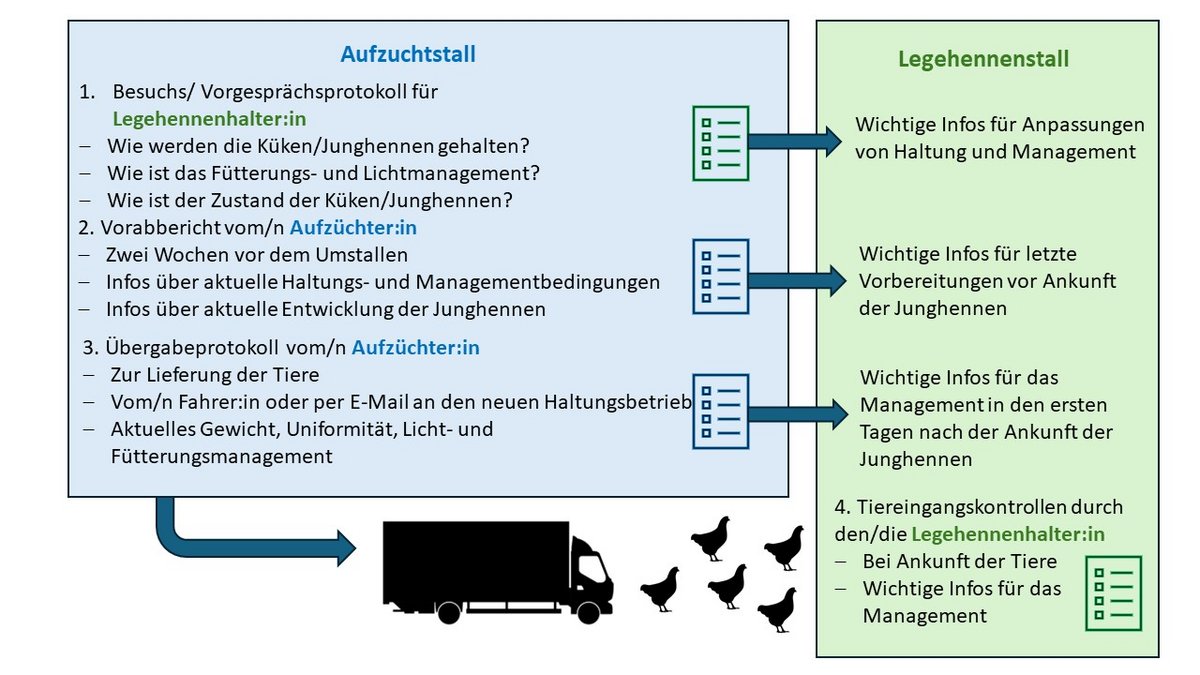
The laying performance and health of the future laying hen depend largely on the exchange of information between the rearing and laying farms. To ensure this exchange of information, the State Agricultural Agency of Hesse and the Foundation of the University of Veterinary Medicine Hannover have drawn up four handover protocols (two for the rearing farm and two for the laying hen farm).
Young hen - Quality young hen
The pullets should be calm and well-adjusted when they leave the rearing unit. This ensures that the pullets experience less stress from acclimatisation when they are moved into the laying house.1
The birds are moved between the 16th and 18th weeks of life. By this stage, the flock’s vaccination programme should, where possible, have been fully completed. In particular, injections should have been administered at least two weeks before the move. Due to fasting (withholding feed prior to loading), transport and the repositioning of the feed and water equipment, a slight decline in weight gain is almost inevitable. However, this should be as short as possible; accordingly, the pullets should not fall below the average weight specified by the breeding company even before loading.
High-quality pullets are characterised, amongst other things, by a high feed intake capacity that corresponds to their body size, depending on their specific genetics. Further characteristics include uniform flock growth, a full plumage, the ability to utilise multiple levels of the housing system, and a balanced temperament. The latter encompasses, in particular, a high tolerance to disturbances and low susceptibility to stress.
It is also of central importance to ensure that pullets can engage in their natural behaviours, such as pecking, scratching and dust bathing. This is facilitated by suitable materials such as textured and manipulable litter, pecking stones and/or alfalfa bales.
These behaviours must be learnt at an early stage so that the enrichment materials familiar from the rearing phase can be utilised optimally in laying hen housing.4
It is important to take into account the specific requirements of the respective housing system, such as access to the outdoor environment and/or free-range areas (EU Organic Regulation 848/2018 and its Implementing Regulation, together with their currently applicable interpretative guidelines7). Enquiries should also be made regarding the extent to which these requirements have been implemented.
Successful communication between the rearing and laying hen farms can help to avoid potential additional stress for the pullets during the transfer1. If, within the first week of housing, it becomes apparent that the flock is underweight, the start of laying should be delayed by adjusting the feeding regime and the lighting programme so that the birds reach their optimal starting weight by the time they begin laying.
Checklists in detail
Below, four checklists relating to the handover of pullets are presented individually and described in more detail. These checklists help to ensure that important information is passed on from the rearer to the layer farmer (and, where applicable, the organic inspector), so that the housing can be optimally prepared for the pullets and the transfer takes place with as little stress as possible.
Explanatory notes on the pullet checklists as a user guide
Further information
MTool for pullets and laying hens
The visit by the layer farmer during the rearing period
To ensure the best possible preparation for future laying hens, the layer farmer should not only focus on the handover from the rearing farm, but also take the entire rearing period into account. This plays a key role in optimally preparing the house for the future laying hens. It is therefore advisable for the future layer farmer to visit the rearing farm in advance or to consult with it. 5
The following information should be obtained from the rearing farm: 6
- Basic information (number of places, hatch date, genetics, organic certificates, etc.)
- Housing (housing system, roughage/pecking material/dust bath)
- House climate (air quality, temperature, relative humidity)
- Lighting (light source, light quality and lighting times)
- Feed (feeding methods, feed during the rearing phase, planned feed prior to transfer to the growing house)
- Water (watering methods)
- Animal health (findings and animal losses)
- Animal weights (weight curve and current status)
- Animal welfare indicators (animal condition and development, behaviour)
Checklist: Pullet farmers – Checklist for pullet farm visits
Young hens – Preliminary report
To ensure they are fully prepared for the arrival of the pullets, layer farmers should receive key information regarding the pullets’ status from the rearing farm at least two weeks before delivery. For example, this should include details of the feed used prior to transfer, the pullets’ weight development and preventive measures, such as the timing of needle vaccinations. The rearing farm should also provide details of the enrichment materials used, such as pecking stones (including their current hardness levels), sources of roughage or the use of grit.5
For biosecurity reasons, a salmonella test should also be carried out two weeks before transfer (Poultry Salmonella Regulation (§13(2)(b))8).
Handover Report
Upon delivery, the layer farmer receives the handover report either directly from the driver or by email. This contains basic data such as weight development, flock uniformity, vaccination status, transport information (fasting time, loading time) and current management guidelines. The management guidelines, particularly regarding feeding times and the lighting programme⁴, are crucial for ensuring the transition from the rearing house to the laying house is as stress-free as possible. A consistent lighting programme is designed to help the pullets maintain their usual daily rhythm, which has a positive effect on animal behaviour⁴ and helps prevent behavioural disorders.⁶
Animal entry checks
Upon arrival of the pullets at the laying farm, an initial animal inspection should be carried out to assess the condition of their plumage and general health, and this should be documented. It should also be checked whether there are any eggs in the transport crates and whether the birds can access water and feed immediately in the new housing system.6
Bibliography
- Critical Control Points in the Rearing of Young Hens – Lower Saxony Chamber of Agriculture Brochure_Layer HACCP_Young Hens.indd
- Rearing mobile and robust pullets
- TierSchNutztV – Ordinance on the Protection of Farm Animals and Other Animals Kept for the Production of Animal Products during their Husbandry
- Chicken Signals by Jan Hulsen | ISBN 978-3-7843-5121-6 | Buy specialist books online – Lehmanns.de
- Guide to Laying Hens.indd
- Communication facilitates the re-housing of pullets – Hesse State Agricultural Agency
- BMLEH – Organic Farming – EU legislation on organic farming
- GflSalmoV – Regulation on the control of salmonella in domestic fowl and turkeys