

The future prospects for broiler roosters and dual-purpose chickens
High-profile panel discussion on controversial alternatives to chick culling at EuroTier digital
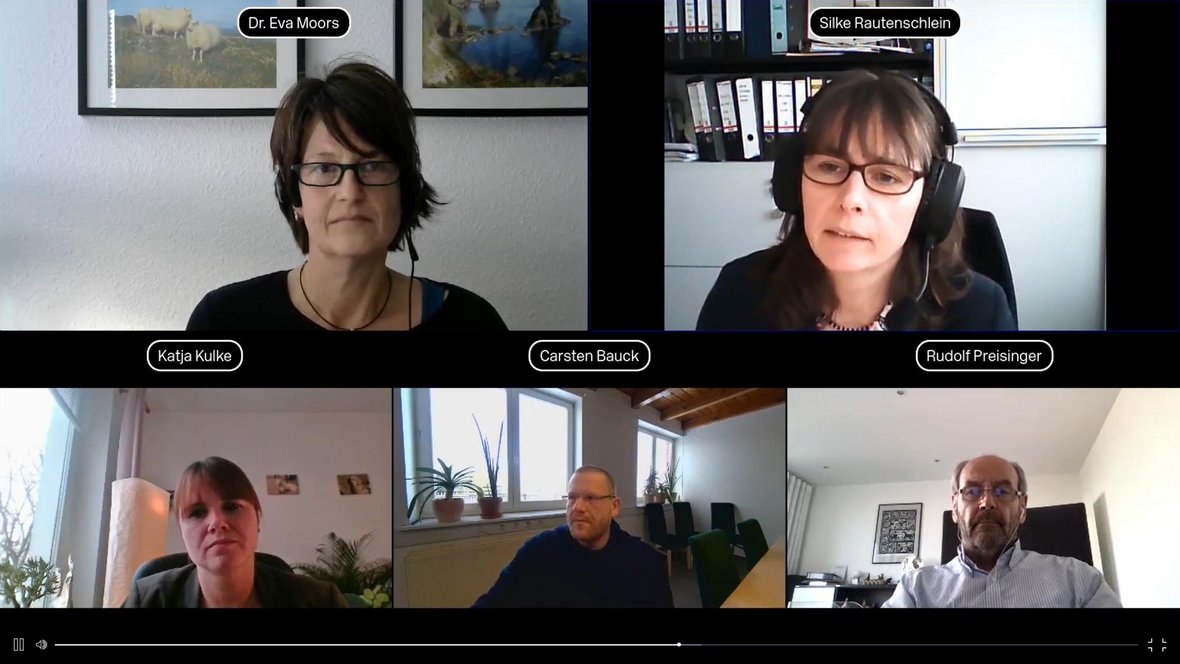
A panel of high-profile experts discussed the “Future Prospects for Broiler Roosters and Dual-Purpose Chickens” as part of the EuroTier professional programme. Prof. Dr Silke Rautenschlein (Project Manager at Integhof, University of Veterinary Medicine Hannover Foundation), Carsten Bauck (Bauckhof), Dr Eva Moors (Animal Welfare Service, Lower Saxony State Office for Consumer Protection and Food Safety) and Prof. Dr Rudolf Preisinger (Lohmann Breeders GmbH) discussed the advantages and disadvantages of rearing male chicks and dual-purpose chickens as alternatives to sex determination in the egg. The discussion was moderated by Katja Kulke from the office of the Poultry Animal Welfare Competence Centre at the Lower Saxony Chamber of Agriculture.
Due to the decision taken by the Federal Cabinet in January 2021 to adopt the draft law on the culling of day-old chicks, the topic had gained even greater significance in the run-up to the event. As things stand, from 2022 onwards, no male chicks from laying lines may be killed, and in a second step, from 2024 onwards, no sex determination in the egg may take place after the 6th day of incubation. However, current methods for sex determination in the egg only begin from the 8th or 9th day. The widespread establishment of a method for sex determination before the 6th day of incubation in hatcheries by 2024 therefore remains a major challenge. However, with current and future methods of sex determination in eggs, there is always a certain error rate, meaning that not all male chicks are identified by these methods. Based on Prof. Preisinger’s experience to date, error rates can certainly be as high as 2–5%. For this reason, the Managing Director of Lohmann Breeders GmbH emphasised that an industry-wide solution must be found for these birds in the future.
At the start of the discussion, Carsten Bauck presented the Bruderhahn Initiative Deutschland, which he co-founded. For ethical reasons, the initiative has set itself the goal of rearing the male chicks from laying lines. Mr Bauck, who farms according to Demeter guidelines, is thus supporting the general efforts of organic associations to do away with sex determination in eggs in future and instead use brother roosters and dual-purpose chickens. However, the breeder also recognises the challenges involved in rearing brother roosters: One of these is that, due to the comparatively longer rearing period, cockfights already occur at the onset of puberty. Low stocking densities of max. 18 kg/m², plenty of enrichment material and adequate housing design are therefore necessary. “The brother cock is merely a stopgap measure,” says Bauck, “in reality, the future lies in the breeding and use of dual-purpose chickens.” However, the use of dual-purpose chickens would very quickly widen the price gap between conventional and organic eggs. A shift in consumer acceptance must take place to enable the transition and ensure farmers are fairly remunerated.
Prof. Dr Rautenschlein also sees advantages in dual-purpose chickens. The male birds are calmer. Furthermore, studies have shown that losses were slightly lower in a direct comparison with roosters from the Lohmann Brown line. With regard to behaviour, the scientist highlighted the advantages of the hens in particular. For instance, the birds in the Integhof project exhibited less feather pecking and cannibalism and retained an intact plumage even at the end of the laying period. Furthermore, it had been shown that the energy and protein density in the feed for the Lohmann Dual birds could be reduced without any loss of performance, thereby enabling the use of regional feedstuffs.
Despite some advantages, however, demand for dual-purpose chickens in Germany currently stands at around 0%. Prof. Dr Preisinger emphasised that the birds are currently used largely for scientific research. Only small batches are kept in Germany, mostly in mobile housing. This is primarily due to the low economic viability of the birds. For both broiler roosters and dual-purpose chickens, meat yield is comparatively low, particularly with regard to the sought-after breast meat. Furthermore, the laying performance of dual-purpose chickens was initially around 20% lower. Even though the breeding company Lohmann Breeders is striving to improve the performance parameters of dual-purpose chickens, “the difference will remain significant”, according to Prof. Preisinger. Consumers have so far been unwilling to spend more money on these products. The meat in particular must be cross-subsidised by the eggs in order to stand a chance on the market. The meat quality of brother cocks and dual-purpose chickens, however, differs significantly from that of conventional broilers. Carsten Bauck therefore recommends preparing the aromatic meat as a stew.
In addition to concerns regarding economic viability and a lack of consumer acceptance, the issue of the absence of legal requirements for the rearing of brother cocks was raised. As they are used for meat production, the minimum requirements for broiler chickens set out in the Animal Welfare and Livestock Husbandry Ordinance currently apply to Bruderhähne. According to Dr Moors, this should be viewed critically, both in terms of behavioural differences and the stocking density requirement of 39 kg/m². “The housing requirements should be based more on those for young hens,” demanded the Animal Welfare Service representative. In July 2020, the Bundesrat submitted a request to the Federal Government to amend the Animal Welfare and Livestock Husbandry Ordinance. The guidelines for broiler chickens are not suitable for application to male chicks. Discussions on this matter have already taken place at federal level. From the perspective of the Lower Saxony Animal Welfare Plan, the development of minimum requirements for the rearing of male chicks is definitely necessary, emphasised Dr Moors at the end of her remarks.
Further information on sex determination in the egg as an alternative to chick culling can be found on the project website at https://fokus-tierwohl.de/de/gefluegel/geschlechtsbestimmung-im-ei