
- Uwe Beißwenger, Baden-Württemberg State Audit Office
- Lambert Grosse, VzF GmbH
- Ulrich Kühnlein, Baden-Württemberg Cattle Fattening Advisory Service
- Martin Mayr, AELF Töging am Inn
- Stefan Müller, KälberKontorSüd GmbH
- Lower Saxony State Office for Consumer Protection and Food Safety
- Dr. Georg Teepker, Lower Saxony Chamber of Agriculture
- Klaus Zimmerer, AELF Nördlingen-Wertingen
- Julia Maischak-Dyck, Landesbetrieb Landwirtschaft Hessen
- Caroline Leubner, Landesbetrieb Landwirtschaft Hessen
- Lukas Trzebiatowski, Department of Veterinary Medicine, JLU Giessen
- Lydia Stahl, Department of Veterinary Medicine, JLU Giessen
As the most common housing system in cattle fattening remains the concrete slatted pen, rubber mats are now used here to improve animal welfare by enhancing the animals’ lying comfort. Lying on a flexible surface is closer to cattle’s natural behaviour than resting on bare concrete slats.
There is a wide range of rubber mats available, and careful consideration should be given to the selection process in order to find and use the most suitable mat for the specific farm. Furthermore, there are regulations – such as DIN 3763 – which must be strictly observed when selecting the mat to ensure that the investment does not prove to be a mistake in the long run.
The following summarises the most important information on rubberised slatted floors. It outlines the advantages and potential pitfalls associated with retrofitting or their use in new buildings.
Better replication of natural ground conditions in terms of elasticity and deformability compared to solid concrete floors
More species-appropriate lying behaviour in cattle (shorter but more frequent lying periods, species-appropriate lying down and standing up) compared to plain concrete floors1
Rubberised floors are preferred2,3 by cattle for lying down and result in less heat loss whilst lying7 down.
A significant reduction in hoof damage on rubber-surfaced floors compared to bare concrete floors (fewer painful sole and white line haemorrhages)1. A similar positive effect has also been4 observed in dairy cattle farming.
Generally improved hoof horn architecture on rubber-coated floors5, resulting in fewer premature cullings due to lameness8.
Fewer pathological findings at the carpal joints in cattle on rubber-surfaced floors compared to bare concrete floors6.
Fewer tail tip injuries in cattle on rubberised floors compared to cattle on bare concrete floors6.
-
There may9 be increased activity and more frequent mounting
Less wear on the hooves on rubberised floors compared to concrete floors5 (this does not apply if only the lying area is fitted with rubber mats). Hoof trimming may be necessary if the animals are kept for a long period.
In some farms, the bulls are slightly more soiled.10 Possible causes:
- a tendency for less faecal matter to pass through rubberised flooring compared to solid concrete slatted flooring (ensure correct installation!)
Investment costs
- approx. €50 to €120 per square metre
- Estimates of durability vary between 5 and 10 years (highly dependent on the quality of the mats and the installation; however, some come with a 5-year manufacturer’s warranty)
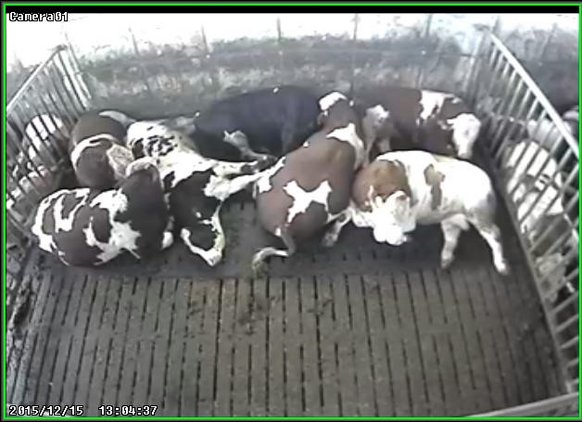
The “Lower Saxony Animal Welfare Guidelines for Beef Cattle Farming” require a soft, elastic and deformable lying area in new or converted buildings. In single-area pens in this housing system, the entire floor must be designed to be soft, elastic and deformable (rubberised floors meet this requirement). In dual-area pens, only the lying area is fitted with a rubber covering. This preserves the abrasive effect of the concrete floor on the hooves. A lying area of at least 2.5 m² is required for finishing bulls.
Interesting facts
When retrofitting, it is recommended to initially fit only one or a few pens with rubber mats, possibly of different types. This allows you to determine which system is most suitable for your specific farm. Care should be taken to ensure that all seasons are taken into account during this ‘trial period’. In this way, experience can be gained without significant financial loss.
Rubber mats in cattle walking and lying areas must comply with the requirements of DIN 3763. This standard applies to cattle over six months of age and was published in April 2020. This DIN standard sets out requirements for elastic stable floor coverings, including with regard to improving animal welfare: “Cattle are, by their nature, grazing animals. As such, they have adapted to partially malleable ground surfaces. This type of ground surface affects the animals both when lying down and when standing and walking. A sensible floor design based on elastomer mats can meet these needs of cattle. To this end, this document sets out requirements for elastomer mats for cattle housing.” Elastomers are dimensionally stable yet deformable plastics. This means that under pressure they can deform elastically but subsequently return to their original shape.
From an animal welfare perspective, a two-area pen with a separation of the functional zones for lying down and feeding/moving around is preferable. In this housing system, only the lying area is fitted with a rubber mat; the floor in the activity area at the feeding table is equipped with concrete slats without a covering. Compared to a single-area pen with a full rubber covering, hoof wear is more likely to occur here. For the activity area, abrasive rubber mats of tested and recognised quality are now also available for dairy cattle housing. However, long-term experience regarding their use in the housing of male beef cattle is still lacking.
The current construction guidelines for the rearing of fattening bulls, feedlot cattle, fattening calves and suckler cows published by the North Rhine-Westphalia Chamber of Agriculture in 2020 also provide important guidance.
It is recommended that rubber mats be laid on a single level in such a way that there are no points of contact between the floor and the rubber mat, or within the rubber mat itself, which could lead to premature damage to the mats caused by ‘bumping against’ them.
Findings from experiments
Studies have shown that rubber flooring has proven effective in practical trials. Findings from the Bavarian State Institute for Agriculture in Grub, for example, show that fattening bulls preferred slatted flooring fitted with a rubber covering to concrete slatted flooring for resting. The duration of rest for the animals on concrete floors was increased, as the animals avoided having to stand up and lie down more frequently on the hard surface. Physiologically, cattle lie down several times a day for short periods to rest. Animals kept on rubberised flooring suffered fewer tail tip injuries.
Bulls kept on rubberised floors also showed higher weight gains compared to bulls fattened on concrete slatted floors. Slaughter weights were 4 to 7% higher in animals kept on rubberised floors.
Further information:
https://www.lfl.bayern.de/mam/cms07/publikationen/daten/informationen/p_41132.pdf
Use in cattle fattening
The independent test reports from the DLG are recommended for selecting suitable rubberised mats. Regardless of DLG testing, the various mats demonstrate differences in quality in practical use. These differences arise, amongst other things, from variations in durability, deformability, slip resistance and the degree of soiling caused by the animals. To gain an impression of these rubber mats in practical use, farm visits are a good way to see the various rubber mats in action on site.
For use on young animals under 6 months of age
- End of the current transition period for soft or resilient bedding surfaces from 2024 (Animal Welfare and Livestock Management Ordinance)
- Have the manufacturer confirm compliance with the required softness level in accordance with the DIN standard (Class 2)
- Please note that delivery times may be long in some cases
Bibliography
1 Graunke, K. L., Telezhenko, E., Hessele, A., Bergsten, C., Loberg, J. M., 2011: Does rubber flooring improve welfare and production in growing bulls in fully slatted floor pens? Animal Welfare 2011, 20: 173–183
2 Bahrs, E.: Behaviour and health status of fattening bulls on rubber slatted flooring. PhD thesis, University of Munich, 2005
3 Rouha-Mülleder, C., Absmanner, E., Kahrer, E., Stanek, C., Troxler, J.: Assessment of various housing systems for cattle fattening. 15th Freiland Conference/22nd IGN Conference in Vienna, 2008
4 T. Fjeldaas, Å.M. Sogstad, O. Østerås, 2011: Locomotion and claw disorders in Norwegian dairy cows housed in freestalls with slatted concrete, solid concrete, or solid rubber flooring in the alleys,
Journal of Dairy Science, doi.org/10.3168/jds.2010-3173.
5 Elite Best Practice 2012
6 Zerbe F., Mayer C., Kjaer J.: Influence of slatted floor quality and space availability on the incidence of tail tip and integument injuries in fattening bulls. KTBL Publication 471, p.47ff., 2008
7 Freiberger et al., 2009
8 Mülleder, C., Absmanner, E., Kahrer, E., Zeiner, H., Stanek, Ch. & Troxler, J., 2008. Alternative housing systems for cattle fattening under Austrian conditions, with particular consideration of concrete slatted floors with rubber mats. Final report on research project 1447, self-published by the Institute for Animal Husbandry and Animal Welfare, Vienna,
9 Margin, L.; Gottardo, F.; Briscic, M.; Contiero, B.; Cozzi, G., 2019: Health, behaviour and growth performance of Charolais and Limousin bulls fattened on different types of flooring. Animal 13:11, pp. 2603–2611
10 Brscic, M.; Ricci, R.; Prevedello, P.; Lonardi, C.; De Nardi, R.; Contiero, B.; Gottardo, F., Cozzi, G., 2015: Synthetic rubber surface as an alternative to concrete to improve welfare and performance of finishing beef cattle reared on fully slatted flooring. Animal 9:8, pp. 1386–1392
11Zerbe, F. and Reiter, K., 2012: Use of non-abrasive rubber mats in bull fattening too? 17th International Symposium on Animal Welfare on 12 and 13 March 2012 in Nürtingen