
- Dr. Jens Baltissen, Federal Association for Cattle and Pigs
- Dr. Dieter Krogmeier, Bavarian State Institute for Agriculture
- Konstanze Rohwer, Blauer Lieth Farm, Westerrönfeld; Animal Welfare Pilot Farm
- PD Dr. Anke Römer, State Research Institute for Agriculture and Fisheries of Mecklenburg-Western Pomerania
- Caroline Leubner, Landesbetrieb Landwirtschaft Hessen
Introduction
For some time now, extended calving intervals have been a topic that is frequently mentioned in relation to the productive lifespan of cows, animal welfare and low calf prices. But what does this actually mean, and how does it benefit my farm?
With an extended calving interval, also known as extended lactation, the first insemination after calving is delayed longer than usual. The farm decides for itself how long a voluntary waiting period to allow the cow. A waiting period of 80 days or more can be described as an extended calving interval. But let’s start at the beginning. What is the calving interval or the voluntary waiting period? This is illustrated in Figure 1.
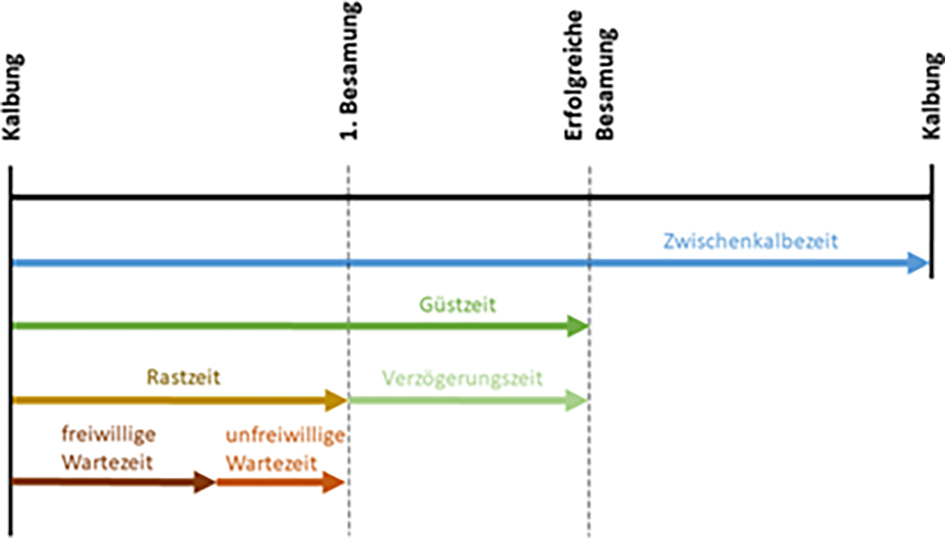
From a physiological point of view, a cow’s first oestrus occurs approximately 9 to 12 days after calving. The oestrus cycle lasts an average of 21 days and occurs regularly throughout the year. From the 40th day after calving, many cows show clear signs of oestrus.
Terms and definitions relating to cow fertility
- Gestation period: the period from insemination to calving
- Intercalving period (ICP): the period between two consecutive calvings
- Resting period (RZ): the time between calving and first insemination
- Voluntary waiting period (VWP): The period of time allowed to elapse after calving until the first insemination.
- Involuntary waiting period (IWP): The time between the voluntary waiting period and the first insemination
- Inter-calving period (ICP): The time between calving and successful insemination
- Delay period (VZ): Period from the first insemination after calving until successful mating
- Heat utilisation rate (HUR): Proportion of cows correctly identified as in heat and inseminated
- Conception rate (CR): Percentage of pregnant cows out of the inseminated cows
- Non-return rate (NRR): % of cows that did not come into heat again within a specified period after the first insemination (after 28, 56 or 90 days).

For Holstein cows, this currently stands at 413 days (vit Annual Report 2020).
The importance of the calving interval – then and now
For many decades, with a standard lactation period of 305 days, the aim was to achieve an intercalving interval of one year, and the ‘fertility limit’ was set at around 400 days between calvings. Initially, this applied to lower milk yields of around 3,500 kg per year. The calving interval therefore had to be less than 400 days to prevent the cows from drying off naturally. When artificial insemination was first introduced, a limit of 365 days was set, which was appropriate for the milk yields of the time. A calving interval exceeding 400 days was considered a ‘poor’ fertility result. A voluntary waiting period of 40 days has been the standard to date.
In the 1990s, it was considered good for an optimally managed farm to achieve an intercalving interval of 12 to 13 months. It was also recommended to fall below the average gestation period of 105 days, which could be achieved by shortening the rest period or the delay period. Furthermore, calf prices were relatively high and faster breeding progress could be achieved. One calf per year covered the cow’s fixed costs, and for dual-purpose breeds the market value was also at a good level, which is why one calf per year was economically advantageous.
As milk yield increases, these limits should be reconsidered, as the higher the average yield, the more days the cow should be allowed as a voluntary waiting period in order to capitalise on economic benefits and to improve animal health and welfare. Figure 2 shows the trend over the years based on the calving interval and average yield.
Requirements for the successful implementation of an extended calving interval
Whether extending the intercalving period is suitable for your own farm and cows depends on several factors. The extent to which the intercalving period is extended is a decision that must be made on an individual animal basis. The basic prerequisite is that the cow is healthy and in good physical condition. The housing environment must also be optimal for the extension to be successfully implemented.
Sufficient milk yield and good persistence are important. This means that a cow’s daily milk yield declines only slowly after the peak lactation period and that the cow consequently maintains a consistently good milk yield beyond the standard lactation length, enabling her to enter an extension period. Furthermore, good oestrus monitoring with a high pregnancy rate is important, which necessitates more intensive animal observation. The decision regarding the duration of the voluntary waiting period for each individual animal is therefore based on milk yield, the day of lactation and the lactation number. In addition, the best possible feed, tailored to the animal’s performance, must be ensured, particularly in late lactation.
If milk yields are too low or persistence is poor, the extension should be avoided. Fertility problems are also a criterion for exclusion. If there is a high demand for offspring, e.g. for the sale of breeding stock, extending the intercalving period makes no sense, as fewer calves will be born.

Practical implementation of the extended ZKZ
If the conditions on the farm are right and suit the herd, the decision on the best time for insemination must always be made on an individual animal basis. As a general rule, the higher the milk yield, the longer the intercalving period can be. The voluntary waiting period must therefore be adjusted accordingly.
Recommendation regarding the duration of the voluntary waiting period:
- 9,000 – 10,000 kg per year --> Wait one to two cycles longer for the first insemination (60 – 80 days after calving, depending on signs of oestrus)
- Over 10,000 kg --> Wait at least two cycles longer for first insemination (at least 80 days, preferably 100 days after calving, depending on signs of oestrus)
This means that cows with higher milk yields can be granted a voluntary waiting period of more than 100 days. Table 1 illustrates the latest possible insemination date depending on the day of lactation and the annual milk yield (kg).
However, the decision on the timing of insemination cannot be based solely on milk yield. The current body condition, as well as the fat-protein ratio (FPR), may be relevant for decisions specific to individual animals. The FPR should be below 1.4 at the time of insemination to ensure that the cows have sufficient energy for a new pregnancy and that ketosis is not present.
Advantages of an extended calving interval
Deliberately extending the interval between calving can lead to synergistic effects. The improvement in fertility indicators is the first point to mention here. With early insemination, there is no guarantee that the cows will become pregnant due to the negative energy balance. The cows channel all their nutrients and energy into milk production and have few resources left for a new pregnancy.
Furthermore, it is evident that the rest period influences insemination effort and the delay time. Research by Röhle (2016) showed that cows with a milk yield of < 7,000 kg experience a longer delay time and higher insemination effort the longer the rest period granted to the cow. The optimal rest period here is between 40 and 60 days, underlining the point that extending this period is not advisable for lower milk yields. Insemination should resume from this point onwards. For cows producing over 12,000 kg of milk, the study showed a different result. The longer the rest period, the shorter the delay time and the lower the insemination effort. From the 120th day of lactation onwards, the lowest effort (high non-return rate) and the shortest delay time were recorded.
The trials by Niozas et al. (2019) also revealed many advantages to waiting longer before insemination. Oestrus can be detected more easily, and first-service conception rates also improve. The proportion of non-pregnant cows and those with inactive ovaries decreased, which may be because the cow is no longer in an energy deficit at first insemination when the timing of insemination is adjusted to milk yield. This also has a positive effect on the calf. Furthermore, fewer embryos die in the early stages. This results in economic benefits, as insemination costs are reduced. In addition, the use of hormones for oestrus stimulation can be significantly reduced, leading to lower costs.
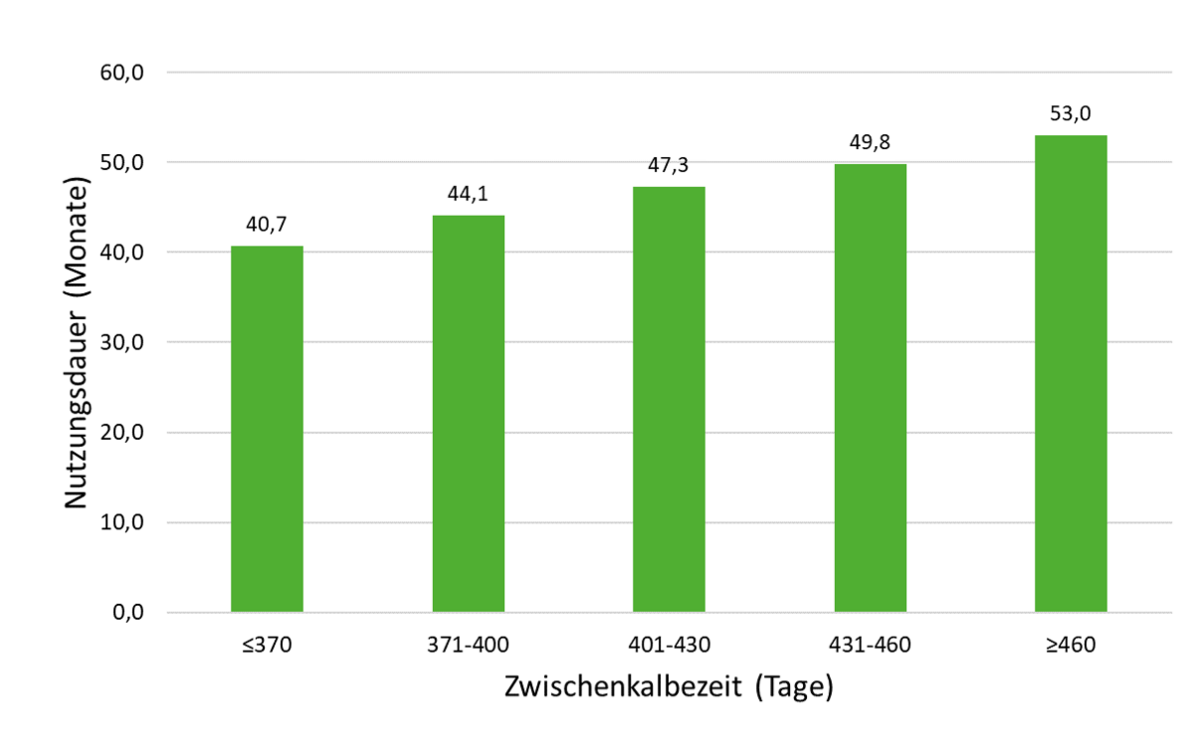
A major advantage of an extended calving interval is the longer productive life of dairy cows, which is also currently a key focus. As insemination takes place later and the cows become pregnant more quickly, they remain in the herd for longer. They are not deemed infertile after two or three unsuccessful inseminations and are culled prematurely. The greater interval between calvings reduces the likelihood of metabolic disorders or mastitis. The reduced number of calvings means that, over the course of their productive life, cows enter the critical phase surrounding calving less frequently. The effort involved in calving supervision and the resulting treatment and veterinary costs associated with calving and early lactation are therefore automatically reduced. This also includes udder health, as cows are dried off at a lower milk yield. The longer the calving interval is extended, the longer the productive life of the dairy cows (see Figure 3).
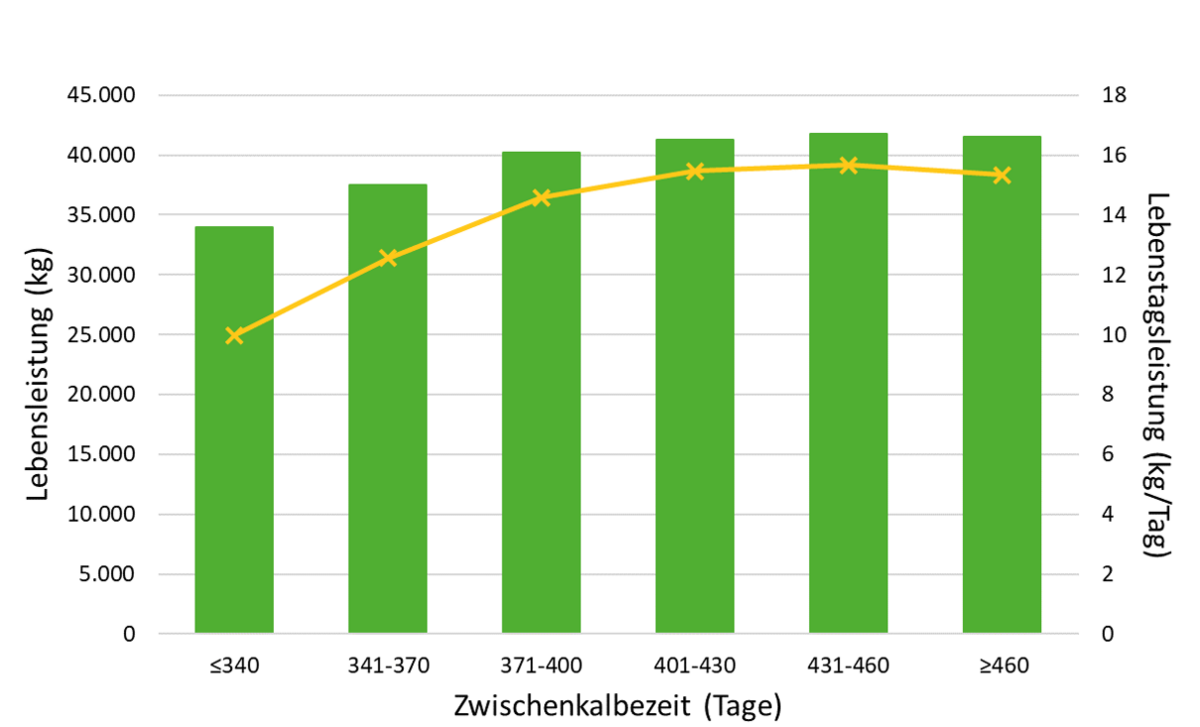
Lifetime production and production per day of life increase when cows are allowed a longer calving interval (Römer, 2016). The highest production levels were observed in cows with a calving interval of 431 to 460 days (Fig. 4) compared to cows with shorter or even longer calving intervals.
In addition to a longer productive life and higher lifetime milk yield, significantly fewer calves are born. This has the advantage of reducing the workload on both the cows and the calves. As fewer cows are culled, fewer heifers need to be made available for replacement, which reduces the costs of the expensive rearing of young stock.
Extending the calving interval also influences the persistence of dairy cows. Lactation persistence can increase as a result of delayed insemination. Studies by Rudolphi (2012) found that cows with a longer calving interval exhibit better persistence.
Overall, it can be said that extending the calving interval can bring benefits for animal health, the environment and the farmer.
Disadvantages of a prolonged calving interval
Despite its many advantages, extending the calving interval also has disadvantages that must be taken into account. An extended calving interval is not suitable for every animal. The decision for or against it must be made on an individual animal basis, which involves greater effort.
In order to successfully implement an extended calving interval, heat detection and insemination success on the farm must generally be good. If these are inadequate, the risk of losses due to infertility may increase. In such cases, insemination must take place at least one cycle earlier.
By skipping the oestrus, the proportion of oestrous cows in the herd increases, the risk of injury from mutual mounting rises, and restlessness in the barn caused by bellowing cows may also increase.
If the lactation period is extended, particular care must be taken with feeding, especially in late lactation, as there is an increased risk of the cows becoming overweight. This can only be remedied through sensible feeding management. The higher the herd performance and the performance of the individual animals, the lower the risk.
What can be a major advantage can also be a disadvantage. The absence of calves for sale results in economic losses. This can be particularly significant in the Fleckvieh and Braunvieh breeds. Crossbred calves can be sold on the market at good prices, but this proportion decreases with a prolonged calving interval. Fewer calves born also leads to a slowdown in breeding progress.
Economics
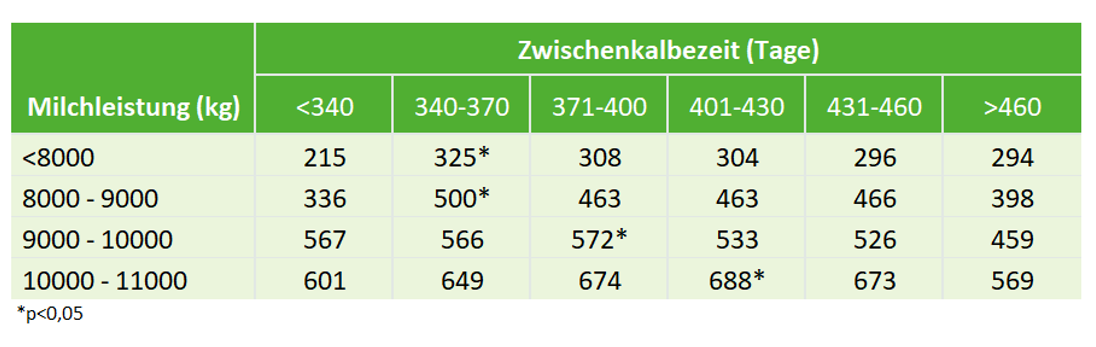
Where milk yields are low, a short calving interval is also advisable from an economic perspective. However, if the conditions for a longer calving interval are met, there can certainly be advantages. Research by Harms et al. (2018) shows that the higher the lifetime milk yield, the greater the increase in gross margin. This is because lifetime production and the cow’s productive lifespan increase for every day the calving interval is extended. Furthermore, it was found that there is a clear financial benefit when a calving interval of 401 to 430 days is allowed for cows with a milk yield of > 10,000 kg (see Table 2).
A comparison of calving intervals of 400 days with those of 500 days in a project “OptiLak – Evaluations of the optimal lactation duration for differentiated milk yields” showed that, when revenues and costs are considered together, the contribution margin of dairy farms with calving intervals of 500 days increases, provided that the reproduction rate is deliberately reduced.
From the perspective of feed economy, too, the extended calving interval can be recommended. Hufe et al. (2021) expressed a similar view in their study. Although they calculated that the IOFC (Income over feed costs) per feed day is €33.00 higher per year for a 350-day calving interval compared to a 471-day interval, the IOFC per kg of ECM remains stable.
The benefits of allowing young cows a longer intercalving period have already been mentioned. However, it also has a positive impact on profitability. The reduced number of calves also offers an economic advantage. Fewer calf pens and housing spaces are required. This saves money and working time. However, one should not cut back on the intensity of handling the remaining calves. In Fleckvieh and Braunvieh herds, economic losses may arise if fewer calves are born, as these breeds command higher prices for calves and cow carcasses.
Extended calving interval from a breeding perspective
Direct breeding for extended ZKZ is complicated by the fact that ZKZ depends on management decisions specific to individual farms and individual animals. A persistence breeding value, designed to specifically breed for a slower decline in the lactation curve, is available in Germany for Fleckvieh and Braunvieh, and since April 2023 also for the Holstein breed. The ‘RZPersistence’ describes the ability of cows to maintain milk yield for as long as possible throughout lactation. It is derived from the fat and protein content and enables selection for higher milk yield in extended lactations (more than 305 days).
The extended calving interval clearly holds potential in modern livestock farming. This is demonstrated by practical experience (as discussed in the Fokus Tierwohl network’s podcast) and by scientific research in every respect. The focus is on benefits for the cows’ health, but also on benefits for the farmer themselves. If decisions are made on an individual animal basis and the system suits the farm in question, the extended calving interval represents an improvement in dairy farming and contributes to increasing the productive lifespan and improving animal health and welfare. The notion of the 400-day limit for good fertility in high-yielding cows must be discarded, as this is still geared towards lower milk yields.
However, the extended intercalving period does require a certain amount of extra effort through more intensive animal observation. Farmers also need to be patient, as the cows must be given more time.
The latest practical findings will also emerge in the coming years from the Knowledge-Dialogue-Practice project ‘Extension of the lactation period and selective drying-off to minimise the use of antibiotics in dairy cows (VerLak)’. The aim of this project is to generate practical experience and evaluate its application under practical conditions.
Bibliography
- Burgers, E. E. A., Kok, A., Goselink, R. M. A., Hogeveen, H., Kemp, B., & Van Knegsel, A. T. M. (2021): Fertility and milk production on commercial dairy farms with customised lactation lengths. Journal of Dairy Science, 104(1), 443–458.
- Esslemont, R. J. (1993): Relationship between herd calving-to-conception interval and culling rate for failure to conceive. Vet. Rec. 133, 163–164.
- Gaillard, C., Phuong, H. N., Blavy, P., & Sehested, J. (2016): Simulations to define the optimum lifetime management for Holstein cows. In 67th Annual Meeting of the European Association for Animal Production (EAAP) (Vol. 22). Wageningen Academic Publishers.
- Harms, J., Römer, A., Boldt, A. & Volkmann, N. (2015): Longer breaks pay off. In: top agrar 12/2015.
- Harms, J., Römer, A. and Boldt, A. (2018): One calf per cow per year – Is this still economically viable and sensible from an animal welfare perspective? In Communications from the State Research Institute for Agriculture and Fisheries; Issue 60, 2018.
- Heuwieser, W. (1997): Strategic use of prostaglandin F2α – Principles and objectives of prostaglandin programmes. Prakt. Tierarzt 78, 141–149.
- Hufe, P., Waurich, B. & Hermenau, G. (2021): Relationships between calving intervals and feed efficiency. In: Blickpunkt Rind 02/2021, 46–49.
- Jahnke, B (2002): Ensuring good fertility in high-performance herds; Research report from the Institute for Animal Production Dummerstorf of the State Research Institute for Agriculture and Fisheries Mecklenburg-Western Pomerania.
- Karch, G., Karch, L. & Koch, C. (2019): Extended lactation – giving cows a longer autumn. In: Milchpraxis 03/2019 (53rd year).
- Kaske, M, Niozas, G, Tsousis, G, Römer, A., Wiedemann, S., Steinhöfel, I. and Bollwein, H. (2019): Only one calf every 500 days? In: topagrar 05/2019.
- Kok, A., Lehmann, J. O., Kemp, B., Hogeveen, H., van Middelaar, C. E., de Boer, I. J. M., & van Knegsel, A. T. M. (2019): Production, partial cash flows and greenhouse gas emissions of simulated dairy herds with extended lactations. Animal, 13(5), 1074–1083.
- Kruif, A. de, R. Mansfeld and M. Hoedemaker (1998): Veterinary herd management in dairy cattle. Stuttgart: Ferdinand Enke Verlag, 27–70, 275–290.
- Lehmann, J. O., Mogensen, L., & Kristensen, T. (2019): Extended lactations in dairy production: Economic, productivity and climatic impact at herd, farm and sector level. Livestock Science, 220, 100–110.
- Liebenberg, O. (1974): Agriculture in Figures and Facts. Cattle Production. Neumann Verlag Radebeul. Redefining the intercalving period, in B&B Agrar 03/2019
- Lührmann, B. (2011): Fertility – is it worth it? 29th Scientific Symposium 10/2011 in Güstrow.
- Mansfeld, R., A. de Kruif, M. Hoedemaker & W. Heuwieser (1999): Herd-based fertility monitoring. In: Grunert, E. and A. de Kruif (eds.): Fertility disorders in female cattle, 3rd edition. Berlin: Parey Buchverlag, 337–350.
- Metzner, M. & Mansfeld R. (1992): Veterinary care of dairy farms. Part 2: The assessment of fertility parameters. Possibilities and limitations. Prakt. Tierarzt 9, 800 – 814.
- Niozas, G., Tsousis, G., Steinhöfel, I., Brozos, C., Römer, A., Wiedemann, S., Bollwein, H. & Kaske, M. (2019): Extended lactation in high-yielding dairy cows. I. Effects on reproductive measurements. Journal of Dairy Science, 102(1), 799–810.
- Peters, S. & Mahlkow-Nerge, K. (2020): Extended calving intervals – An alternative for high-yielding cows?, in Proteinmarkt 07/2020.
- Rudolphi, B. (2011): Strong into old age – High performance and long-term use are not a contradiction. Neue Landwirtschaft, 5/2011, Deutscher Landwirtschaftsverlag GmbH, Munich, 68–71.
- Röhle, N. (2016): Influence of the rest period selected based on milk yield on first insemination success, insemination costs and delay time. Master’s thesis, Humboldt University of Berlin.
- Römer, A (2020): New fertility strategies in dairy herds: Improving cow health and longevity, 53rd Annual Conference on Reproductive Physiology & Pathology, 28 February 2020 in Rostock.
- Römer, A., Boldt, A. & Harms, J. (2019): Redefining the intercalving period, in: B&B Agrar 03/2019.
- Römer, A., Boldt, A., & Harms, J. (2020): One calf per cow per year – not a sensible goal for high-yielding cows from either an economic or an animal welfare perspective. Landbauforschung – Journal of Sustainable and Organic Agricultural Systems, 70(1), 39–44.
- Römer, A., Boldt, A., Ali, A., Harms, J., Losand, B., Seidel, J., Kunze, A. & Heße, AC. (2020): Evaluations of the optimal lactation duration for differentiated milk yields, Final report, State Research Institute for Agriculture and Fisheries, Mecklenburg-Western Pomerania. www.landwirtschaft-mv.de/Fachinformationen/Tierproduktion/Milcherzeugung/
- Stöckler, S. (2007): Fertility and milk yield; seminar at the Hohenems Agricultural School and Training Centre.
- Sehested, J., Gaillard, C., Lehmann, J. O., Maciel, G. M., Vestergaard, M., Weisbjerg, M. R., Mogensen, L., Larsen, L. B., Poulsen, N. A. & Kristensen, T. (2019): Extended lactation in dairy cattle. Animal, 13(S1), pp. 65–74.
- United Information Systems for Animal Husbandry w. V. (2021): Trends, Facts, Figures. Annual Report 2020.
- Weber, S. (2019): Tracking production indicators. Das Blatt. Information service of LMS Agricultural Advisory Service/LUFA Issue 1 (8), 8–12.
- Wieczorek, S., Hagelschuer, P. & Adam W. (1977): The economic evaluation of the length of the intercalving period. Monatsh. Veterinärmed. 32, 321–326.
Internet sources
Take heart: Break free from old traditions, Landfreund 05/19 api.swissmilk.ch/wp-content/uploads/2019/05/tierhaltung-nur-mut-loesen-sie-sich-von-alten-zoepfen-landfreund-nr-5-2019-de.pdf, accessed on 07/05/2021.
One calf every year, Elite Magazine 03/2019 www.elite-magazin.de/heftarchiv/betriebsleitung/jedes-jahr-ein-kalb-14205.html, accessed on 29 April 2021.
Illustrations
- Boldt, A., Becker, F., Martin, G., Nürnberg, G., Römer, A., & Kanitz, W. (2015). A phenotypic approach to the effects of production traits, parturition, puerperium and body condition on the onset of luteal activity in high-yielding dairy cows. Animal Reproduction Science, 157, 39–43.
- BRS/ADR (1991–2018). Development of the calving interval and average milk yield of MLP cows from the spring webinar on calving interval and fertility, 23 March 2021, RSH eG.
- Harms, J., Römer, A. and Boldt, A. (2018): One calf per cow per year – Is this still economically viable and sensible from an animal welfare perspective? In Communications from the State Research Institute for Agriculture and Fisheries; Issue 60, 2018.
- Kruif, A. de, R. Mansfeld and M. Hoedemaker (1998). Veterinary herd management in dairy cattle. Stuttgart: Ferdinand Enke Verlag, 27–70, 275–290.
- die-fruchtbare-kuh.ch/fileadmin/user_upload/customers/swissgenetics/Dokumente/Checklisten/CL_Uebersicht_Fruchtbarkeitskennzahlen.pdf
- Römer (2016). Voluntarily extended intercalving period in dairy cattle. 48th Livestock Farming Symposium. 24 March 2021, Gumpenstein.