
Introduction
There are many possible applications for biochar in agriculture. Above all, the potential for soil improvement (water and nutrient storage) and for increasing carbon storage (CO2 storage) in the soil make biochar attractive. You can find out more about the opportunities and challenges in agriculture here:
Use of biochar in agriculture: opportunities and challenges
(Note: The statements on the benefits in animal nutrition have been partially refuted by more recent studies, see below)
With regard to the additional benefits of biochar as animal feed for cattle, an improvement in animal health, an increase in performance and the reduction of methane emissions are discussed.
production process
Biochar is produced in a process known as pyrolysis (combustion at high temperatures > 400°C in the absence of oxygen) of organic matter/biomass. During this process, the carbon in the source material is firmly bound into molecular structures. In addition to biochar, pyrolysis oil and pyrolysis gas are also products of the process. Both can be further used for energy production.
In theory, any organic biomass is suitable as a source material. Carbon Standards International publishes a list of permissible biomasses for the production of EBC-certified biochar products, e.g. for use as animal feed:
Positive list of permissible biomasses for the production of biochar (as of 20 June 2024)
The carbon content and quality of the end product depend on the material used. This makes it difficult to compare studies on the use of biochar. The basic principle is that the higher the proportion of woody material, the higher the carbon content in the end product.
Production is possible on a small to industrial scale.

Different legal frameworks apply depending on the intended use of biochar. The most important ones in the field of animal husbandry are:
EC Regulation No 68/2013: Biochar in the list of feed materials
Certification
The European Biochar Certificate (EBC), a voluntary industry standard, is issued by the Ithaka Institute and, according to the institute itself, is regularly reviewed in light of new findings and requirements. The German Federal Environment Agency (UBA) and the German Biochar Association (German Biochar e.V.) recommend the use of EBC-certified biochar.
Use in animal feed
For use in agriculture, a carbon content of over 80% and low levels of contaminants are recommended (relevant legislation includes Directive 2002/32/EC on undesirable substances in animal feed and Regulation (EC) No 396/2005 on maximum residue levels of pesticides in or on food and feed of plant and animal origin).
The dosage of biochar as a supplement in the daily feed ration varies between 50 and 150 g per cow per day, depending on the manufacturer’s instructions. Two scientific studies (including Erickson et al. 2011) found no significant differences in efficacy depending on the biochar dosage (0.5–3% of dry matter). It should be noted, however, that high proportions of biochar in the ration reduce the proportion of digestible nutrients.
Practical examples
A survey of Swiss farmers involving 197 participants revealed that just under 20% use biochar as a permanent addition or as a supplement in specific cases. The majority cited the treatment or prevention of diseases, as well as the reduction of greenhouse gas emissions, as their reasons (Dittmann et al. 2024). However, as this survey focused on biochar, it can be assumed that the sample of participants was not representative of all Swiss farmers.
Report on the practical use of biochar in Switzerland
There is currently no information available on the frequency of use in Germany.
Recent research projects have investigated the potential positive effects of biochar in cattle feed. In summary, researchers found that biochar (at various dosages) had no significant effect on CH₄ emissions or performance parameters in cattle of different ages and for different purposes. At the same time, however, no adverse effects on the cattle studied were detected, even with high levels of biochar in the diet. According to current knowledge, routine supplementation with biochar offers no benefits. In the treatment of diarrhoeal diseases in young animals, practical experience has shown good results.
| Proven effects | Unproven effects |
| Effective toxin binding in the digestive tract of ruminants (summarised in Schmidt et al. 2019) | Change in milk composition (Dittmann et al. 2024; Ettle et al. 2024; Terler et al. 2023) |
| Reduction in toxin concentration in milk (summarised in Schmidt et al. 2019) | Increase in milk yield (Dittmann et al. 2024; Ettle et al. 2024; Gerster et al. 2022) |
| Increase in feed intake when poor-quality feed (contaminated with mycotoxins) is provided (Erickson et al. 2011) | Improvement in body condition (Ettle et al. 2024; Dittmann et al. 2024) |
| Reduction in symptomatic calf diarrhoea caused by infection with the parasitic protozoan Cryptosporidium parvum (cryptosporidia, small intestine parasite) (Watarai & Koiwa, 2008) | Reduction in enteric methane emissions (CH4 emissions) in
|
| Effects on energy and nutrient intake (Ettle et al. 2024; Terler et al. 2024; Gerster et al. 2022) | |
| Increase in dry matter intake in beef cattle (Terry et al. 2019; Sperber et al. 2022) | |
Changes in carcass characteristics in crossbred animals (Latack et al. 2025) |
Concerns regarding the availability of trace elements
Biochar has the ability to bind trace elements. It has been demonstrated that biochar can significantly reduce the availability of trace elements in the soil for plants (Namgay et al. 2010).
Current findings provide no evidence of similar effects in animal nutrition (Ettle et al. 2024, Dittman et al. 2024).
Cascade use in livestock farming
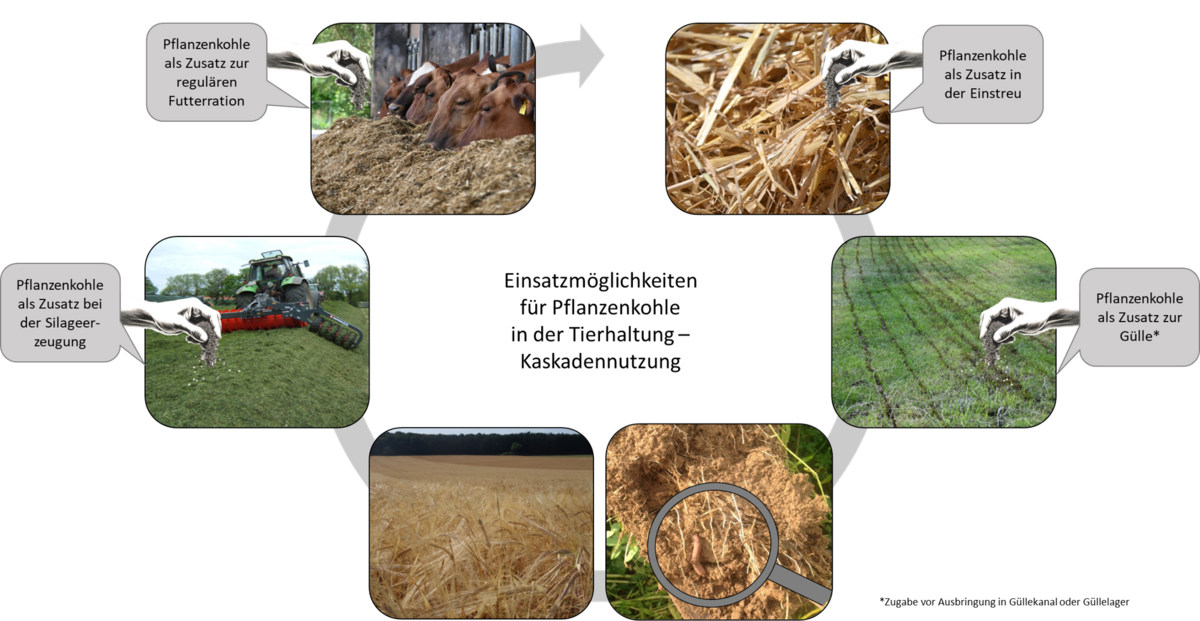
The cascading use of biochar (Fig. 1) in agriculture aims to utilise it effectively in various ways (see, for example, Schmidt et al. 2019). This is made possible by the fact that biochar is an indigestible carrier material. In the first stage of use, biochar can be loaded with nutrients (also: activated), which are then slowly released as it is used and become available, for example, in the soil.
The starting point for its use can be in animal feed, in silage preparation, in bedding or as an additive to slurry. Through the further use of excreta as organic fertilisers (slurry, liquid manure, farmyard manure), the nutrient-enriched biochar ultimately reaches the field and can act there as a soil improver. As there are as yet no proven benefits of using biochar in the feed of healthy adult cattle, the downstream application options for biochar appear more suitable for initiating cascade use.
Recommendations for application rates of biochar can be found, for example, at the Swiss Ithaka Institute and in the report ‘The Use of Biochar in Agriculture: Opportunities and Challenges’.
| in silage | in slurry | in bedding |
| Stabilisation of fermentation | Reduction of odours | Reduction of odours |
| Reduction in the risk of fungal infestation | Reduction of nitrogen losses (NH3) from slurry through ammonium binding | Reduction of moisture |
| Reduction of undesirable butyric acid content | Reduction in the incidence of hoof diseases |
Terminology
Terra Preta
Terra Preta is Portuguese and simply means ‘black earth’. It originally referred to the fertile, deep black anthropogenic soil found in the Amazon region. It was created through the unique farming practices of the indigenous peoples. To achieve this, they mixed wood and plant charcoal with manure, compost, human faeces and, in some cases, clay and bone components, thereby improving the soil. Today, the term Terra Preta is frequently found on products marketed, for example, for the home garden.
Biochar
Biochar is an outdated term for plant charcoal, derived from the English word ‘biochar’. As the products referred to do not necessarily originate from certified organic farming, the term is no longer used today to avoid confusion or ambiguity.
Carbon sinks
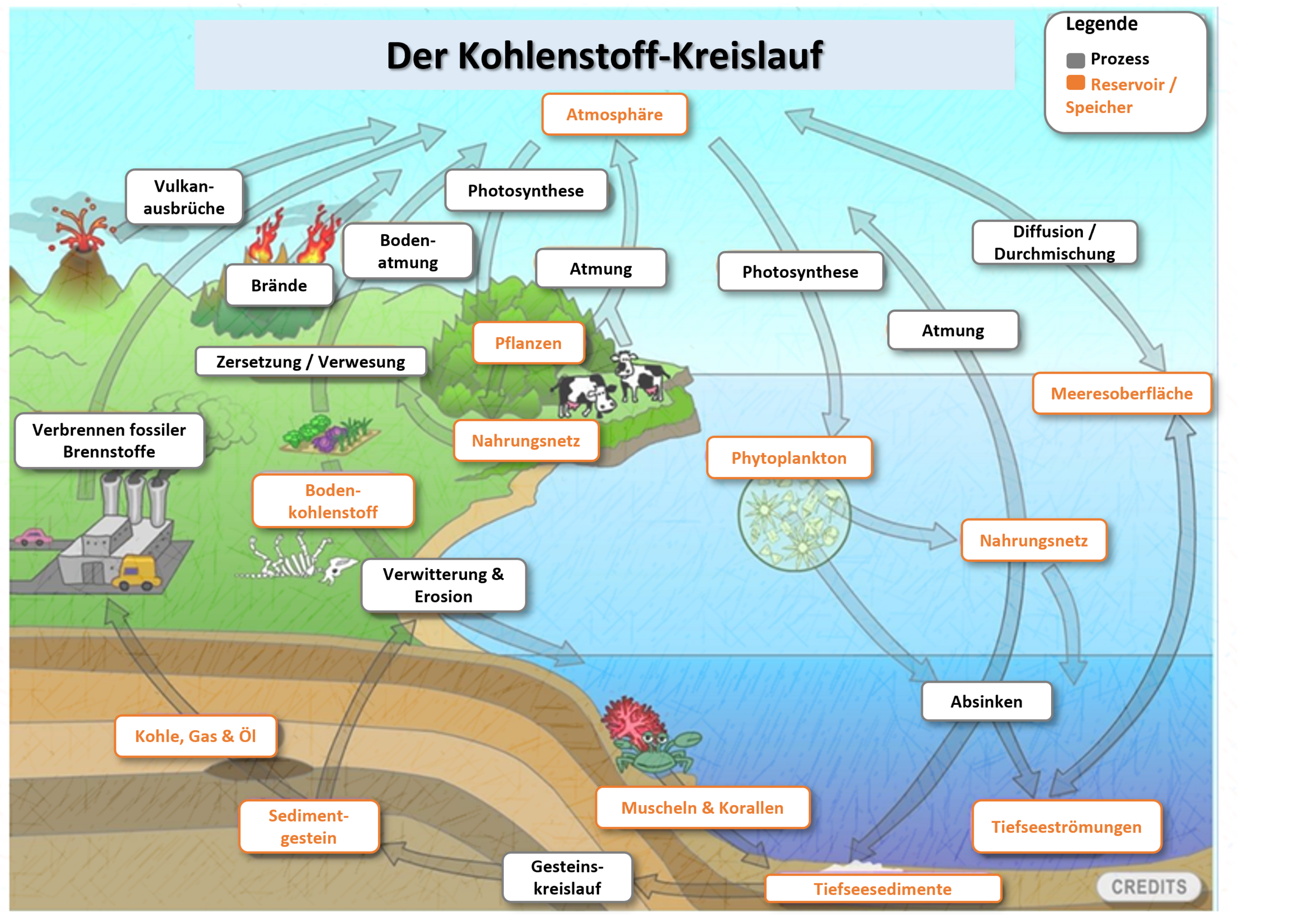
Structures, ecosystems or organisms that absorb and store atmospheric carbon (sometimes also referred to as negative emissions) are known as carbon sinks or reservoirs. They form part of the carbon cycle (Fig. 2). Examples of natural carbon sinks include oceans and peatlands, but also biochar. In the form of biochar, carbon is firmly bound and can thus be stored in the soil over the long term. Carbon sinks are receiving particular attention in the fight against climate change, as they play a part in reducing atmospheric CO₂ and thereby ultimately help to mitigate the greenhouse effect. Corresponding carbon sink certificates are traded on the market. Such carbon sinks are also enshrined in the EU Climate Law to achieve the European Union’s ‘climate neutrality’ by 2050. To achieve the interim target of a 55% reduction in emissions by 2030, the ‘Fit for 55’ package was additionally introduced.
Conclusion
Based on current knowledge, the use of biochar in the daily feed of healthy cattle offers no additional benefits and is not economically viable. However, the occasional supplementation of small amounts of biochar for preventive purposes or in cases of diarrhoea can have a positive effect. Through cascade utilisation, the positive effects of biochar in the soil and as a carbon sink can be harnessed. Nevertheless, further research is needed into its practical application and benefits, for example in relation to its use in slurry.
Further information
Animation on the carbon cycle (in English)
Report on the use of biochar for dairy cows in Switzerland
Feeding experiment – cattle: feeding charcoal to cows?
Information from the Ithaka Institute on the use of biochar in livestock farming
Biochar: Protecting the climate and improving soils
Biochar is not suitable for reducing methane emissions from dairy cows
Bibliography
- Latack B.C., Carvalho P.H.V., Moura G.A.B., Zinn R.A. (2025) Influence of biochar supplementation on comparative growth performance and carcass characteristics of Angus x Holstein versus Charolais x Holstein calf-fed steers, Journal of Animal Science, doi: 10.1093/jas/skaf113.
- Chen B., Koziel J.A., Bialowiec A., O’Brien S. (2024): The potential role of biochar in mitigating gaseous emissions from livestock waste – A mini-review, Journal of Environmental Management, Volume 370, doi: 10.1016/j.jenvman.2024.122692.
- Conlin E., Lardner H., Ellis J.L., Mandell I.B., Wood K.M. (2021): PSVII-13 Performance and environmental benefits from biochar supplementation in beef cattle grazing systems, Journal of Animal Science, 99, pp. 448–449, doi: 10.1093/jas/skab235.799.
- Dittmann M.T., Baki C., Terranova M., Amelchanka S.L., Dubois S., Wiget A., Leiber F., Krause H.-M., Baumann S. (2024): The effect of biochar supplementation on feed utilisation, milk production and methane emissions in lactating dairy cows, Animal Feed Science and Technology, Volume 318, doi: 10.1016/j.anifeedsci.2024.116127.
- EBC (2012–2024) ‘European Biochar Certificate – Guidelines for the certification of biochar’, Ithaka Institute, Arbaz, Switzerland. www.european-biochar.org, Version 10.4G dated 21 December 2024. (accessed on 16 May 2025)
- Erickson P.S., Whitehouse N.L., Dunn M.L. (2011): Activated carbon supplementation of dairy cow diets: Effects on apparent total-tract nutrient digestibility and taste preference. The Professional Animal Scientist, 27, pp. 428–434.
- Ettle T., Obermaier A., Höcherl S., Mozes S., Schneider S. (2024): Cattle: Feeding charcoal to cows? Bavarian Agricultural Weekly.
- Gerster E., Engel S., Fey S., Reutlinger W. (2022): Methane emissions from Fleckvieh dairy cows when using feed charcoal. Conference proceedings: Forum on Applied Research in Cattle and Pig Feeding, 4–5 May 2022, Soest.
- Leng R.A., Preston T.R., Inthapanya S. (2012): Biochar reduces enteric methane and improves growth and feed conversion in local “Yellow” cattle fed cassava root chips and fresh cassava foliage, Livestock Research for Rural Development, 24, pp. 2–7
- Namgay T., Singh B., Singh B.P. (2010): Influence of biochar application to soil on the availability of As, Cd, Cu, Pb and Zn to maize (Zea Mays L.), Soil Research, 48, pp. 638–647.
- Nitsch H. (2023): Use of biochar in agriculture: opportunities and challenges, www.ifls.de/fileadmin/user_upload/Pflanzenkohle_Bericht_IfLS_Rentenbank.pdf. (accessed on 16 May 2025)
- Schmidt H.P., Kammann C., Gerlach A., Gerlach H. (2016): The use of biochar in animal feeding, Ithaka-Journal, Arbaz, Switzerland, ISSN 1663-0521, pp. 364–394.
- Schmidt H.P., Hagemann N., Draper K., Kammann C. (2019): The use of biochar in animal feeding. PeerJ 7, doi: 10.7717/peerj.7373.
- Sperber J.L., Troyer B.C., Erickson G.E., Watson A.K. (2022): Evaluation of the effects of pine-sourced biochar on cattle performance and methane and carbon dioxide production from growing and finishing steers, Translational Animal Sciences, 6, pp.1-7, doi: 10.1093/tas/txac152.
- Terler G., Winter M., Mandl M., Sweeney J., Steinwidder A. (2023): Effect of biochar or biochar and urea supplementation on feed intake, milk yield, feed conversion and methane production of dairy cows. Czech Journal of Animal Science, 68, pp. 245–254, doi: 10.17221/38/2023-CJAS.
- Terry S.A., Ribeiro G.O., Gruninger R.J., Chaves A.V., Beauchemin K.A., Okine E., McAllister T.A. (2019): A Pine-Enhanced Biochar Does Not Decrease Enteric CH₄ Emissions, but Alters the Rumen Microbiota. Frontiers in Veterinary Science, 6, p. 308, doi: 10.3389/fvets.2019.00308.
- Watarai S., and M. Koiwa (2008): Feeding activated charcoal from bark containing wood vinegar liquid (nekka-rich) is effective as a treatment for cryptosporidiosis in calves. Journal of Dairy Science 91.4, pp. 1458–1463, doi: 10.3168/jds.2007-0406.