
- Dr. Hans-Joachim Herrmann, Hesse State Agricultural Agency
- Antoine Janssen, Agricultural Specialist in Hoof Care
- Mag. Hubert Reßler, Hochstädter Klauenpflege GmbH
- Dr. Jörg Willig, Cattle Health Service, LUFA North-West
We would also like to thank Dr Fanny Rachidi, Clinic for Hoofed Animals, University of Leipzig, for her valuable support.
- Caroline Leubner, Landesbetrieb Landwirtschaft Hessen
Regular and professional hoof care is a key pillar of dairy cows’ animal health. Routine care should take precedence over the treatment of hoof diseases. Regular, professional hoof care is a preventive measure and helps to minimise any adverse effects on animal welfare caused by delayed intervention.
Hoof care as a preventive measure always pays off economically – provided the carers are qualified. Nevertheless, in practice, action is not always taken in good time. This guide aims to address how hoof care can be organised and integrated into farm operations. A standardised procedure that sets fixed schedules can ensure more consistent action when it comes to hoof care.
The considerations are based on the example of a farm with 120 milking cows. The following decisions lead to different approaches to the organisation and integration of hoof care:
- Is hoof care carried out in-house, by a service provider, or a combination of both?
- Is herd-based or individual hoof care carried out?
- How often, or at what intervals, is hoof care carried out?
Optimising animal handling both prior to and during hoof care contributes significantly to personal and on-farm acceptance. This also increases the ‘desire’ to carry out hoof care. Hoof care can thus be more easily established as an integral part of animal husbandry activities. The location and design of the hoof care area play a key role in this.
Good professional practice in hoof care
As a general rule, only individuals with the necessary knowledge and skills should be involved in hoof care. When employing external hoof care staff, care should be taken to ensure they hold the qualification of ‘certified hoof trimmer’ or a comparable qualification (such as a specialist in hoof care or a veterinary surgeon specialising in cattle). In addition, importance should also be placed on individual animal-specific documentation of hoof care. This includes findings, treatment and, where necessary, further measures in aftercare. In this regard, it is also important to consider the cause of hoof diseases in order to address the trigger and thus reduce the incidence of such diseases.
If the farm decides to carry out hoof care on its own premises, qualified training for the designated person(s) is essential. A one-week basic course should be regarded as a prerequisite and primarily enables the care of healthy hooves as part of preventive measures. Further hoof-related activities in the context of treating lameness are only advisable once the necessary routine and experience have been acquired.
If the farm prefers to work with external staff, every dairy farm must nevertheless have a functional hoof trimming stand and basic knowledge of hoof care in order to provide first aid to cattle in the event of acute lameness and, if necessary, to carry out follow-up care.
The right time and frequency for hoof care
When it comes to scheduling hoof care, it is important to develop a strategy tailored to the specific farm.
If the example farm with 120 dairy cows has opted for external hoof care, a so-called herd-wide hoof trimming session appears to be a sensible solution. Depending on the herd’s milk yield, a routine hoof trimming is carried out two to three times a year on all animals in the herd. As a guideline for determining the frequency of routine hoof care, the aim should be to schedule one hoof care appointment for every 3,000 kg of milk yield. This limits the stress caused by hoof care to a maximum of three times a year for this herd.
However, taking into account individual differences between animals, an interval of four to six months between hoof care sessions may be significantly too long. In such cases, it is advisable to split the routine care. The hoof care company then visits, for example, six times a year and treats half the herd plus the ‘problem cows’. This approach allows for a much more timely response to lactation-specific requirements in hoof care. Furthermore, problem animals are subject to closer monitoring. In larger facilities, this division into animals for routine herd trimming and an additional group with special hoof care needs has long been practised in order to implement short care intervals.
From the perspective of an individual farm, it is understandable that the herd and farm operations should be burdened by hoof care for as few days as possible. Consequently, daily throughput is often used as a measure of quality. However, what is decisive for the quality of hoof care is not how many animals have passed through the hoof care station, but how many have been cared for competently and professionally. For a herd of 120 dairy cows, it therefore makes sense to employ several hoof trimmers with two hoof trimming stations, so that there is only disruption in the barn on a single day per appointment. The workload for the external hoof trimmers is thus significantly lower, which also reduces stress for both humans and animals.
When managing the herd’s hoof care in-house, the practice of herd-wide trimming is used less frequently. Instead, hoof care is carried out continuously at regular intervals.
Scheduling a fixed day for hoof care is highly recommended as part of standard work procedures on farms with growing herds. This also makes it easier to plan other necessary tasks, such as those in the outdoor areas.
Returning to the example farm with 120 high-yielding cows, 360 hoof care procedures must be planned for each year. If young stock are included on a pro-rata basis (the principle applies: breeding maturity equals care maturity), this amounts to around 450 animals in total. It is therefore advisable to set aside a fixed day each week for hoof care on the farm. On each hoof care day, an average of ten cows must then be cared for and treated if necessary. This corresponds to the throughput that a trained person can manage in half a day.
No general statement can be made regarding the correct timing of hoof care. This is particularly true as the analysis of hoof care records increasingly reveals significant individual differences between animals. Practitioners are aware of this and generally know exactly which animals on the farm require hoof care.
Which animals should be presented on a weekly basis? Lame cows, previously documented animals requiring monitoring, and any necessary dressing changes must, of course, be taken into account. To reduce this proportion of animals requiring treatment, it is necessary to develop a farm-specific strategy. The following approach has proven effective when implemented consistently: all cows due to be dried off are treated first. Any existing defects can heal properly during the dry period, and the cow starts the demanding early lactation phase with healthy hooves. In this particularly critical phase, given the negative energy balance, hoof pain acts as a deterrent to visiting the feed table.
The metabolic stress during early lactation is often also evident in the hooves. A hoof care appointment around two to three months after calving can prevent many problems and is therefore strategically sensible. With three scheduled appointments per year, the third appointment should fall between the second appointment and the new drying-off date.
In contrast to the first two hoof care appointments, which are increasingly being implemented on farms due to their importance, the third appointment is often overlooked. However, as part of a consistent hoof health strategy, it is important for maintaining or improving the health status of the hooves and avoiding having to start from scratch every year. Documentation and scheduling are essential for strategy development.
In the context of discussions regarding the extended intercalving period, further adjustments may be necessary on the farm in future.
Farms should therefore assess, at farm level, what can be achieved within the constraints of available resources. If a farm overestimates its own capacity or fails to adhere consistently to the care schedule, the strategy will remain merely on paper.
Aftercare
For animals with deeper defects or severe lameness, a single treatment session is not sufficient. Cows’ high pain tolerance often masks lingering problems. It is only gradually becoming recognised that animals with fissures in the hoof should be brought back for treatment until a closed hoof has reformed. The frequency of care may vary depending on the condition, treatment and therapy.
Consistent follow-up care is always recommended. The rule is: if no improvement is evident by the third visit, the vet must be consulted in all cases.
Regardless of whether hoof care is carried out in-house or by an external service, follow-up care can be performed on the farm itself provided the necessary expertise is available. In large-scale operations, it is a standard part of the hoof care provider’s remit to be responsible for follow-up care as well. Qualified documentation is always essential to ensure the traceability of the measures taken and the success of the treatment.
change in attitude
Depending on the type of surface, hooves are subjected to varying degrees of abrasion. On smooth floors or soft surfaces, wear is very minimal; on rough surfaces (weathered mastic asphalt, broom-finished new concrete), however, abrasion can even exceed the rate of growth. This can result in difficult-to-treat separations of the connective tissue at the tip of the hoof sole. With appropriate acclimatisation, horn growth adapts to varying load situations to a certain extent. Growth and wear remain in balance. The horn-forming dermis simply needs to be given sufficient time to adapt. We refer to this as ‘programming’ the hooves. However, changes in housing conditions can overwhelm the hooves’ ability to adapt.
In practice, two housing changes in particular play a role:
- The transition from indoor housing to grazing occurs annually and requires the utmost care in hoof management, particularly where driveways are long and/or stony. A sole that is 1 to 2 mm thicker does no harm here, but even more important is the interval between the last hoof trimming and the time of the first turnout. For cows from loose housing, the maintenance trim is usually carried out three to four weeks beforehand. Cows from tethered housing with very dry hooves show a high net loss of hoof horn and protective hoof wall, so the routine hoof care appointment should be carried out even earlier – closer to three months before the start of grazing.
- When switching from tethered to loose housing, hoof care should also be scheduled approximately three months before the move. Very dry hoof horn may become severely softened shortly after the changeover and, at the same time, be subjected to heavy strain due to increased movement and the associated abrasive forces. When moving from the old to the new loose housing system or when moving into newly built stalls, the new, usually more abrasive floors must also be taken into account.
Animal transport
What is the best way to select animals for hoof care? How can individual handling work, and how can the flow of animals be optimised? These are questions relating to the management of animal movement to the hoof care station or the location where hoof care is carried out.
Except in special situations, cows are generally driven freely and not led by a rope or halter.
Straight and, where possible, short access routes that are free of obstacles should be taken into account at the planning stage. The routes should also be free of factors that directly damage hooves, such as sand and gravel. Depending on the average dwell time, waiting areas may need to be equipped with water and feed supplies as well as lying areas. Generally, the time the animals spend in these areas should be based on the usual dwell time they spend in the pre-waiting area before milking, so that provision of such facilities can be dispensed with. A special case is groups of animals that are separated, for example via the automatic milking system, prior to the hoof care appointment and may therefore remain there for several hours. In such cases, provision of supplies must be ensured. If only individual animals are selected for hoof care, separation upon leaving the milking parlour is advisable. With automatic milking systems (AMS), this can usually be easily automated. If the separated animals are not treated immediately by the hoof trimmer, they require a waiting area of sufficient size. The size of the waiting area depends on the throughput of the hoof trimmer and also on the number of cows separated there.
If a hoof care session for the entire herd is carried out by an external service provider, it is hardly possible to differentiate between individual animals. It is nevertheless advisable to prioritise and treat the problem group first. Otherwise, care is carried out according to the performance groups.
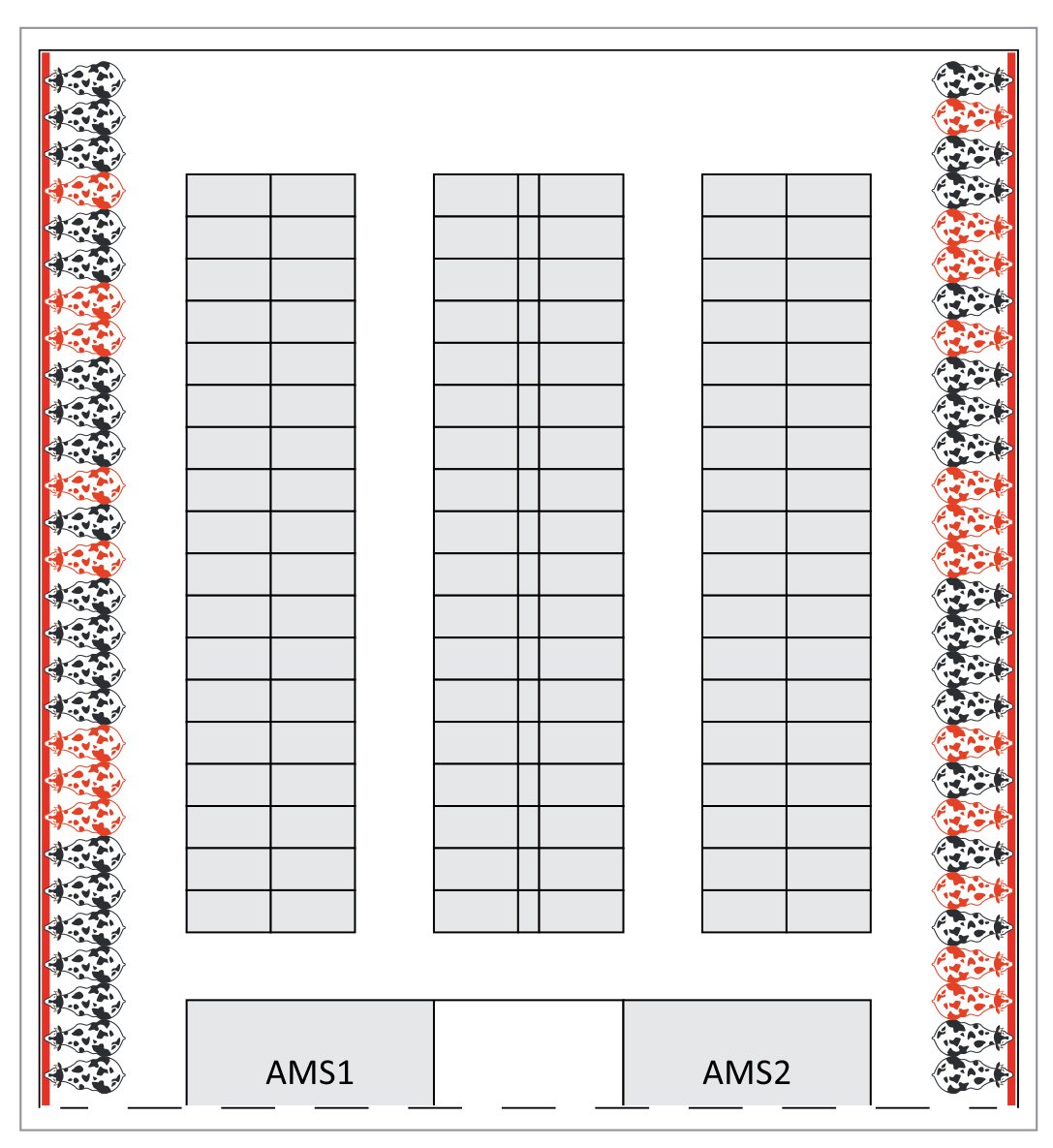
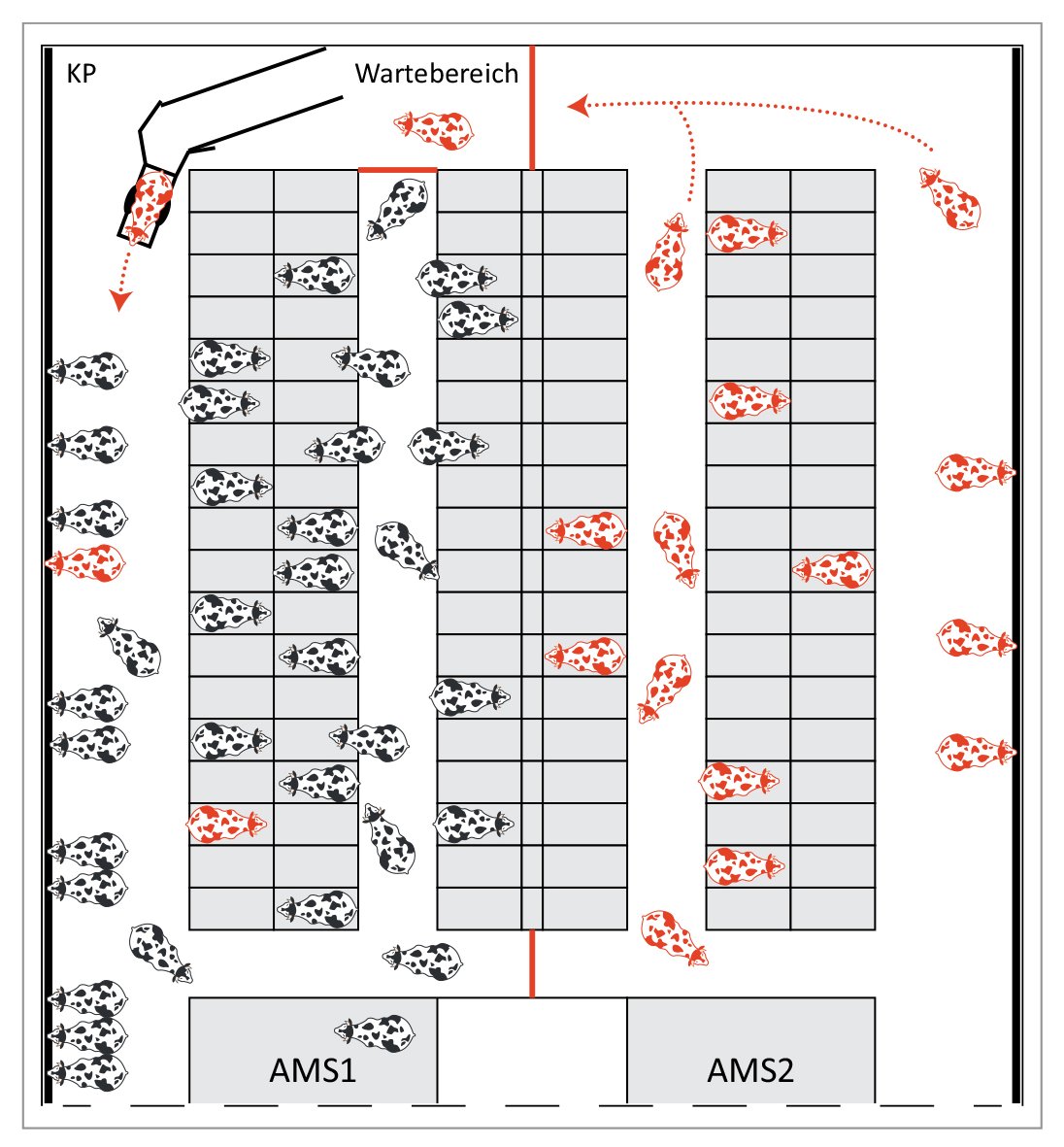
A possible procedure in an AMS operation, where only parts of the herd are to be treated, is illustrated schematically in Figure 1.
The cattle designated for hoof care and separated from the herd should not feel isolated. External hoof trimmers generally carry the necessary equipment for a low-stress herding process. Nevertheless, it is advisable to discuss space requirements and procedures in advance and to adapt them if necessary.
The animals are individually guided from the waiting area into the drive passage. A funnel-like structure facilitates this. Individualisation passages are a maximum of 80 cm wide to prevent the animals from turning round. For health and safety reasons, the movement areas for humans and animals should be kept separate where possible.



(Image: Karstens)
At this point, let us take a closer look at the concept of a ‘straight passage’. ‘Straight’ means that the animal experiences no interruption in its flow of movement. Right angles or even acute angles should therefore be avoided. Curved structures, which give the animal a sense of steady progress, have proven effective. In large-scale facilities, such solutions are already taken into account during the planning of hoof care areas and are permanently installed (Figure 2). The driving force behind this development is the American scientist Temple Grandin.
Even if such solutions are unlikely to be feasible for the average farm, they may nevertheless provide inspiration for individual solutions.
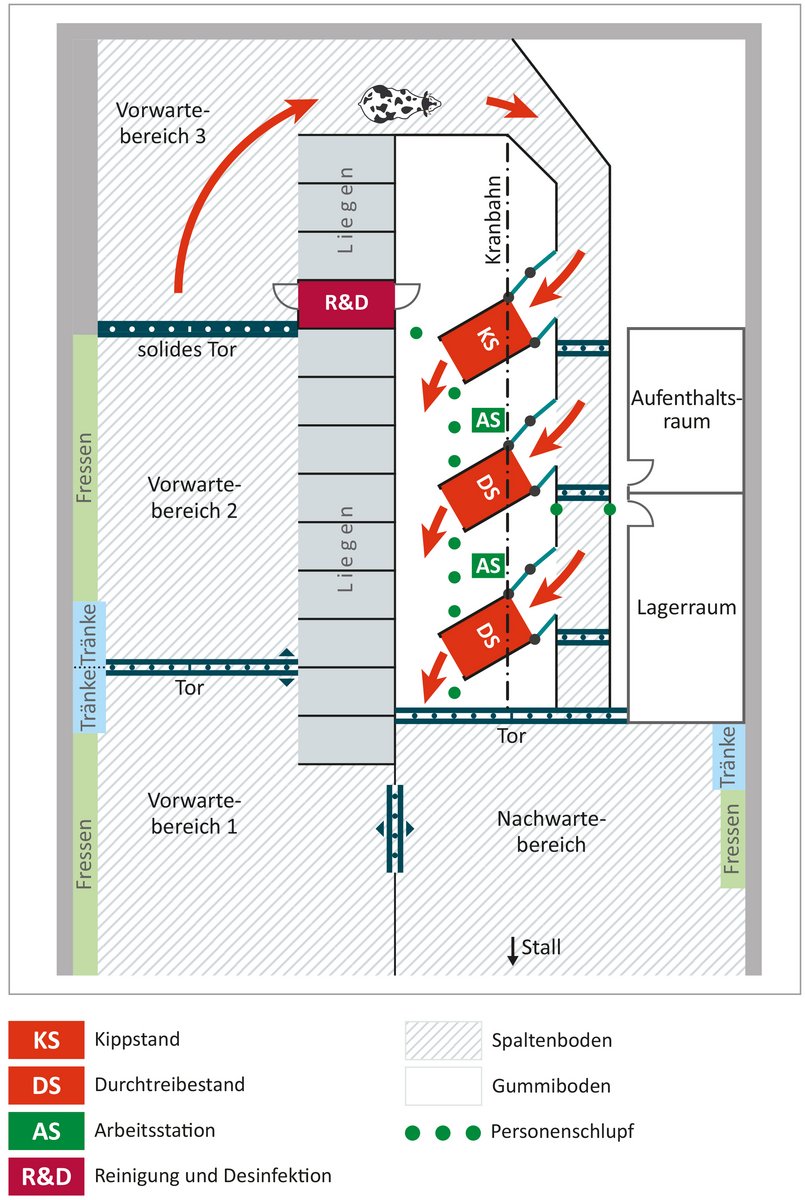
(Diagram not to scale)

(Diagram not to scale)
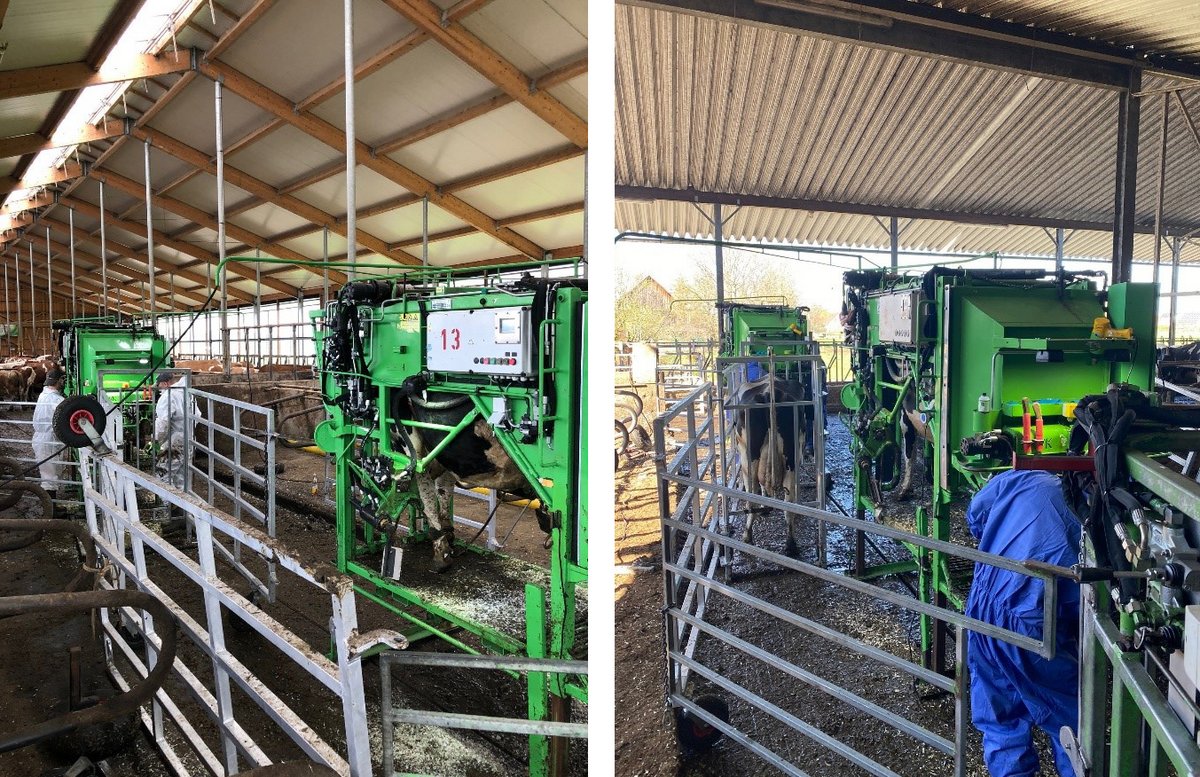
(Photos: Hubert Reßler)

Location
A prompt response to any abnormalities in a cow’s gait is a key factor in the success of farms with good hoof health.
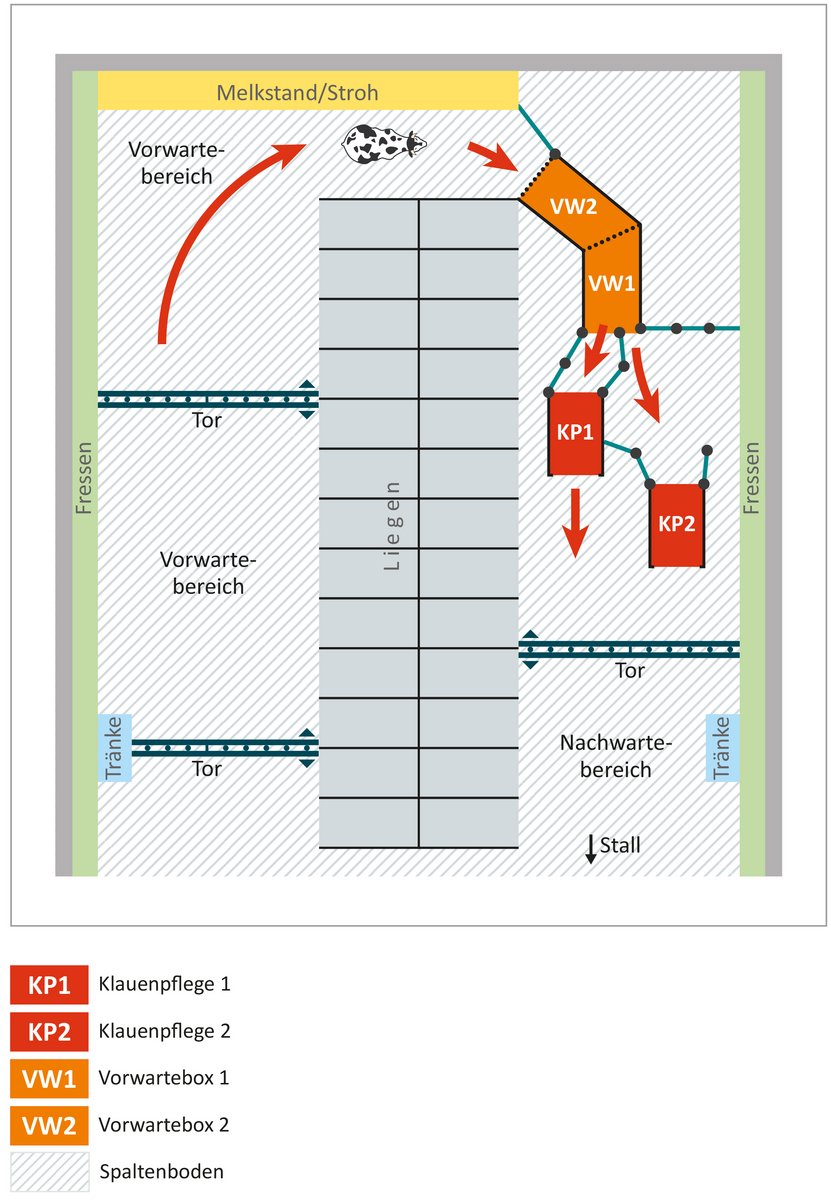
Wherever possible, the hoof care bay should be permanently installed. Together with the entry system, the waiting area and the exit area, it forms a functional unit. There are no definitive recommendations regarding the level of automation – all options are open, provided they are adapted to the farm’s specific conditions. The physical proximity to the sorting facility (usually after the milking parlour / AMS) is sensible with regard to problem animals. As the areas for sick and freshly calved cows should be located a short distance from the milking area, a connection to this is advisable. If a cow is identified in the milking parlour as requiring treatment, it should be possible for a person to guide her to the hoof care pen via a short route. With automatic milking systems and also in some milking parlours, it is possible to pre-select animals that are to be separated. In new buildings, the location of the hoof care pen should be determined in advance during the planning stage, taking the aforementioned aspects into account.
Two examples are shown below of how the location of the hoof care pen can be chosen for external and on-farm hoof care (Figs. 3 & 4). In the case of on-farm hoof care, the hoof care bay is permanently installed. In this area, a rubberised walking surface is suitable to provide the animals with additional grip. Electricity and water connections, as well as storage for tools and materials, should be planned nearby.
(Image: LLH)
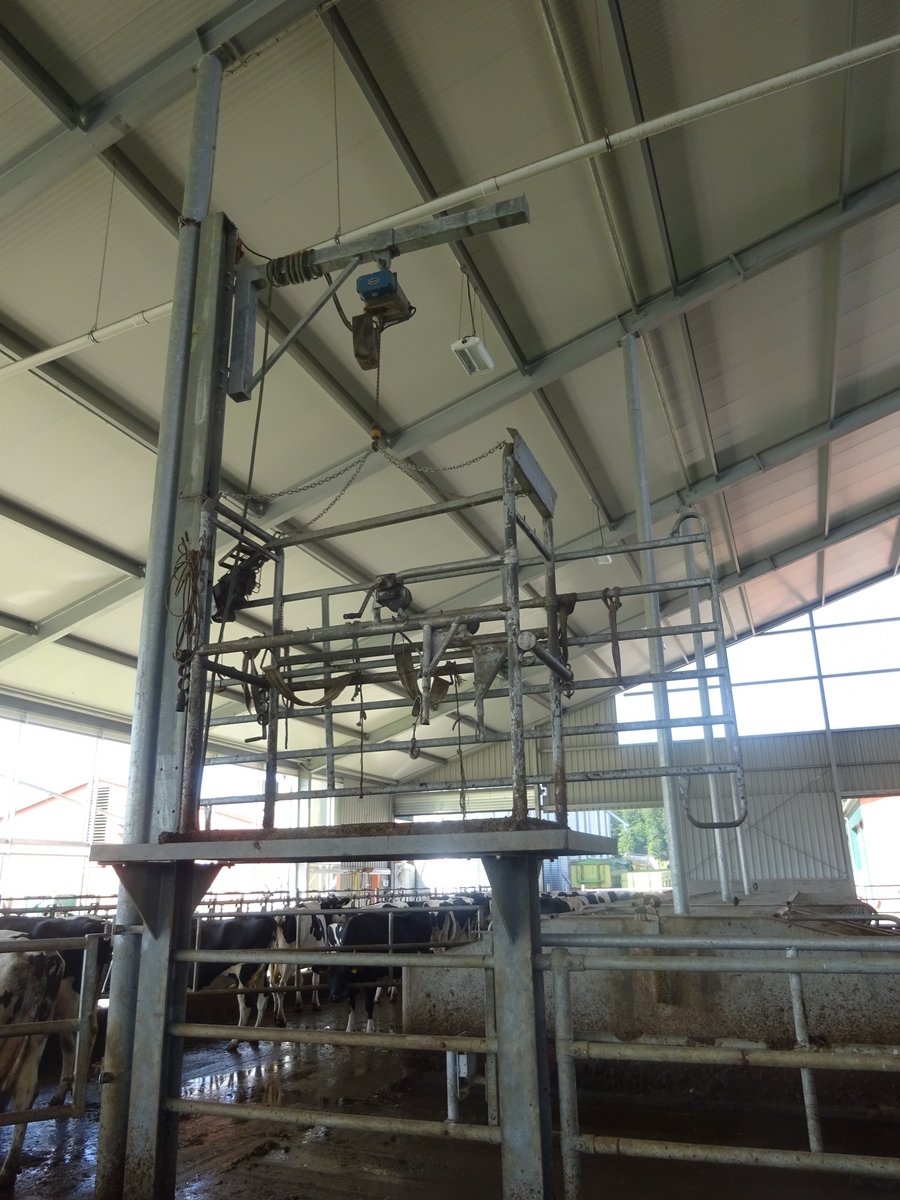
When managing small groups of animals on one’s own premises, an alternative arrangement of the hoof trimming stand and access route may be worth considering. One clever solution, for example, is to suspend the stand above the animal area using a mounting system (Fig. 7). If necessary, the stand can be lowered using the required partition grids, in compliance with occupational health and safety regulations (SVLFG).
The area designated for hoof care should be under cover and, where possible, draught-free. An area of at least 18 m² that is freely accessible from all sides is necessary for comfortable working conditions. The floor should be level, non-slip and easy to clean. Good, glare-free lighting of the work area without shadows cast around the hooves is essential for safe working. The lights used should ensure an illuminance of at least 500 lux at the workstation.
All supply lines (electricity and water) are routed downwards from above to the hoof care station to prevent tripping hazards. Tools should be hung at an ergonomically suitable height on the station. Consumables such as bandages and blocks are stored within easy reach but out of reach when hoof care is not being carried out.
Checklists should be used to ensure proper preparation for hoof care, regardless of whether it is carried out professionally by a service provider or in-house.
Conclusion
Hoof care is an important aspect of animal husbandry that every farm should address thoroughly, with a view to integrating it effectively and firmly into daily operations for the benefit of both the animals and staff. Good organisation frees up time for other important tasks and ensures that hoof care becomes a natural part of working with the animals. The less preparation required before hoof care for each individual animal, the more likely it is that necessary care measures will be carried out promptly. The saying ‘Healthy hooves produce milk’ only truly comes into its own through regular and professional hoof care. It helps to keep the animals healthy and promote animal welfare.
Bibliography
DLG e. V. (2010). DLG Fact Sheet 362: Hoof Care Stalls. 1st edition. DLG e. V.
Elite Magazine. Three tips to make hoof care easier (2021). https://www.elite-magazin.de/herdenmanagement/drei-tipps-um-die-klauenpflege-zu-erleichtern-15982.html
Fiedler, A., Maierl, J. & Nuss, K. (2019). Diseases of the hooves and toes of cattle. 2nd edition. Georg Thieme Verlag, Stuttgart.
Hulek, M. (2005). Hoof health & hoof care. Stocker.
Kofler, J. (2012). Monitoring of hoof health in dairy herds and functional hoof care.
Schleswig-Holstein Chamber of Agriculture (2020). Organisation and management of hoof care. Hoof care seminar.
Schleiter, H. (1966). Hoof Care in Domestic Animals. 3rd edition. Hirzel Verlag, Leipzig.
Schneller, W. (1984). Healthy Hooves – High-Performance Cattle: Significance, Causes, Prevention and Treatment of Hoof Damage. Schober.
Reßler, H. (2016). When a hoof care team visits the farm. Hochstädter Bullenbote – Hoof Care Specialist. https://www.klauenpflege.de/site/assets/files/1603/seiten_aus_bullenbote_2016_1_end_web.pdf
Rosensteiner GmbH. Your own well-organised cattle care area checklist:
https://rosensteiner.at/fileadmin/user_upload/Checkliste_Pflegeplatz.pdf
https://rosensteiner.at/de/produkte/klauenpflege/pflegeplatz