
Prevent navel infections through disinfection
Umbilical infections in calves are a problem on many farms and can have various causes. One way to reduce the incidence of umbilical infections is to disinfect the umbilicus.
In newborn calves, the umbilical sheath only closes within the first few days of life. This open connection provides a gateway for germs to enter the body. If the umbilical cord is moist and warm, it provides ideal conditions for bacteria to grow. This can lead to umbilical infections of varying severity. In the worst case, umbilical inflammation can develop into a general infection that affects the entire body. Lung and joint inflammation can also originate from umbilical inflammation.
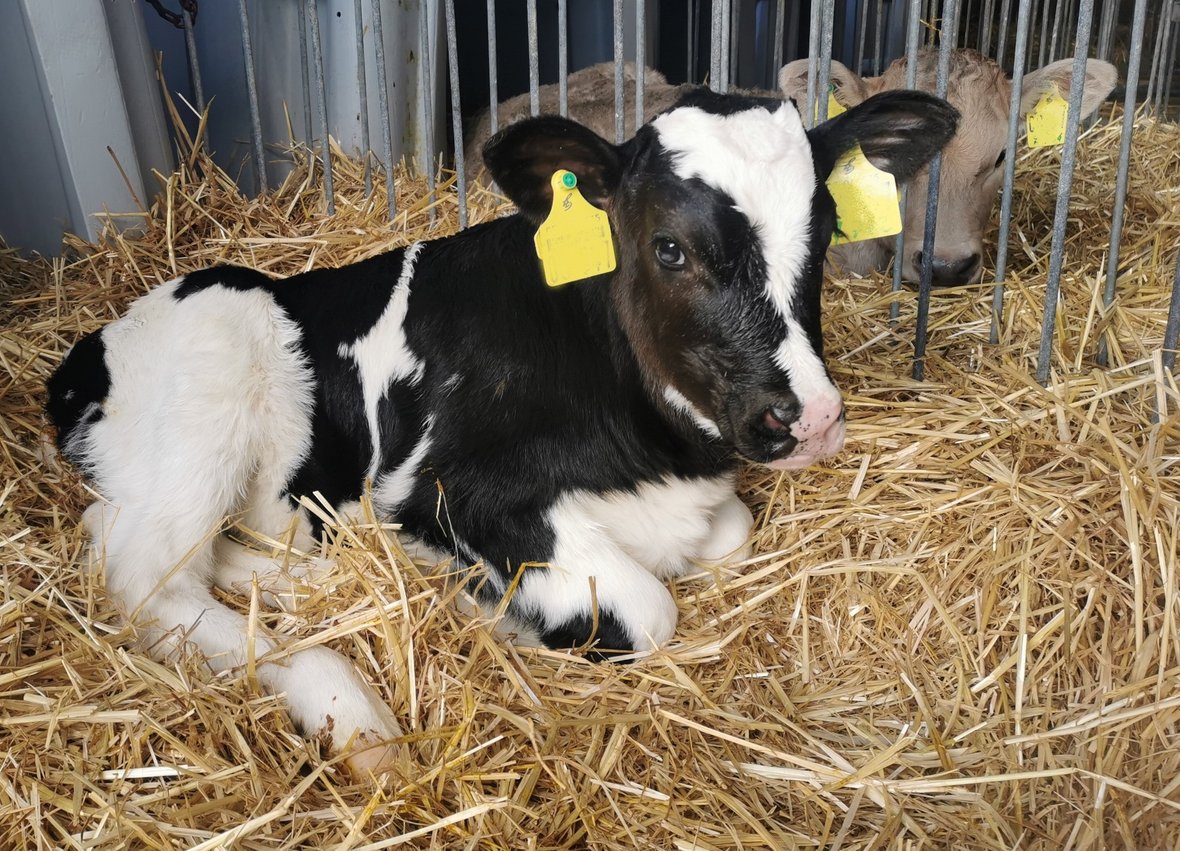
Umbilical disinfection is a preventive measure. It alone cannot compensate for poor hygienic conditions (e.g. in the calving box or during obstetrics) or insufficient colostrum intake. As a general rule, hygiene is always paramount and has a major influence on the prevention of diseases such as umbilical inflammation. Bedding management plays a particularly important role. The straw bedding in the calf and calving areas should always be of the highest quality and regularly maintained by adding fresh straw to provide the calves with dry and low-germ lying areas.
Recommendations for umbilical cord disinfection
In general, as little manipulation of the navel as possible should be carried out. If this is necessary, you should only work with clean gloves.
Timing and frequency
The navel should be disinfected once immediately after birth. In farms with an increased rate of navel infections, disinfection should be repeated the next day.
Disinfectants
Alcoholic iodine solutions or chlorhexidine solution promote the drying out of the umbilical cord and are therefore preferable to disinfection with PVP iodine.
Procedure
You can either dip the umbilical cord in the liquid or spray it from all sides.
Spraying: Pour the disinfectant solution into a spray bottle and spray the umbilical cord from all sides. The advantage: the bottle is sealed and the liquid cannot be contaminated.
Dipping: Use a dipping cup for umbilical cord disinfection that is used exclusively in the calf area. Discard the pumped-up liquid after dipping. Change the liquid once a week.
What should be avoided at all costs?
Due to the open connection to the abdominal cavity, the penetration of disinfectant can lead to damage to internal organs. The umbilical cord should therefore only be treated externally. Do not rub the disinfectant in or pour it into the umbilical cord. Blue spray is not suitable as it delays the drying of the umbilical cord and contains antibiotics, the use of which must be reduced at all costs to prevent the development of resistance.
Visual inspection of the navel
Regardless of umbilical cord disinfection, you should visually inspect the navel daily during the first week of life, for example while feeding. Look at the navel in good lighting conditions and assess the presence of the umbilical cord, the degree of drying and whether there is any visible increase in circumference, as well as whether there is any fluid leakage. If any abnormalities are found during the visual inspection (see table) and the calf's general condition or milk intake is disturbed, a careful examination of the umbilical cord can be carried out. You should only use clean gloves for this. When palpating the umbilical cord, pay attention to its diameter, consistency, increased warmth and painfulness. Excessive pressure can cause secretions from the navel to be pressed into the abdominal cavity or into the liver via an inflamed umbilical vein.
| Parameters | Findings |
| Length of the umbilical cord | 1 - 2 hand widths (approx. 19.5 cm +/- 9.9 cm) |
| Dry umbilical cord | from the 4th day of life, sometimes not until the 7th day of life |
| Loss of umbilical cord | At approx. 14 days of age |
| Umbilical cord diameter in the main navel | Approximately 2 cm after birth; regresses over time; diameter varies between approximately 1 cm on the 7th and 15th day of life |
Signs of umbilical inflammation
- Swelling of the umbilicus (thicker than a little finger)
- The umbilicus is warm and firm
- Sensitivity to pain (arching of the back, kicking) when touched
- Discharge of fluids from the navel (e.g. blood, pus, urine)
- Fever (above 39.5 °C)
- Poor general condition, reduced drinking
If one or more of these signs occur, a vet should be consulted.