
Slaughter on the farm
In Germany, cattle may only be killed in the slaughterhouse if the animals are intended for human consumption. Until recently, exceptions were only made for farms that, for example, keep their cattle outdoors all year round and kill the animals on the pasture with a bullet shot and then take the animal to the slaughterhouse. However, new regulations now make it possible to slaughter animals on the farm if the relevant requirements are met. An event organised by the Focus on Animal Welfare network at a cattle farm in the Harz Mountains showed how this can work.
Almost 20 participants gathered early in the morning at the Thielecke farm in the Harz Mountains to learn more about beef marketing and the major topic of on-farm slaughter. With over 600 hectares and 1000 cattle of the Harzer Rotes Höhenvieh breed, the farm had a lot to offer. Three different stations provided information on the most important aspects of slaughtering on the farm: the legal framework, marketing and the slaughtering process itself. The first station was hosted by Wolf Fischer (LLG Saxony-Anhalt). With the help of a keynote speech, he introduced the topic of the "official marathon". Many farms that are new to direct marketing are faced with a "jungle" of directives and regulations. The federal structures mean that different requirements are imposed at district level with regard to the implementation of applicable legislation. Nevertheless, the participants were given an overview of the general legislation to be observed and the authorities to be involved when planning their own slaughterhouse. Reference was made to the comprehensive compendia from Bavaria and North Rhine-Westphalia. Examples were the Manual for the Authorisation of Slaughterhousesor the legislation on direct marketingwere mentioned. The participants were then allowed to describe their own experiences. The main topics discussed were the long time required for the authorisation process, long processing times for applications and the differences in authorisation practices at local authority level. The participants also criticised the lack of offers and the sometimes high costs for the certificate of competence/certificate of expertise "Distance injection, immobilisation and killing of fallow deer and extensively kept cattle" required for the implementation of bullet shooting. The participants' wishes for standardised nationwide regulations for approval procedures, more transparency, the creation of guidelines for direct marketing and slaughtering on the farm and an exchange platform for direct marketers became clear.
At the second station, "Marketing", Arne Kutschbach gave a brief insight into the work of Agrarmarketing-Gesellschaft Sachsen-Anhalt (AMG). He reported on the funding opportunities currently available for direct marketing in Saxony-Anhalt. The host farm Thielecke then invited the participants to a tasting of the farm's own meat and sausage products and allowed those present to judge the flavour with the help of a sensory protocol. The farm attaches great importance to marketing all parts of the animal. This is why it offers its customers meat packages once a month, which include prime cuts as well as leg slices and goulash meat, for example. The company also keeps several Angler saddleback pigs and Leicoma crossbreeds for sausage production. Thanks to the regional, transparent production and the openness of the farm owners, consumers who are conscious of animal husbandry are targeted and profitable product prices are achieved.
A very special station was the "slaughtering process" itself, which the participants were able to accompany on this day from the stunning to the hanging of the cattle halves. Master butcher Marvin Freystein had scheduled three cattle for slaughter that morning. These were driven into the barn the evening before and loaded in the morning to cover the 4 km distance between the slaughterhouse and the barn. "Calm, low-stress handling and loading is very important to us!" says the master butcher. While the pork for the sausage products is processed while still warm, the beef cuts spend an average of around three weeks in the maturing room. Twelve cattle can be slaughtered per week. In the future, there is still free capacity, particularly in contract slaughtering.
Lunch in the farm restaurant was followed by a presentation by Lea Trampenau (ISS - Innovative Schlachtsysteme) on the semi-mobile slaughtering of cattle. Among other things, she has developed an innovative mobile slaughter system herself and has been working on the topic of pasture slaughter for many years. It is much less stressful for the animals as, among other things, the stress of transport is eliminated. This has a positive effect on both the animal's well-being and the quality of the meat. The process also has great potential for strengthening regional value chains.
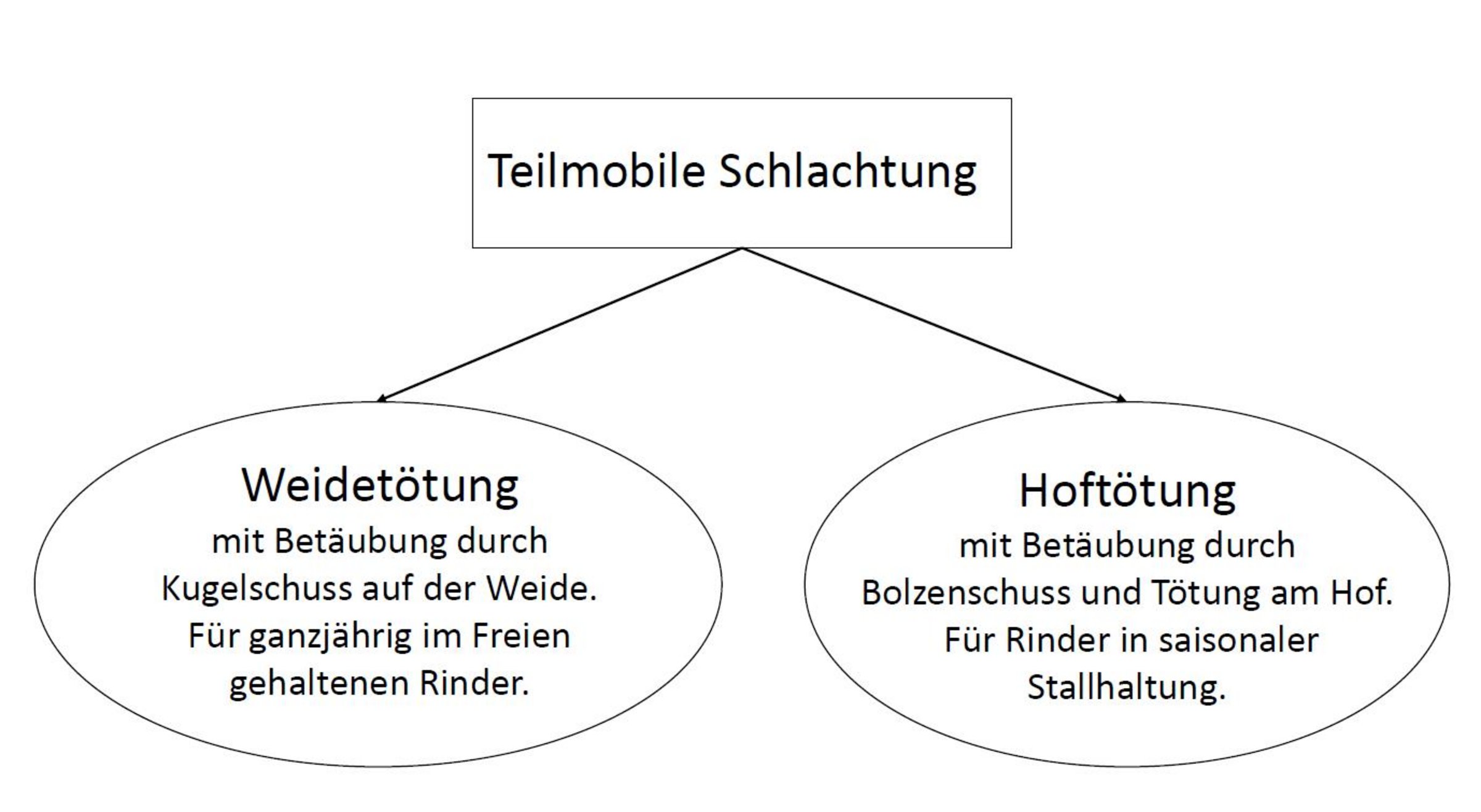
Before the participants were able to inspect the slaughter trailer on site, Ms Trampenau explained the special features of semi-mobile slaughter in her presentation. Semi-mobile because the animal is not killed directly on the premises of an EU-approved slaughterhouse, but in a mobile unit of the slaughterhouse, for example in a special slaughter trailer. Semi-mobile slaughter can be carried out as pasture slaughter or farm slaughter, depending on the conditions under which the animals are kept (Figure 1). The slaughter process is regulated by numerous legal provisions for the implementation of semi-mobile slaughter. Important legal bases are the EU Hygiene Regulations 852/2004 and 853/2004 and the EU Animal Welfare Slaughter Regulation No. 1099/2009. In national law, the Animal Food Hygiene Ordinance (Tier-LMHV) and the National Animal Welfare Slaughter Ordinance must be taken into account. Since July 2021, Chapter VI a in Annex III / Regulation (EU) No. 853/2004 has been an extension of EU hygiene law on slaughter on the farm.
This separate legal framework defines the following points, among others
- Authorisation requirement for slaughter on the farm
- 3 cattle, 3 horses, 6 pigs per slaughtering process on the farm; exceptions possible
- Use of a mobile slaughter unit
- Bleeding possible outside the mobile unit
- Presence of the official veterinarian
- Maximum journey time of two hours to the mobile slaughterhouse
- Written agreement between farmer and slaughterhouse
Naturally, the question of the economic viability of the project arose. The obligatory presence of the official veterinarian during semi-mobile slaughter is a significant cost factor. With well-rehearsed processes, the time required will level out at 15 to 20 minutes plus the journey time, the speaker is certain. She also advises: "Have the confidence to increase the price and market the ethical added value and a closed farm cycle to your customers."
Author: Anne Helene Ahrend, Saxony-Anhalt State Institute for Agriculture and Horticulture
Further information on the topic of semi-mobile slaughter
Association of farmers with artisanal meat processing (focus on organic production) e.V. (vlhf)