
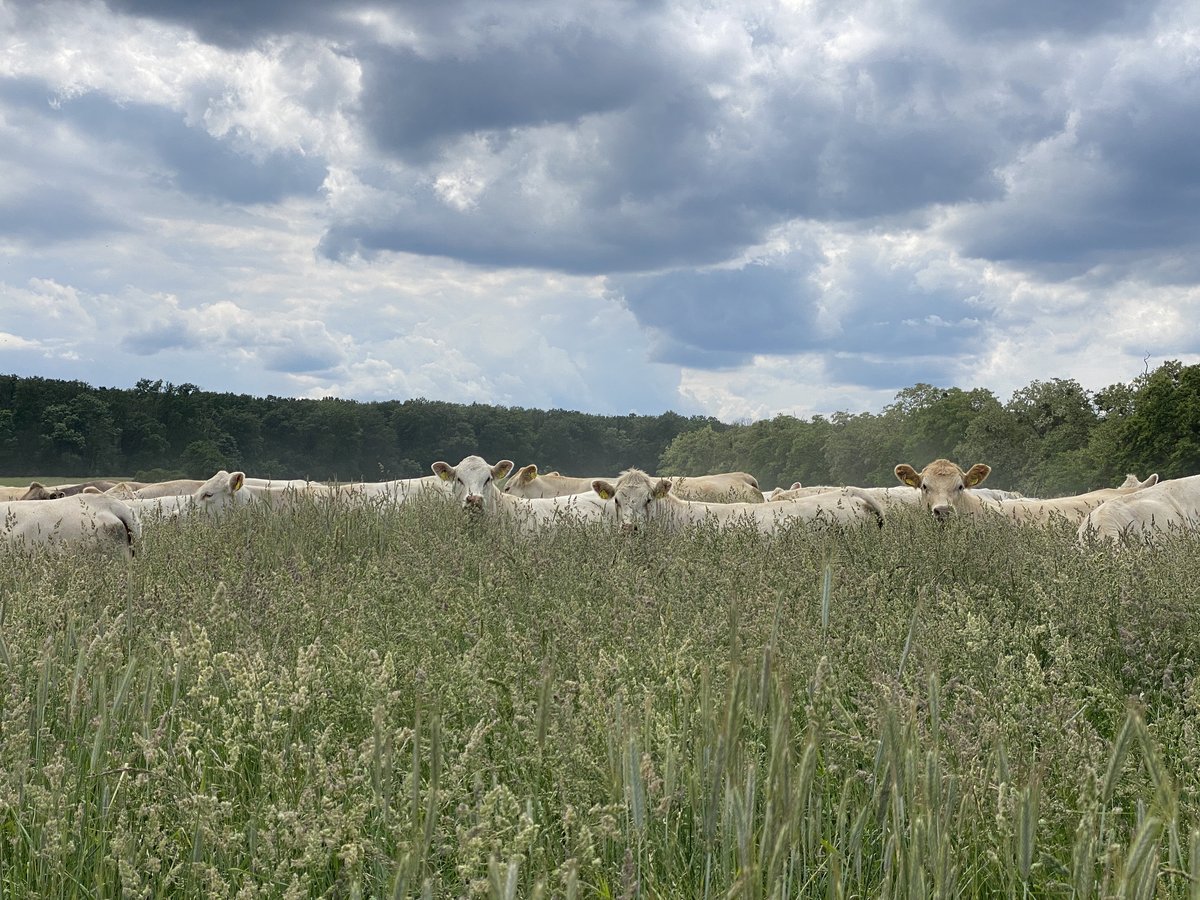
a high growth rate of the plant population and a high animal stocking density during grazing. (© Mob Grazing Network)
Dairy cow and cattle farming in a changing climate - innovative concepts for climate protection and adaptation
Mob grazing for pasture management in drought-prone regions
In cooperation with the German Networking Centre for Rural Areas (dvs) and the Focus on Animal Welfare project, an online event was held on the topic of "Dairy cow and cattle farming in a changing climate - innovative concepts for climate protection and adaptation". In addition to current topics such as "Looking at climate change in the big picture" and "Agroforestry systems in combination with cattle farming", the topic of "Mob Grazing" was also explained in more detail and current projects were presented.
What is "mob grazing" anyway, why is it relevant in Germany and when does it make sense to use this grazing system? Ruven Hener (consultant for holistic cattle farming and grazing) and Josefin Röwekamp (Klimapraxis & Netzwerk Mob Grazing) provided answers.
What is mob grazing?
"Mob grazing" is a grazing concept in which a high stocking density of animals (live weight of over 100,000 kg per hectare of pasture) grazes a very small area of pasture for a very short period of time (Lemus, 2011 Gurda et al., 2018; Zahn et al., 2022). The growth is given long rest periods of one month to one year. The long rest period means that the plant communities can root deeply and biomass can form (Gurda et al., 2018; Zahn et al., 2022). The growth in this grazing is similar to the height of the cattle at the withers (Fig. 1). In principle, growth heights of over 25 cm are aimed for. The grazing time (duration of stay of the cattle) is between six and 24 hours per grazing section with the aim of leaving a large grazing residue, which should serve as a trampled mulch layer, of around 50 % of the total growth (Gurda et al., 2018; Zahn et al., 2022). The remaining biomass protects against dehydration and serves as a source of nutrients for the soil. The soil can retain water better and plant growth is promoted.
Why is mob grazing also relevant in Germany?
Looking back at the extreme drought year of 2018, according to the UFZ Drought Monitor, in December 2018 there was an exceptional drought in large parts of Germany down to a soil depth of 1.80 metres. To date, not all soils in Germany have recovered, although it has rained more this year than ever before since weather records began (Deutscher Wetterdienst, 2024). Soils are still dry in some areas, especially in eastern Germany. On the one hand, high levels of precipitation are often only recorded regionally - some regions have been extremely affected by heavy rainfall, others less so. In addition, the soils in parts of eastern Germany are sandy and have a lower water storage capacity (Kühn et al., 2015).
Regardless of the soil type, it must also be assumed that the climate is changing in Germany as a whole: It is getting warmer and extreme weather events such as heavy rainfall and long periods of drought are increasing (IPPC, 2023). For this reason, it is important to develop management strategies that are adapted to climate change (Zahn et al., 2023). One possibility is "mob grazing", which could achieve improved feed yield stability in ruminant husbandry.
When does mob grazing make sense?
This grazing strategy should not be considered for all locations, especially not in favourable locations. Mob grazing, on the other hand, is suitable in regions with low precipitation (< 600 mm rainfall per year) and for locations where top grasses and legumes dominate. As the amount of precipitation changes not only annually, but also within a year, it is advisable to proceed strategically and use this form of grazing primarily in dry periods. In addition, the short duration of stay on each grazing section means a different work structure: fences have to be moved and the animals have to be driven to a different pasture every day. This is why large parcels are advantageous: here, only the fences between the parcels need to be moved instead of driving the animals to a different pasture. To implement mob grazing in everyday life, it is also very helpful to know and use the stockmanship method. By using targeted body language, cattle can be moved in a controlled manner using stockmanship. This is particularly important in the case of frequent round-ups in order to be in the right place at the right time with the cattle and reduce the amount of labour required.
EIP project "Mob grazing in arable forage production"
The grazing strategy is currently being tested in an EIP project . The aim is to develop an innovative grazing system that is climate-resilient and drought-resistant on the one hand and resource-efficient on the other. The project is being scientifically monitored and analysed alongside the farms, which are carrying out various trials on the grazing system.
Further information on the EIP project
Conclusion
Climate change will pose challenges for farms in many areas in the future. It is therefore important to continue researching these topics and to test and analyse them in practice - on farms.
Author: Carina Führer, Landesbetrieb Landwirtschaft Hessen
Literature
- Gurda, A., Renz, M., & Brink, G. (2018). Defining Mob Grazing in the Upper Midwestern United States. Journal of Extension, 56(4). doi.org/10.34068/joe.56.04.11
- Zahn, N., Ertel, C., Hener, R., Franke, S., Beck, A., Westphal, J., & Schleip, I. (2022). Mob grazing as a grazing strategy in grassland and arable forage in increasing droughts in north-east Germany. Proceedings of the 65th annual conference of the Arbeitsgemeinschaft für Grünland und Futterbau, 46-49.
- Zahn, N., Franke, S., Schleip, I., & Röwekamp, J. (2023). Does mob grazing protect soils and yields? Ecology and Agriculture, 3/2023. www.oekom.de/_files_media/zeitschriften/artikel/OEL_2023_03_22.pdf
- Lemus, R. (2011). What is Mob Grazing and Does It Really Provides Grazing Advantages?, 7/2011.
- German Weather Service (dvs) (2024). Record Rainy Twelve-Month Period, 7/2024. www.dwd.de/DE/wetter/thema_des_tages/2024/7/21.html
- Kühn, D., Bauriegel, A,. Müller, H. & Rosskopf, N. (2015). Characterisation of the soils of Brandenburg with regard to their distribution, properties and potentials with a presentation of averaged analytical investigation results including background values (grain size composition, soil physics, soil chemistry). Brandenburg. geowiss. Beitr. 22 (2015), 1. S. 5 - 135.
- IPCC. (2023). Climate Change 2022 - Impacts, Adaptation and Vulnerability: Working Group II Contribution to the Sixth Assessment Report of the Intergovernmental Panel on Climate Change (1st ed.). Cambridge University Press. doi.org/10.1017/9781009325844