
(Picture: Josefine Scheinert, LAZBW)
New approaches to rearing, fattening and husbandry technology - into the future with fit calves
Event organised by the Animal Welfare Competence Centre for Cattle highlights new approaches and ideas in calf rearing and husbandry
As cattle farms are currently facing a constant stream of new challenges and calf rearing is also moving more into the political spotlight, the Focus on Animal Welfare project is also focussing on calf-related topics.
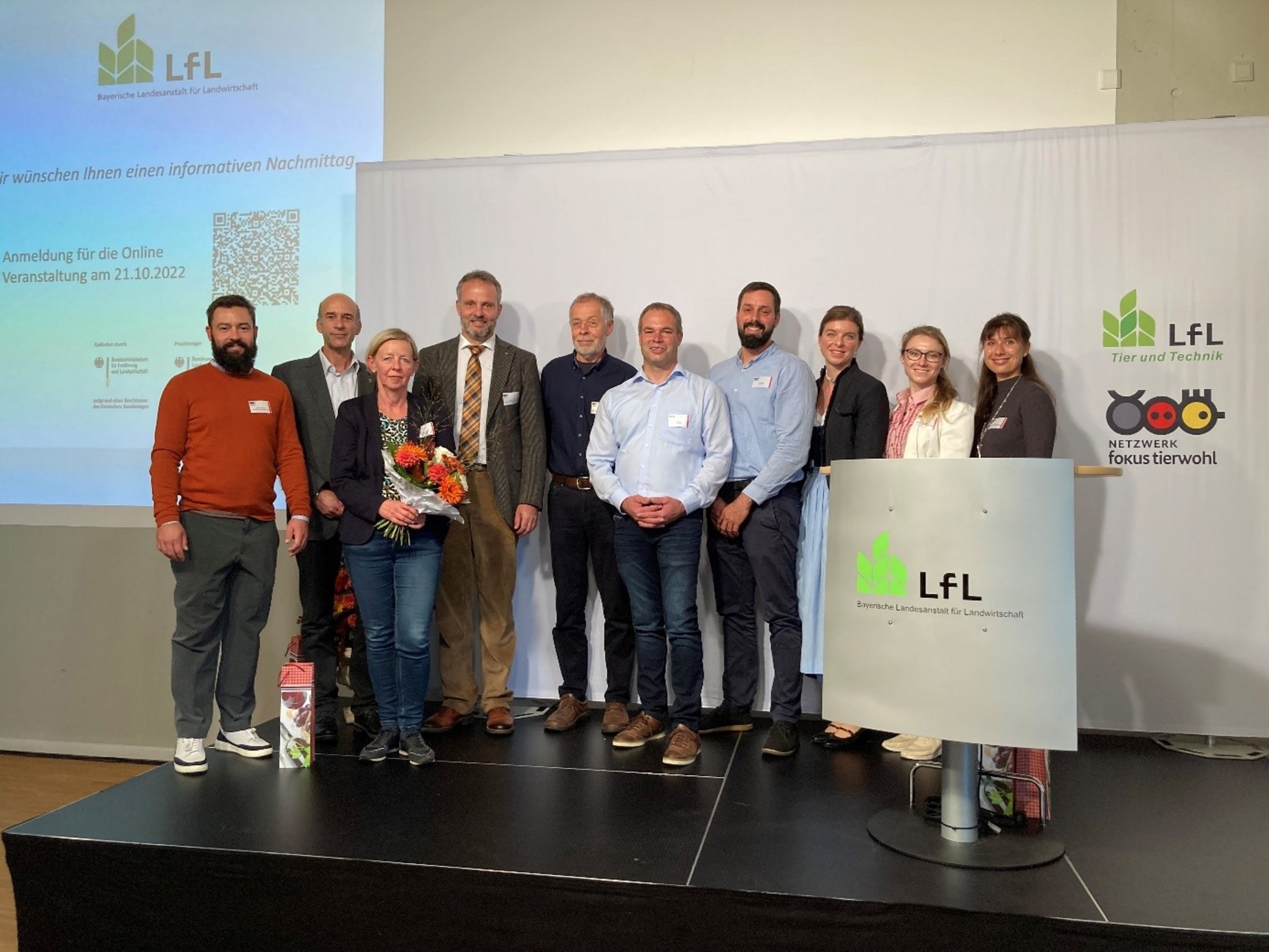
As part of the knowledge transfer events, the federal states of Baden-Württemberg, Bavaria and Hesse joined forces to present new approaches and ideas for calf rearing and husbandry to practitioners in a combined face-to-face and online event.
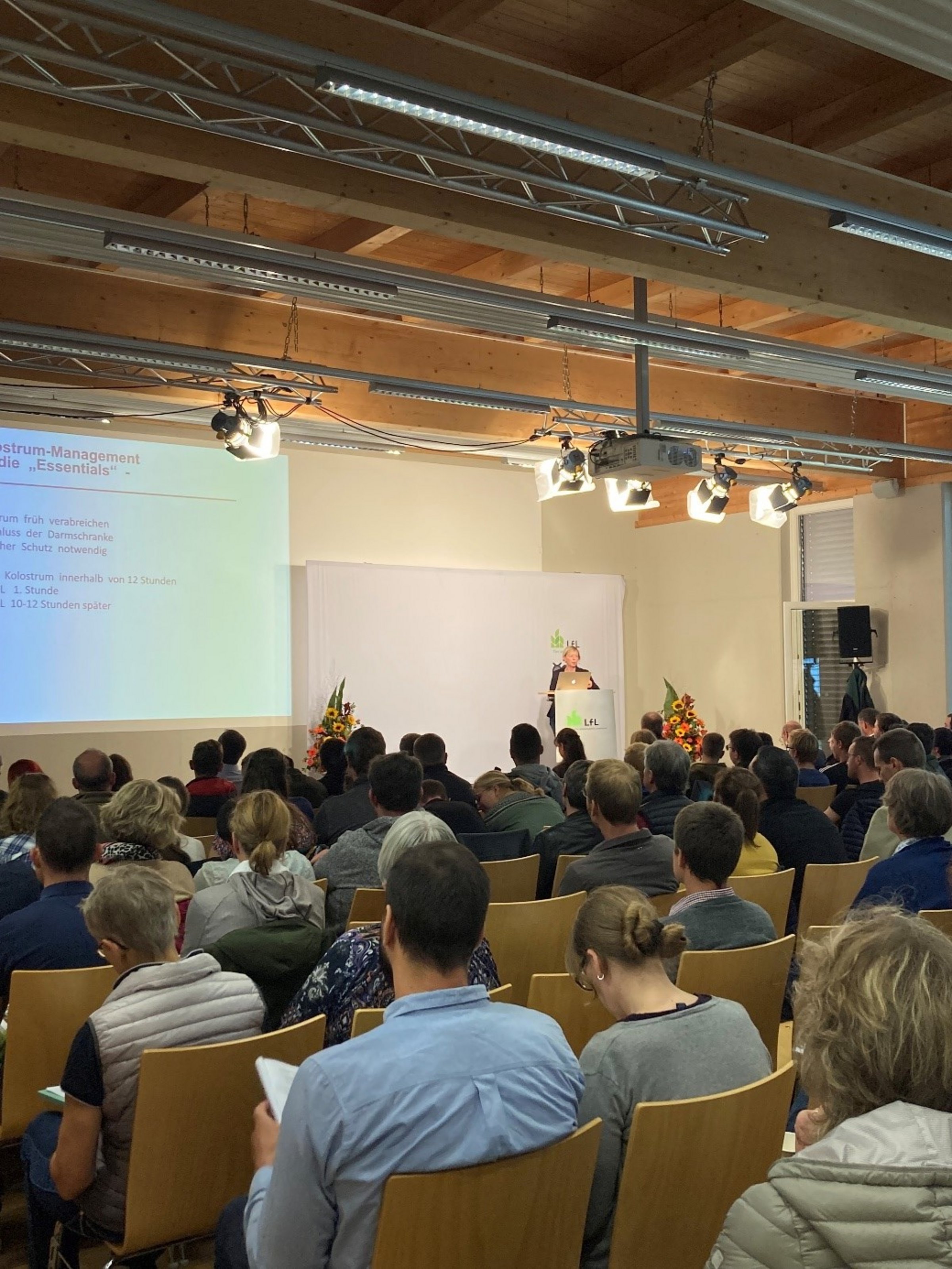
The information day on 19.10.2022 at the LfL Bayern in Grub focused on barn climate, air supply, housing systems and optimised work processes. The content of the presentations built on each other logically and guided the participants through the various aspects of calf husbandry, highlighting sticking points and pitfalls. Afterwards, there was the opportunity to find out more about the topics covered at a company exhibition and to develop ideas for solutions on your own farm.
Good lung health - what are the calf's needs?
The lungs are a crucial point when it comes to the health of calves. Dr Maren Feldmann from the Swiss Calf Health Service explained the challenges faced by a calf's lungs. Fluctuating temperatures, excessive humidity, draughts, harmful gases and dust are all factors that can seriously jeopardise health. It is therefore important to minimise the risk factors as much as possible, e.g. by providing sufficient bedding and creating a suitable microclimate with false ceilings.
Calves' demands on the barn climate - possible structural and technical realisation
The participants had now learnt that air quality is a crucial factor for calf health. But how do you transfer this theoretical knowledge to the barn? This is highly dependent on the housing system, as Johannes Zahner from the Bavarian State Research Centre for Agriculture explained. For example, it is difficult to maintain a constant temperature in outdoor climate barns. If side walls are used to reduce air exchange, meticulous care must be taken to ensure that no gaps are left for draughts. In igloo housing, on the other hand, too high a temperature is to be expected in summer if there is no effective shading provided by trees or an insulating roof. Depending on the type of building, natural ventilation or, for example, in-depth and well-planned hose ventilation can ensure even air distribution.
(Image: Josefine Scheinert, LAZBW)
New aspects of calf husbandry - What suits my farm?
The best system is always the one that works. This can vary from farm to farm and depends on local conditions, the management situation and also personal preferences. Dr Hans-Jürgen Kunz from the Institute for Animal Breeding and Husbandry in Kiel drew attention to the advantages and disadvantages of different husbandry systems. Igloos, as a form of classic individual housing in the first weeks of life, create a microclimate and are easy to clean and disinfect. On the other hand, individual boxes made of wood are difficult to clean and can lead to the transmission of diarrhoea pathogens, for example. Dr Kunz presented various stables for group housing and showed small but significant improvements. For example, removing the raised standing areas in the Riswick calf barn makes it easier to remove manure. Stables that have no external walls allow good air supply, but should not be located in places exposed to wind.
What can my calf housing look like? - Practitioners present their ideas and solutions
Mr Benedikt Renz runs a family farm with 170 dairy cows and is one of the impulse farms in the Focus on Animal Welfare network. Using practical examples with lots of visual material, he showed how his version of calf rearing works. He built his own calf barn himself with a south-facing mono-pitch roof. Impressive pictures showed the visitors how the low position of the sun in winter means that the barn is warmed up and how the high position of the sun in summer means that the barn is shaded. When building his calf canopy, he took great care to ensure that there were no gaps between the wall and the retracted ceiling, giving the calves a place to retreat without draughts. The cow and calf sheds were designed so that mother and calf can still see each other even after separation.
And what does the feeding barn look like?
Mr Frieder Meidert from Rosenheim stepped in at short notice for the presentation by "Scheck Gbr". He showed his structural realisation of the feeder rearing in the form of an outdoor climate stable, which is littered with straw and does not require individual animal restraint. His aim is to obtain healthier, happy foragers with fewer injuries. In his presentation, he calculated the rearing costs involved and showed photos of properly cleaned and disinfected stalls and happy feeders.
After a delicious lunch from the sumptuous buffet, the event participants were able to visit the company exhibition after the presentations and talk to the exhibitors and speakers in person and ask questions. At the stand of Tiergesundheitsdienst Bayern e.V., participants were able to obtain in-depth information on calf health. The LKV-Beratungsgesellschaft mbH and the Institute for Animal Nutrition of the LfL Bayern were also represented. Dr Knopf & Oswald GmbH and the companies Lock Antriebstechnik GmbH and HAKA Josef Häufele GmbH & Co KG presented innovative ideas for barn ventilation in line with the presentations. The companies ZIMMERMANN Stalltechnik Vertriebs GmbH and Wilhelm Kristen GmbH + Co. KG were all about optimising husbandry for greater animal welfare. At Gummiwerk KRAIBURG Elastik GmbH & Co KG, visitors were able to view various versions of rubber pads. VetSmart NEOWOLF GmbH combined physics, veterinary medicine and technology for the planning of barn construction and ventilation technology and smaXtec GmbH presented its bolus system for the early detection of abnormalities. Urban GmbH & Co KG, PATURA KG and Albert Kerbl GmbH presented their products for calf rearing and in particular for better calf feeding management. "Last but not least, there was an information stand of the Focus on Animal Welfare network, where the animal welfare multipliers provided information about the network and its technical content. The many vocational school students in particular were enthusiastic about the well-founded, free information on the homepage, Facebook, Instagram and Spotify.
to the online conference proceedings of the event (video recording)
In the subsequent online event on 21 October 2022, insights were given into obstetrics and colostrum management in order to continuously improve these everyday things that every dairy cow farm knows. This is because studies repeatedly show that there is still a need for optimisation. The presentations were rounded off with a digression on the use of materials to keep calves occupied.
Birth as a key event for cow and calf
An easy birth provides a good start to life. However, not all births run smoothly without human assistance, and Prof. Dr Axel Wehrend (Veterinary Clinic for Obstetrics, Gynaecology and Andrology, Justus Liebig University Giessen) demonstrated the process and the way in which obstetrics is carried out, including in front of the camera. The motto is: Give the cow enough time to manage the birth on her own. Only when there is no sign of progress in the birth should professional obstetric assistance be provided. This is because calves that have had to be assisted during birth are more likely to suffer from diarrhoea, pneumonia and umbilical inflammation. To get tips and tricks from experts, you can find a wide range of information and specialist videos on the subject of birth at www.fokus-tierwohl.de.
Optimise colostrum management
Once the calf has arrived, there are measures that should be taken immediately after the birth. The most important thing here is to give the calf as much colostrum as possible as quickly as possible. Dr Christian Koch from the Lehr- und Versuchsanstalt für Viehhaltung, Hofgut Neumühle, presented the background to these recommendations. Successful colostrum management is the starting signal for long-lived and high-yielding cows. Graphs were used to illustrate the extent to which the permeability of the intestinal wall for immunoglobulins decreases in newborn calves. Just six hours after birth, 50% of the immunoglobulins can no longer be absorbed. The IgG concentration (mg/ml) also rises significantly higher when colostrum is given immediately after birth (within the first hour of life) than when it is given later and remains relatively constant at a high concentration for several days after birth. However, not only immunoglobulins but also colostral growth factors have a positive effect on the development of the calf. Mr Koch and the members of the Working Group on Feeding Systems in Calf Husbandry in the Focus on Animal Welfare project agree that it is best to provide more than 3 litres of fresh and untreated colostrum from the mother within the first hour. Information on this topic will soon be available at www.fokus-tierwohl.de.
More fun in the barn - activities for calves
Prof Dr Gudrun Plesch (FiBL Deutschland e. V.) and Jasper Metzger-Petersen from Bioland Hof Backensholz (impulse farm in the Fokus Tierwohl network) rounded off the successful morning with their views on activity material for calves. After all, it's not just pigs that like this. These experiences became apparent during the model and demonstration project on animal welfare to optimise the group housing of calves with regard to avoiding and reducing mutual suckling, explained Ms Plesch. In order to encourage calves' pronounced play and exploratory behaviour and thus increase animal welfare, there are different and attractive occupation options, such as fir trees or hay racks. The simplest and most cost-effective solutions bring more fun and distraction into the calf barn. Further information can be found at www.fokus-tierwohl.de/de/rind/mud-tierschutz-beschaeftigungsmaterial-kaelber. The brochure on the results of the MuD animal welfare project can be ordered from the BLE media service and is also available for download.
Finally, Mr Metzger-Petersen illustrated his way of keeping calves to the participants and shared his experiences with the housing material. The newly-built calf barn with the possibility of a run is open for farm tours at any time. Among other things, rubber hedgehogs and home-made hay racks made from canoe barrels are very popular with the calves.
The successful event, both in person and online, whets the appetite for more and makes us look forward to upcoming major events - the planning of which has already begun.
Authors: Office of the Animal Welfare Competence Centre for Cattle