
Birth as a central event for cow and calf
EuroTier digital 2021 - Network Focus Animal Welfare in the DLG Spotlights
At EuroTier digital at the beginning of February 2021, the nationwide Fokus Tierwohl network was represented in the specialist programme with numerous contributions. The Cattle Spotlight included a presentation on calf birth.
Birth and obstetrics - that's where it all begins
What begins with birth and, if necessary, obstetrics in cattle was probably clear to all viewers right from the start: hopefully a long, healthy life for a productive cow. Professor Axel Wehrend, Head of the Clinic for Obstetrics, Gynaecology and Andrology of Large and Small Animals at the Faculty of Veterinary Medicine at JLU Giessen, began his lecture by explaining the consequences of a difficult birth. Cows reduce their feed intake after a difficult birth due to pain. This reduces performance and fertility also suffers due to infections of the reproductive organs - the calves suffer from the consequences. A protracted and difficult birth leads to delayed or poor colostrum intake, as the calves' tongues are often swollen, making it difficult for them to suckle. This often leads to diarrhoea, lung or umbilical inflammation, in the worst case resulting in death or lifelong problems such as increased susceptibility to disease and poorer fertility as a cow. A high proportion of heavy births is demonstrably associated with increased calf mortality.
So how can heavy births be reduced?
The expert went into great detail on the major challenge of adequate birth monitoring. He presented results from studies that show that good birth monitoring can halve the stillbirth rate. The frequency of monitoring as well as the recognition of animal signals are decisive factors for this. From his work as a consultant, he explored the question of whether a birth can be reliably predicted eight hours in advance. The indicators frequently cited in practice, such as oedematisation of the vulva, mucus discharge, colour of the vaginal mucosa, loosening of the broad pelvic ligaments, flexibility of the tail tip, tail posture, lactation, teat filling and oedema formation, were put to the test by him. The sobering realisation from his investigations was that all these signs could often be observed days before birth and that only the examination of the degree of loosening of the broad pelvic ligaments allowed a reliable prediction. However, as the pelvic ligaments begin to loosen in 40% of the animals observed up to seven days before birth, only the complete loosening of the broad pelvic ligaments is considered a reliable sign of an imminent birth.
The importance of a well thought-out design of the calving pen with regard to the needs of humans and animals was another point of the presentation. The cow should be moved five days before birth to a clean area that is freshly bedded with plenty of straw every day. Visual contact with other cows is just as important as sufficient space and a good infrastructure (possibility of checking without disturbing the cow, water supply, possibility of restraint...).
The calving barn is not a sick barn!
The importance of good hygiene in this sensitive area becomes clear when you realise that the cow and calf are highly susceptible to infection immediately after birth. The calving area can become a hotbed of germs on the farm, as even healthy cows can excrete not only Coxiellae (Q fever pathogen), but above all Salmonella and Neospora (dogs as carriers!) with the birth fluids, explained Professor Wehrend, explaining the scientific findings. Hygiene should therefore not remain just an empty word.
Can a difficult birth be recognised in time through normal observation?
Signs of heavy births are more frequent pawing, urination and rubbing. Although these are statistically significant features, they are of little practical importance because the frequency cannot be adequately tracked, even with regular observation. The great challenge of recognising problems at an early stage became clear in this context. If the passage of the head is delayed by more than 1.5 hours after the amniotic sac has broken, the birth is delayed, parts of the afterbirth are visible before the calf is born or there are deviations from the norm (e.g. only one leg is visible), then these are reasons for a check-up. Here too, meticulous attention must be paid to cleanliness. Water alone is not enough. The vulva should also be cleaned with soap and then rinsed with water.
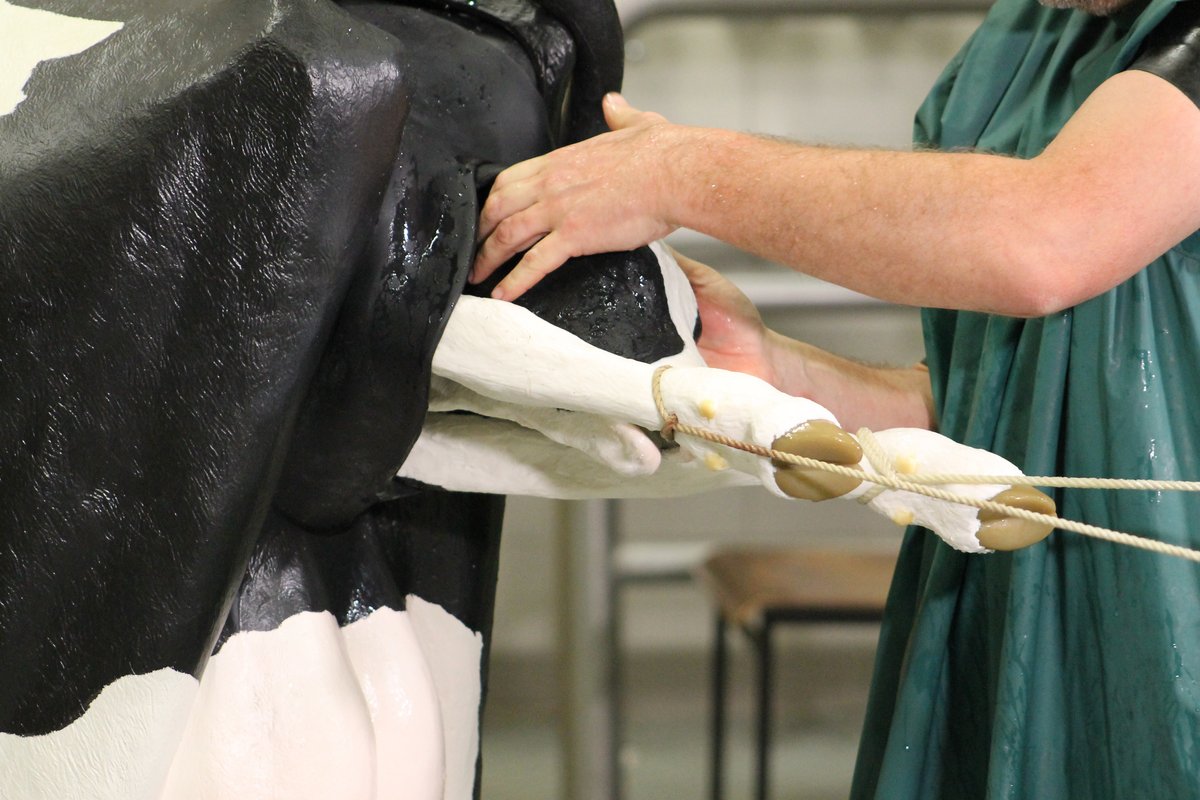
The phases of labour (opening phase, expulsion phase, postpartum phase) must be known. Pulling assistance should only be given on a lying animal, as this allows the cow to develop maximum strength and the bony birth canals to reach their maximum diameter.
In the first phase of labour, patience is required above all, as stress can lead to unnecessary obstructions in the cow. In the second phase, the expulsion phase, the head enters the pelvis. The contractions and abdominal pressure are intensified by nerve stimuli. It is crucial to ensure that the external genital organs are sufficiently stretched during labour. When pulling out, it is particularly important to ensure that the direction of traction is changed towards the cow's hocks at the right time so that the calf's hind limbs can stretch. This is the case when the calf's ribcage is born. At this moment, the umbilical cord, which has been safely supplying the calf up to this point, also breaks. Rapid intervention is required in the case of posterior presentation, as the umbilical cord is severed before the calf's head has left the womb. Pulling assistance should be provided by a maximum of two people.
According to Professor Wehrend, the risk of birth injuries increases if the cows become obese before birth (fat is soft but cannot stretch), are stressed or have a selenium, calcium or energy deficiency.
Use the mechanical birth assistant wisely
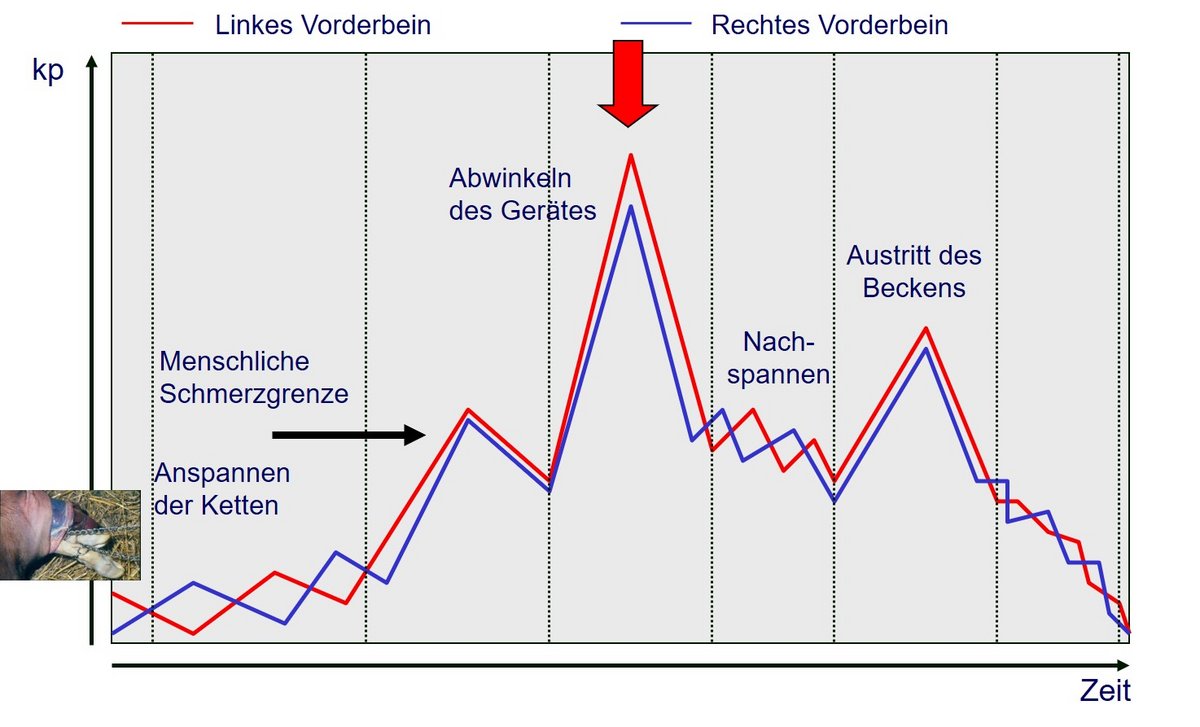
This aid is often used too often and too early. This rarely leads to external injuries, but often to internal injuries that are not immediately recognisable. Tilting the mechanical obstetric aid in particular leads to unexpected force development due to the changed angle of pull (see Fig. 1). In any case, its use should only be considered if the following conditions are met:
- No postural, positional or positional anomalies
- The cervix must be fully open
- Fruit not too large in absolute or relative terms
- Cow should be lying down
- First alternating traction, from the moment the eyes become visible in the pubic cleft simultaneous traction
- Change traction in the direction of the udder when the breast emerges
- Use a tension limiter
- Sufficient breaks for stretching
Caesarean section and fertility
According to Professor Wehrend, the question of whether a caesarean section is worthwhile can be answered with a clear yes if it is performed in good time. In such cases, the calf can usually be saved and the cow is more likely to become pregnant again (68%) than after a stillbirth (46%) (Geschwind et al., 2003). With the exception of delayed presentation of the calving cow or uterine torsion, no negative influence on re-pregnancy was found. If a caesarean section can prevent internal injuries to the cow, it is also worthwhile.
In order to optimise birth monitoring, the following questions should be answered with certainty:
- What do I monitor and how often?
- When and how do I recognise difficult births?
- How do I carry out obstetric care correctly?
- Where are my limits and when should I call in a vet?
Finally, he encouraged the audience to practise simple corrections, such as a carpal joint flexion position, on stillborn calves and pointed out that detailed information on the topic of birth management will be made freely available in future as part of the nationwide Focus on Animal Welfare network.
Author: Gudrun Plesch, FiBL Deutschland e.V.
Axel Wehrend
Source: Gudrun Plesch, FiBL Deutschland e.V.