

Behaviour of Muscovy ducks
The Muscovy duck (Cairina moschata), also known in its domesticated form as the Turkish, warty, Barbary or flying duck, does not, unlike the Peking duck (Anas platyrhynchos domestica), have the mallard (Anas platyrhynchos) as its wild ancestor.
Muscovy ducks, of the genus Cairina, are solitary animals and only come together in the wild for mating. They originate from South America and have an elongated body, with long tail feathers and a bare beak base with wart-like skin in the drake. The so-called ‘caruncle’ becomes even more prominent during the mating season. The bill is highly innervated and equipped3 with sensory receptors. There is a hook on the upper bill and the toes end in claws (Figs. 2, 3 and 4). There are eight different colour varieties5, comprising solid-coloured or mottled birds (Fig. 1). They prefer to roost high up in trees (tree-roosting ducks) and make less use of bathing opportunities than Peking ducks6 (Table 1). Furthermore, there is a marked sexual dimorphism, such that the males are significantly larger and heavier than the females at slaughter (drake: 4.5–5.2 kg at 12 weeks; ducks: 2.2–2.5 kg at 9–10 weeks). Both sexes are fattened, but are not yet sexually mature at slaughter. Neither the males nor the females are vocal and emit5 at most a soft, breathy sound.
It is important to make a clear distinction between Peking and Muscovy ducks in terms of their behaviour and their requirements for the rearing environment (Table 1).
The Mulard is a cross between Muscovy drakes and Peking ducks and resembles Muscovy ducks in behaviour. As the cross is interspecific, Mulards are always sterile and are used solely for fattening. Sexual dimorphism is less pronounced and the meat yield is higher5.
| Behaviour | Peking duck | Muscovy duck |
| Feeding | 2.4% | 3.7% |
| Drinking | 8.0% | 6.4% |
| Scratching in litter / grass | 11.8% | 10.9% |
| Grooming | 12.6% | 14.6% |
| Sitting | 58.1% | 58.8% |
| Walking | 4.3% | 4.2% |
| Baden | 2.8% | 1.5% |


Potential for aggression and cannibalism
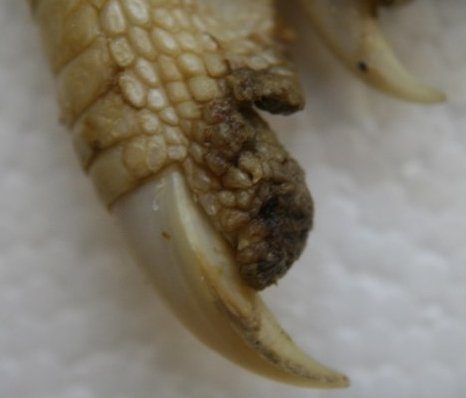
Male muscovy ducks frequently engage in fights, which greatly increases3 the risk of injury in untrimmed birds. To prevent problems with cannibalism and injuries, the downward-curving tip of the beak is trimmed at the hatchery during the rearing of muscovy ducks. The very sharp claws are also trimmed at 10–12 days of age.
Since 1 January 2014, beak trimming has been explicitly banned4 in Lower Saxony. As the problem of cannibalism cannot currently be7 satisfactorily resolved from an animal welfare and economic perspective, even with reduced stocking densities, parent stock rearing has consequently been completely discontinued in Germany. In some parts of Germany, clipped birds from abroad are still being fattened, whilst fattening in Lower Saxony, for example, has virtually come to a standstill.
locomotion behaviour
Musk ducks are generally good runners³. Their locomotion is largely linked to their feeding habits. Musk ducks can cover considerable distances on foot at a leisurely pace. Over short distances, they can run quickly and even hop onto low objects. With their short legs set far back on the body, they shift their centre of gravity alternately onto the leg bearing the weight and move their head synchronously to the side. This results in their characteristic waddling gait6.
In the first weeks of life, the birds do not display any flying behaviour. Ducks begin their first attempts at flight at nine to ten weeks; by this stage, the drakes of the fattening types are already too heavy for this and do not display such behaviour. As Muscovy ducks are waterfowl, they also move about effortlessly by swimming on bodies of water, provided these are available.
Feeding and water intake behaviour
Ducks use various feeding techniques to obtain food. They feed on land, from the water’s surface (by skimming), or by foraging on the riverbed underwater.
For feeding, the duck’s bill is equipped with lateral horn-like lamellae, which enable it to pluck hard grasses and filter the finest food particles from the water. Muscovy ducks are well-suited to feeding on grass and plant material on land thanks to the sharp edges of their bills. They also readily eat insects and, where possible, even hunt them.
Sifting can be classified as an indirect form of drinking within their feeding behaviour. The food is filtered from the water flowing past the sides of the beak with the help of the lamellae, transported further into the beak, collected in the upper part and swallowed.
Dredging is another frequently observed feeding technique, in which the head and neck are submerged in shallow water and food is taken from the bottom of the water. This type of feeding is mostly observed in wild musk ducks floating on the water3. During fattening, no feed should be offered in the water to prevent the onset of disease.
To drink, the birds dip their beaks into the water. The water is sucked in through movements of the beak and tongue. By raising their heads, the water flows through the beak and is swallowed.
Drinking from nipple drinkers does not correspond to the natural behaviour of ducks, but offers hygienic advantages. With their necks and heads stretched out, the ducks peck at the drinking nipple with their beaks open and swallow the water that flows out. Particular attention must be paid to hygiene in the case of open drinkers or bathing facilities where the birds can dip their heads or display bathing behaviour.
- Bathing several times a day is also part of ducks’ comfort behaviour.
- This species-specific behaviour is described by Knierim et al. (2004) as follows: “The duck is on the water and begins bathing by shaking its tail rapidly. It then submerges its head up to its eyes, stands upright and lets water run over its body, shaking its body and raised wings. This movement is performed several times in quick succession. Afterwards, it carries out extensive plumage grooming on land using its beak8.”
- Feather preening is typically carried out after bathing and in conjunction with greasing via the preen gland. This sequence of movements is genetically determined. The ducks use their beaks, necks, the sides of their heads and their throats to smooth over entire areas of feathers or to work on individual feathers³.
- Wing flapping, shaking of the body and head, scratching and stretching of the legs can also be observed.

Resting and sleeping patterns
Unlike Peking ducks, adult muscovy ducks prefer to rest in an elevated position⁶ (Fig. 5). They rest and sleep after every meal. To do this, they tuck their head into their shoulder feathers or pull their neck towards their back and rest their beak on their breast. Unlike chickens, ducks are also active at night. Nevertheless, a continuous period of darkness lasting eight hours should be included in the lighting programme6.
Social behaviour
Social behaviour refers to all forms of behaviour that facilitate communication between animals. In the wild, muscovy ducks live alone or in small, single-sex groups and come together only to mate. In commercial rearing, the birds are kept in larger flocks, but separated by sex. Male muscovy ducks establish a hierarchy within the barn and are territorial.