
- Dr. Christine Ahlers, Thuringian Animal Disease Fund
- Dr. Theresa Bormann, Federal Association of Rural Goose Farmers
- Michael Claßen, farmer
- Dr. Lea Klambeck, Osnabrück University of Applied Sciences
- Wilhelm Kollmer-Heidkamp, farmer
- Pia Niewind, North Rhine-Westphalia Chamber of Agriculture
- Dr. Stephanie Riederer, German Animal Welfare Association
- Dr Katja Kulke, Lower Saxony Chamber of Agriculture
Funding note:
This document was produced as part of the collaborative project ‘Netzwerk Fokus Tierwohl’, funding reference numbers 28N-4-013-01 to 28N-4-013-17, by the ‘Broiler Chickens’ working group of the Poultry Animal Welfare Competence Centre and methodologically and didactically adapted by DLG e.V. and FiBL
Deutschland e.V. The joint project of the Chambers of Agriculture and agricultural institutions across all federal states aims to improve the transfer of knowledge into practice in order to make cattle, pig and poultry farms fit for the future in terms of animal-welfare-friendly, environmentally sound and sustainable livestock farming.
The project is funded by the Federal Ministry of Food and Agriculture pursuant to a resolution of the German Bundestag.
All information and advice is provided without any warranty or liability.
Publisher
DLG e.V. Agricultural
Centre
Eschborner Landstraße 122
60489 Frankfurt am Main
FiBL Deutschland e.V. Animal Welfare
Division
Kasseler Straße 1a
60486 Frankfurt am Main
Reproduction and transmission of individual text sections, drawings or images (including for the purpose of lesson planning), as well as the provision of the information sheet in whole or in part for viewing or downloading by third parties, is permitted only with the prior approval of the relevant office of the Animal Welfare Competence Centre and DLG e.V., Marketing Department, Tel. +49 69 24788-209, [email protected]
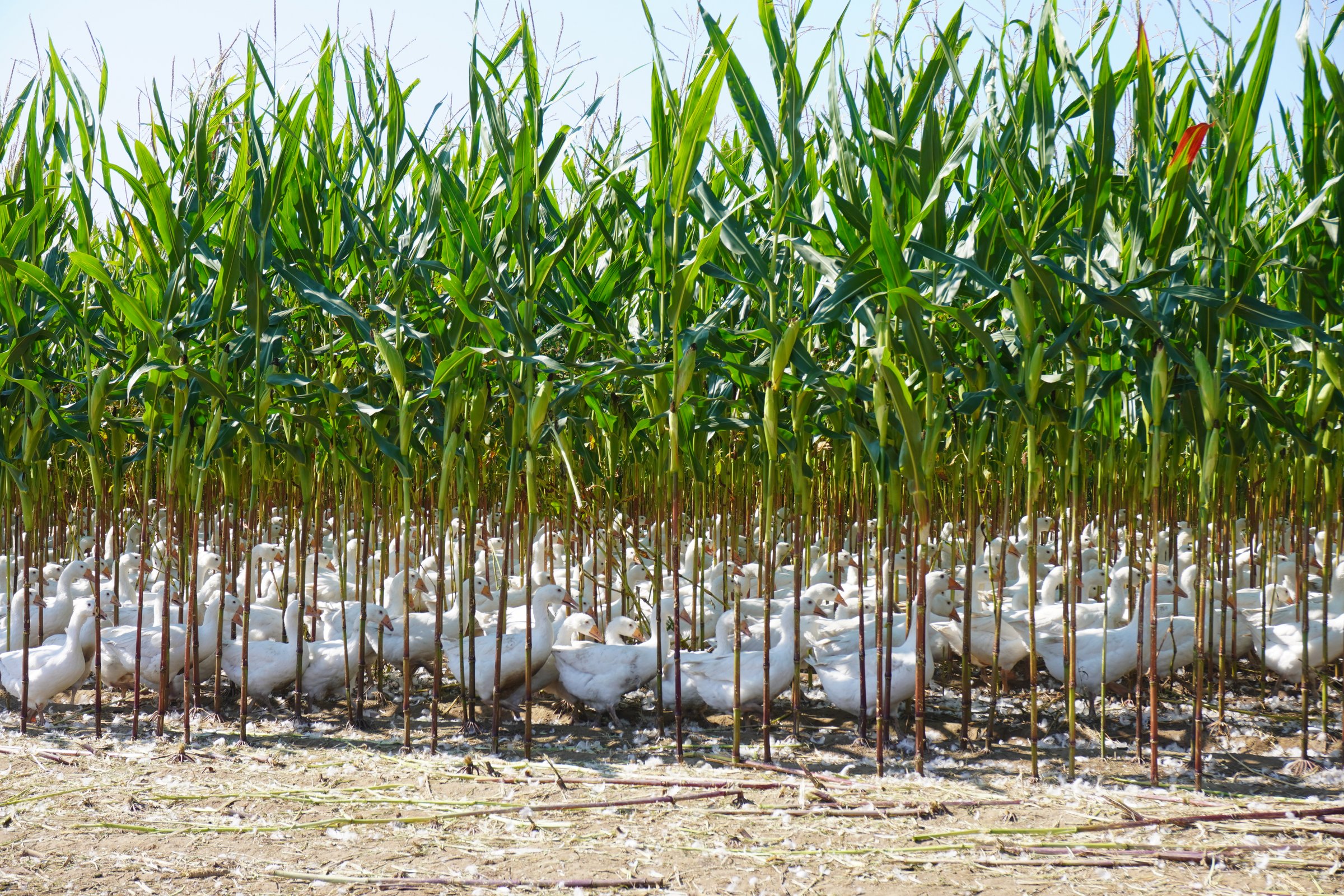
Apart from a few full-time farms in the regions of Germany typically associated with goose farming, goose fattening in this country is predominantly carried out as a sideline to farming for direct marketing, with the animals kept outdoors. A sufficiently large outdoor grazing area should be provided for this purpose. Access to pasture must be provided by the ninth week of life at the latest, once the geese are fully feathered. A practical approach is to allow young goslings access to a green and dry outdoor run for a few hours at a time from as early as the 2nd or 3rd week of life, provided the weather is good. Here, the young birds find fresh greenery and herbs such as chickweed, which they readily eat. Once the geese are fully feathered, they can also be kept outdoors at night and during periods of bad weather. However, it is advisable to house the geese at night in a familiar, covered shelter with bedding. According to Lower Saxony’s ‘Goose Husbandry Agreement’, an outdoor area of at least 10 m² (permanent pasture) per animal should be available; in a rotational grazing system, at least 4 m² is required. Programmes such as ‘Geese from Farm-Raised Free-Range’ even require 15 m² of vegetated and structured area per animal. The NEULAND guidelines for species-appropriate goose husbandry stipulate a minimum of 20 m² per animal for rotational and static grazing.
The grazing area must be available to the animals all year round, or for the entire rearing period, and can make a significant contribution to feeding the animals in a way that meets their needs and is cost-effective. Accordingly, particular attention should be paid to the maintenance and design of the grazing area. Intensive use of pasture land by 500 or more animals per hectare of agricultural land (AL) results in increasing wear and tear on the sward. Between 50 and 70 m² of grassland per goose is required to keep them on a fully grassed area all year round. The requirements for a good and robust goose pasture are shown in Table 1.
| Soil |
|
| Vegetation |
|
| Grass sward |
|
| Growth height |
|
| Other requirements |
|
<figcaption>Table 1: Conditions for an optimal goose pasture (Schneider et al., 2002)</figcaption>
The goose spends most of its time outdoors. Fattening should also take place in the environment to which the goose is accustomed. If the goose has been accustomed to free-range conditions throughout its life, fattening the animals in a shed is difficult; similarly, separating the flock in autumn can lead to problems. Because geese react very sensitively to changes in location, their environment should not be altered. Although fattening in a shed is possible, the transition from free-range to purely shed-based rearing causes the animals enormous stress. The mandatory housing orders during recent outbreaks of avian influenza repeatedly confirm the high levels of stress the animals experience when they are forced to remain indoors. Extensive measures are required here, such as more frequent checks on the animals and the provision of additional enrichment materials (e.g. fresh straw or maize silage). The aim should therefore be to provide the animals with optimal conditions on pasture all year round.
Structure of the outlet
Adequate shade is particularly important during the hot summer months. Shelters must be provided for this purpose, but trees and shrubs are also suitable for providing shade. These also serve to protect against aerial predators, which pose a particular risk to young foals in their first few weeks. One alternative, for example, would be to stretch nets over the outdoor run. A suitable enclosure for the outdoor run, e.g. using a wildlife fence with an electrified wire, offers protection against other predators such as foxes and martens and, depending on the region, wolves too. To ensure the animals have a constant supply of fresh water and feed, appropriate feed and water points must be provided in the outdoor area. In accordance with Section 3 of the Ordinance on Protection against Avian Influenza (GeflPestSchV), the feed and water points must be covered to prevent contamination from, for example, wild bird droppings. With regard to drinking facilities, the water must be provided in such a way that the goose can fully submerge its head and beak in the water and pour it over its body. To protect the outdoor run, it is recommended that the water points for the geese be moved at regular intervals. A bathing facility in the form of larger water areas in the outdoor run is not strictly necessary; these can lead to hygiene problems, particularly at higher stocking densities. Providing enrichment materials is not required where access to the outdoor run is available.
Maintenance measures
The forage requirement per bird and fattening cycle is approximately 140 kg for a late-fattening goose weighing 7–8 kg. The strain placed on the pasture by the birds is considerable. The birds cause deep browsing damage, and their highly corrosive droppings can also damage the sward, which may lead to a one-sided plant community. A rotational grazing system can provide a solution here, which is easily implemented by moving a mobile electric fence. On the other hand, due to their lower body weight compared to other farm animals and their large feet, the pressure on the ground is lower, which proves advantageous in some locations, particularly damp ones.
Maintaining the pasture therefore involves, where possible, a regular rotation of the area or, if necessary, ploughing. The principle of rotational grazing, i.e. expanding the grazing area every 3–4 days, has also proven effective.
When reseeding or sowing new crops, it is advisable to use mixtures containing grasses that geese enjoy eating. These include German ryegrass, red fescue, red fescue, as well as white clover, Swedish clover or dandelion. Less favoured are smooth oatgrass, cocksfoot or meadow grass, as well as field alfalfa, red clover and many wild herbs. The location influences the choice of varieties. Some plants pose a risk of poisoning to geese. Cress-leaved rockcress (Erysium crepidifolium) and black nightshade (Solanum nigrum L.) can lead to the death of the animal if ingested.
The grass height should not exceed 15 cm; 10 cm is preferable, as grass that is too tall is trampled by the animals and is no longer eaten. Overgrown and neglected plants, as well as areas where the animals have concentrated, should be re-mowed.
Liming with approx. 10 tonnes of quicklime per hectare is recommended every two to three years. This has a disinfecting effect and binds acids in the soil. Rolling the paddock in spring levels the turf and promotes a dense grass cover. Hygiene in the area near the barn can be further improved by measures such as spreading wood chips to prevent mudding and/or the formation of puddles.
A real-life example
The Claßen farm in Lower Saxony, a pilot farm within the Fokus Tierwohl network, uses maize plants combined with a clover-grass undersown crop in its outdoor grazing design. This has several advantages. At a young age, the animals initially feed on the grass, whereas older animals also eat the leaves of the maize stalks or even the whole plant, including the cobs. Furthermore, the vegetation provides protection from predators, offers shade and also serves as a source of activity. Another positive aspect is that maize and rye are heavy nitrogen consumers and utilise the nutrients deposited by the geese for their growth. If nitrogen uptake ceases during the vegetation-poor season due to limited space and little to no plant growth, there is a risk that nutrients will accumulate in the soil.
Farm manager Claßen ploughs the fields annually and liming them to keep them clean and minimise weed pressure as much as possible. A total of four fields are available, one of which is used in rotation for the cultivation of winter cereals.
Bibliography
Golze, M. (2019) Presentation: “New findings on the pasture-fattening of geese and their impact on the product quality of goose and duck”. 5th Practical Seminar on Waterfowl Farming, Bernburg
NEULAND guidelines for species-appropriate goose farming (2018): NEULAND guidelines (neuland-fleisch.de)
Pingel, H. (2000) Ducks and Geese. Ulmer, Stuttgart
Schneider, K.-H. (2002) Goose Breeding for Everyone: The Practical Handbook. Oertel und Spörer, Reutlingen
Agreement between the Lower Saxony Ministry of Food, Agriculture and Consumer Protection (ML) and the Lower Saxony Poultry Industry Association (NGW) on minimum requirements for the rearing and fattening of geese (‘Goose Rearing Agreement’): Ducks / Geese | Lower Saxony Ministry of Food, Agriculture and Consumer Protection (niedersachsen.de) (Download section)