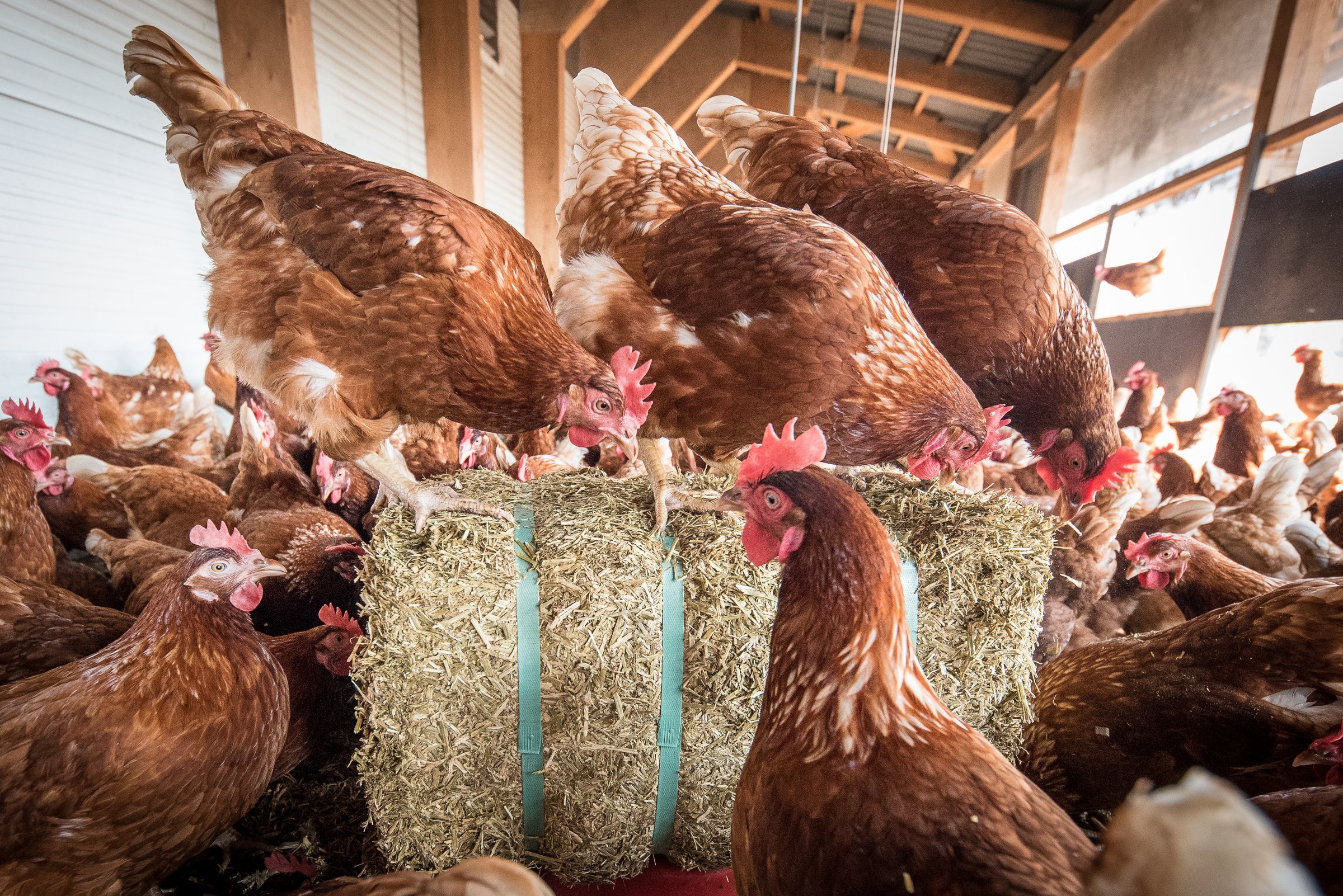
Source: Wolfgang Ehrecke (LWK Lower Saxony)
Feather pecking and cannibalism are behavioural disorders that occur in pullets and laying hens, which have a negative impact on the welfare of the affected birds. Furthermore, these behavioural disorders can lead to reduced performance and increased mortality within the flock. According to current knowledge, the causes lie in a multifactorial process influenced by environmental factors, feeding practices and genetics. To minimise feather pecking and cannibalism, the tips of the upper beaks of day-old chicks were routinely trimmed in the past. Since 1 January 2017, only laying hen chicks with untrimmed beaks have been placed in housing in Germany.
Research projects and practical farms have yielded promising results and a wealth of experience regarding the rearing of pullets and laying hens with intact beaks. A current overview of this is provided below, which will be expanded over time to include new findings.
The cornerstone of animal-welfare-friendly rearing of hens with intact beaks is optimal pullet rearing. To limit the occurrence of multifactorial feather pecking in the house, a ‘quality pullet’ is required that meets today’s standards in modern laying hen houses throughout the entire laying period. It is important to ensure a high level of animal welfare through preventive measures and the reduction of stress. In this context, management practices relating to feeding, enrichment and the maintenance of the animals’ health status play a particularly important role.
Model and Demonstration Projects (MuD) on Animal Welfare
The rearing of laying hens with intact beaks has been studied for several years as part of the Animal Welfare Model and Demonstration Projects (MuD), which are funded by the Federal Ministry of Food and Agriculture (BMEL). These projects aim to incorporate new findings into agricultural practice. The first advisory initiative within the framework of the MuD Animal Welfare projects resulted in the management guide ‘Minimising feather pecking and cannibalism in laying hens with intact beaks’. The guide serves as a basis for advice for the wider industry and offers a wide range of recommendations for action based on ‘best practice’ examples in pullet rearing and laying hen husbandry.
Guideline on Minimising Feather Pecking and Cannibalism (PDF)
Printed copies can be ordered from the Lower Saxony Chamber of Agriculture for a postage fee.
Contact: [email protected]
In a second advisory initiative, work was carried out on establishing a management tool (MTool) for laying hens. The MTool includes a recording and assessment scheme for animal health and behaviour, which allows the current condition of the animals to be recorded on the farm, primarily using animal-based parameters. It also contains a tool for recording and assessing animal performance. The collected data is assessed using an evaluation scheme in the form of a traffic light system, which clearly indicates the necessary action to be taken.
In the selected farms, the tool was used to determine the respective animal condition and to carry out a subsequent analysis of weaknesses in management and husbandry. Advisory recommendations were derived from the collected data, which should lead to improved animal health and be economically viable. Particular attention was paid to feather damage and injuries that can arise in connection with feather pecking and cannibalism.



European Innovation Partnership
To mark the conclusion of the EAFRD-funded project ‘Improved animal welfare for laying hens in Thuringia: rearing laying hens with untrimmed beaks’, a monitoring and assessment scheme (PDF) has been produced for the regular recording of any plumage damage and skin injuries, with the aim of detecting feather pecking and cannibalism at an early stage.
The three-year project was carried out by the Thuringian Animal Disease Fund in collaboration with five laying hen farmers, the Thuringian Poultry Industry Association (Geflügelwirtschaftsverband Thüringen e. V.) and the Thuringian State Office for Agriculture and Rural Areas (TLLLR).
Lower Saxony Livestock Strategy
At the regional level in Lower Saxony, interdisciplinary experts are collaborating within the so-called ‘Lower Saxony Livestock Strategy – Animal Welfare Plan 4.0’ to develop solutions regarding animal-friendly husbandry conditions. From 2011 to 2018, the working group within the Lower Saxony Animal Welfare Plan addressed the issue of beak trimming in conventional laying hen farming. Recommendations were drawn up to provide support to young hen and laying hen farmers in preventing feather pecking and cannibalism.