
Recent legislative changes
(July 2023)
In recent years, there has been repeated discussion about sex determination in the egg as an alternative to chick culling. At the forefront of this debate was the question of whether embryos in the egg are capable of feeling pain. A report commissioned by the German Bundestag in 2017 (updated in 2020) concluded that embryos are not capable of sensation before the seventh day of incubation. It was further assumed that the ability to feel pain develops from the 15th day onwards. For a long time, it was unclear at what point between the 7th and 15th day of incubation this ability begins. Consequently, legislation was enacted stipulating a ban on sex determination in eggs from the seventh day of incubation onwards, to come into force in 2024.
However, a new study from 2023, funded by the BMEL, has now concluded that it can be assumed that no pain perception exists up to and including the 12th day of incubation.
Study findings: Project summary: Pain perception in chicken embryos
Consequently, on 16 June 2023, the Bundestag passed an amendment to the Animal Welfare Act banning the culling of male chicks. Under this amendment, sex determination in the egg may now be carried out up to the 13th day of incubation, after which male embryos may be sorted out. The amendment has met with broad approval from the industry, as the new law allows current sex determination methods to continue to be used.
An update on the development of procedures and methods for sex determination in chicken eggs is available from the BMEL:
BMEL report pursuant to Section 21(6a) of the Animal Welfare Act
Introduction
The culling of male day-old chicks from laying lines has been a subject of controversy within the agricultural sector and among consumers for years. As these lines are bred for egg-laying performance, the male chicks gain very little weight and are therefore regarded as ‘unwanted by-products’. As a result, approximately 42 million male chicks are killed shortly after hatching in Germany every year. To prevent this, there has been an increased focus in recent years on seeking alternatives and researching various solutions. These include sex determination in the egg, the fattening of male chickens, known as ‘broiler roosters’, and the rearing of dual-purpose chickens.
Ban on chick culling from 1 January 2022
In January 2021, the Federal Cabinet approved the draft bill to amend the Animal Welfare Act submitted by the Federal Ministry of Food and Agriculture (BMEL). According to this, the killing of male day-old chicks is to be banned from 1 January 2022. Furthermore, from 2024, sex determination in the egg is to take place before the 7th day of incubation to ensure that no pain is inflicted on the embryos in the egg. However, there is currently no scientific consensus on the exact onset of pain perception in chicken embryos. What is certain, however, is that there is no sensation of pain during the first trimester, i.e. up to the seventh day of incubation.
Technological approaches to sex determination in the egg
Research is currently being conducted in Germany into three methods that enable sex determination in the egg. These involve endocrinological and molecular biological techniques, as well as sex determination using spectroscopy.
Requirements for technological methods
All methods for sex determination in the egg must meet extensive requirements:
- Early detection of sex to avoid causing pain to the embryos
- No adverse effects on the embryos, the hatch rate or the hatched chicks
- High reliability in sex determination
- A rapid method to ensure high throughput in the hatchery
- Cost-effective for the economical implementation of the procedure
- Option to use the sorted eggs for further processing
- Ensuring public acceptance
Research is currently being conducted in Germany into three methods. These involve endocrinological and molecular biological techniques, as well as spectroscopic methods.
Endocrinological procedures
Sex determination by detecting sex hormones
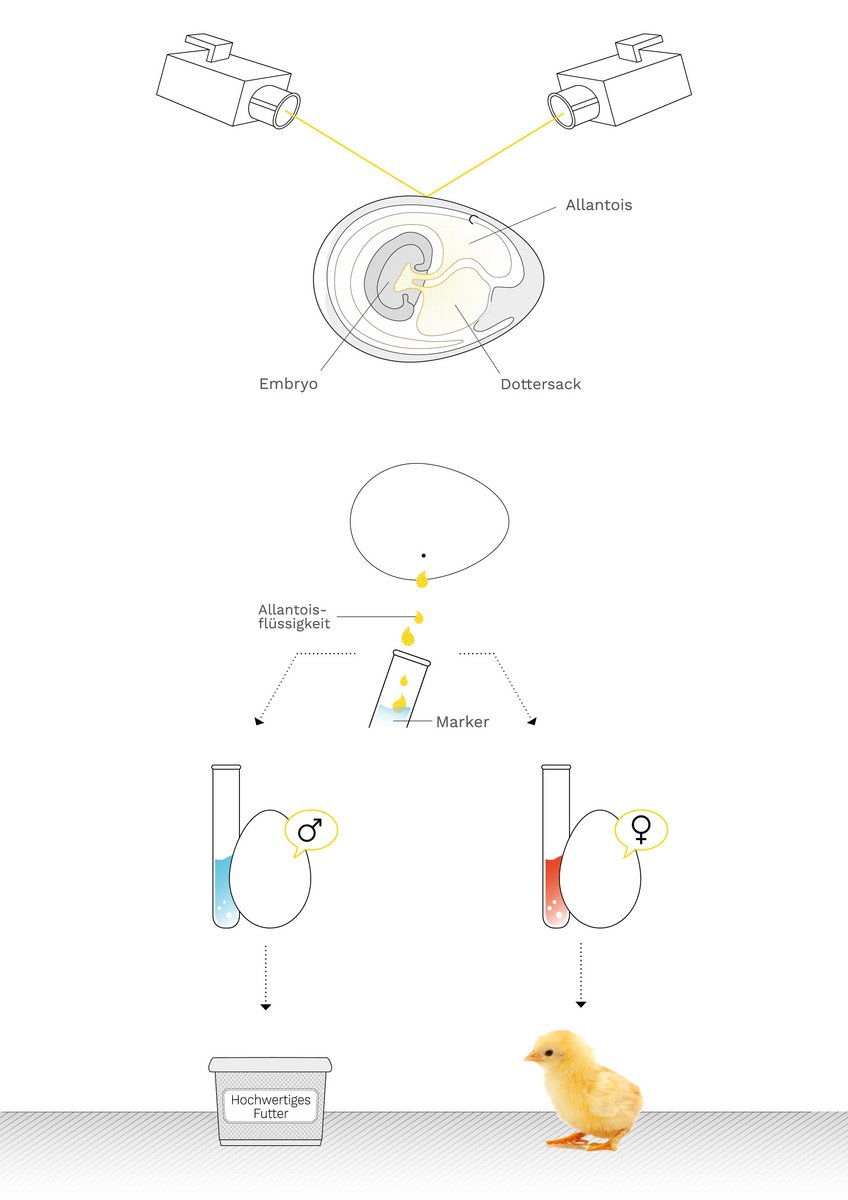
In this endocrinological procedure, the sex of the embryo is determined by detecting the sex hormone oestrone sulphate. To do this, a 0.5 mm hole is burned into the shell of the eggs using a laser on the 8th–10th day of incubation. A small amount of allantoic fluid is then extracted and mixed with a marker. The allantoic fluid consists of oxidised water and metabolic products produced during the embryo’s development. In female embryos, the sex hormone oestrone sulphate is produced, which can be detected by a colour change caused by the added marker. The visual marking facilitates the sorting of the eggs. Eggs containing female embryos are then incubated further, whilst eggs containing male embryos could be used for other purposes, such as feed production. According to research findings, the sex was determined with a reliability of 83.5%. The hatching rate of 80–87.8% is not adversely affected by the drilled hole.


Molecular biology technique
Sex determination through molecular biological analysis
Compared to mammals, the sex chromosomes of birds have evolved differently. As a result, in poultry, sex is determined by the hen’s egg cell rather than by the sperm of the male. This means that sexing sperm, as is done in cattle and pigs using sperm sexing, is not possible.
In the molecular biological method, a small hole is similarly burned into the eggshell on the 9th day of incubation and allantoic fluid is extracted. The sex-specific chromosomes are isolated and amplified and analysed using a molecular biological detection method, PCR (polymerase chain reaction). The reliability of this method is 99%. No data on the hatch rate is available.


Spectroscopic method
In the spectroscopic method, the eggs are incubated for approximately 4 or 13 days and the sex of the embryo is determined using laser-based measurement techniques.
Two different spectroscopic methods are currently under development:
Hyperspectral measurement technology
With this method, there is no need to open the egg. Instead, on the 13th day of incubation, the egg is shone through, similar to using a candling lamp, and the resulting light spectrum is analysed. The method can only be used with brown-egg-laying hens, as it relies on the difference in plumage colour between female (brown) and male (white) chickens.
Raman spectroscopy
On the 4th day of incubation, the air chamber within the egg is located using a thermal imaging camera, and a hole approximately 15 mm in diameter is cut into the eggshell using a laser, without damaging the egg membrane. Subsequently, a blood vessel of sufficient diameter is illuminated using a special procedure known as Raman spectroscopy. The scattering of certain light rays is specific to male and female animals and can therefore provide information on the sex of the embryo in the egg. Finally, the opening in the eggshell is sealed again using biocompatible adhesive tape. Research has shown a reliability of 90–93% and a hatch rate of 81–96%.

International research
Sex determination using biomarkers
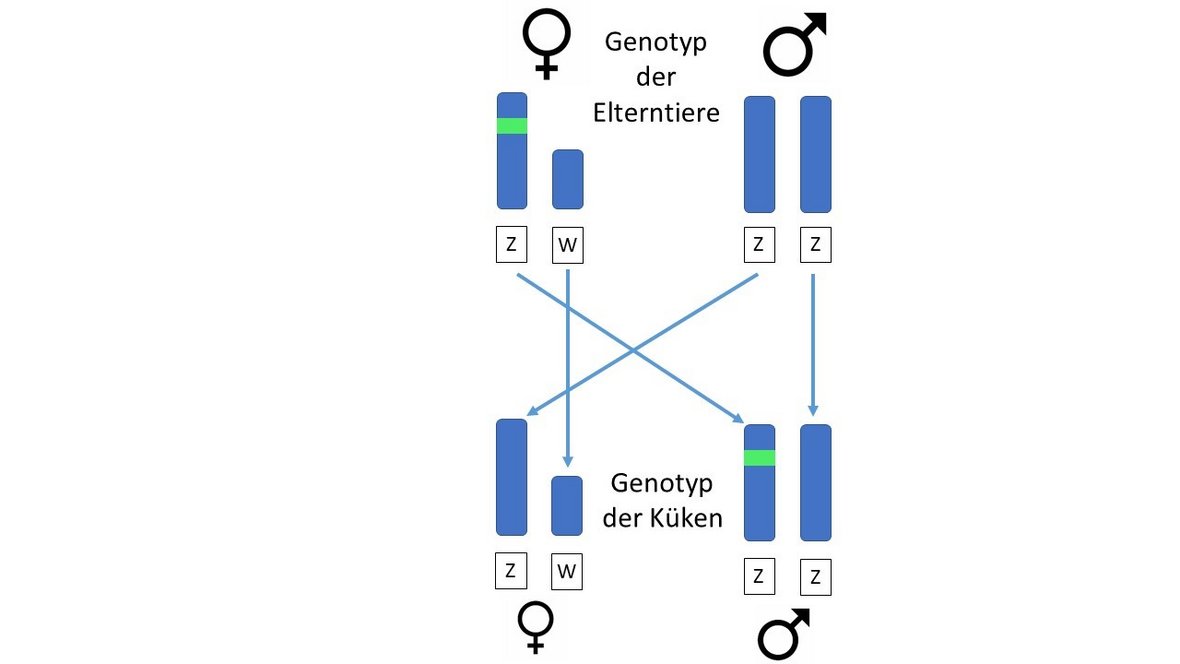
The Israeli company eggXYt is developing a completely different method that begins even before the actual incubation of the egg. Using CRISPR/Cas, a so-called gene-editing tool, a modification is made to the Z chromosome in the hens at the parental level (figure). Due to this molecular biological modification in the mother’s genome, the genetic material of the male chicks contains a biomarker. When the unincubated eggs are examined using UV light, similar to a candling lamp, the eggs from which male chicks would have hatched glow. These can therefore be sorted out before being placed in the incubator and used for other purposes. Meanwhile, the remaining eggs, from which female birds will emerge, can be incubated as usual and show no genetic modification. This method therefore not only prevents the killing of male day-old chicks, but also promises to double capacity in hatcheries and result in savings in staffing and energy costs.
In Europe, the CRISPR/Cas procedure and all genetically modified organisms resulting from it are subject to EU genetic engineering legislation. This means that genetically modified parent animals and the male offspring or eggs resulting from crossbreeding with these animals may only be placed on the market with authorisation and must be labelled as such. However, the same applies to female offspring and their eggs, which do not exhibit any genetic modification. According to EU Regulation No 1829/2003, Chapter II, Article 4 ‘Food produced from a GMO’, these are also subject to authorisation and labelling requirements.
A comparison of methods
Timing is crucial
The endocrinological method is already in use in hatcheries. Eggs from laying hens whose sex has been determined using this method have been on sale in German supermarkets since 2018. Eggs produced using the molecular biology method are also set to be sold in supermarkets by the end of 2020.
However, both methods have the disadvantage that they can only be used from the 8th or 9th day of incubation. Under the new draft legislation, they are therefore not viable long-term solutions. Hyperspectral measurement technology can only be used from the 13th day of incubation and can therefore also only be regarded as a transitional solution. Thus, Raman spectroscopy is currently the only method that meets the requirement for early use in the first trimester (up to day 7). At present, however, no date has yet been set for the market launch of this technology.
Outlook
Based on current knowledge, there is as yet no method available for determining the sex of an embryo that meets all the requirements set out above. The methods based on endocrinological and molecular biological techniques, which are already in use in Germany, only become effective in the second trimester of embryonic development. Consequently, if the draft legislation presented by the BMEL is implemented, they would no longer comply with the requirements stipulating that sex determination must take place by the 7th day of incubation from 2024 onwards.
The poultry industry is open to phasing out chick culling but criticises the short transition period for establishing new technologies and implementing alternative measures. Most organic associations, however, do not regard sex determination in the egg as a suitable alternative, as the culling of male chicks is merely postponed to an earlier stage. Instead, they advocate for the increased use of dual-purpose chickens to counteract selective breeding for broiler and layer breeds. Nevertheless, in organic egg production, up to 95% of eggs are currently still laid by hens whose male siblings were killed as day-old chicks.
Practical methods required by 2024
If no practical method is established by 2024, around 42 million male chicks will enter the market, for which suitable housing systems and marketing channels must be in place. New houses would be required for the rearing and fattening of the male birds; however, their construction is often preceded by lengthy planning permission procedures, which frequently result in rejection. Furthermore, marketing the male birds at the end of the fattening period presents a challenge. Due to their low slaughter weight and a carcass composition that deviates from the norm, large slaughterhouses and cutting plants have so far been reluctant to accept them. Small slaughterhouses are hard to find in Germany due to the high legal requirements. Furthermore, the carcasses of male broilers, which have a lower proportion of breast and thigh meat, can only be successfully marketed if consumers are also willing to pay higher prices for the products. Only in this way can the killing of male chicks be phased out in the future.
Although the poultry industry generally supports phasing out the killing of male chicks, the Central Association of the German Poultry Industry (ZDG) is currently calling for a longer transition period to allow for the development of practical solutions. The association points out that without appropriate solutions, this could result in increased imports of chicks from EU countries where there are no legal requirements regarding chick culling.
Furthermore, even if a suitable method of sex determination is found by 2024 that meets all current requirements, there are further concerns: the use of these technologies will entail increased investment costs and will therefore pose a major challenge, particularly for many of the small hatcheries that frequently produce birds for organic laying hen farming.
Parliamentary process launched
Following the cabinet’s decision, the parliamentary process will now begin to finally pass the BMEL’s amendment to the law. Opinions on this development vary widely. The Central Association of the German Poultry Industry has repeatedly criticised the short transition period until 2024 and describes the move as a “solo effort by the federal government” that fails to take into account the competitive disadvantages faced by the German poultry industry within the EU. From the perspective of the German Animal Welfare Association, legislation on chick culling is long overdue. Furthermore, the animal welfare organisation is calling for a return to dual-purpose chickens and a move away from “high-performance breeding”. Furthermore, in the opinion of the German Animal Welfare Association, the law contains a loophole whereby the killing of day-old chicks (650–750g live weight, <28 days old) is to remain permitted.
Further information
BMEL press release: Ban on chick culling to be introduced
Bibliography
- Federal Statistical Office (2020): Farms with laying hens and egg production in 2019 by farming system. www.destatis.de/DE/Themen/Branchen-Unternehmen/Landwirtschaft-Forstwirtschaft-Fischerei/Tiere-Tierische-Erzeugung/Tabellen/betriebe-hennen-eier-haltungsform-2019.html
- Krautwald-Junghanns, M.-E., Cramer, K., Fischer, B., Förster, A., Galli, R., Kremer, F., Mapesa, E. U., Meissner, S., Preisinger, R., Preusse, G., Schnabel, C., Steiner, G. and Bartels, T. (2018): Current approaches to avoid the culling of day-old male chicks in the layer industry, with special reference to spectroscopic methods. Poultry Science, 97, pp. 749–757.
- Federal Ministry of Food and Agriculture: Phasing out the killing of male chicks. www.bmel.de/SharedDocs/FAQs/DE/faq-kuekentoeten-beenden/FAQList.html (23 October 2020).
- Scientific Services, German Bundestag (2017): On the pain perception of chicken embryos. Department WD 8: Environment, Nature Conservation, Reactor Safety, Education and Research.
- SELEGGT GmbH (2020): The SELEGGT method. www.seleggt.de/seleggt-verfahren/ (23 October 2020).
- Weissmann, A., Reitemeier, S., Hahn, A., Gottschalk, J., Einspanier, A. (2013): Sexing domestic chickens before hatch: A new method for in ovo gender identification. Theriogenology, 80, pp. 199–205.
- Weissmann, A., Förster, A., Gottschalk, J., Reitemeier, S., Krautwald-Junghanns, M.-E., Preisinger, R., Einspanier, A. (2014): In ovo gender identification in laying hen hybrids: Effects on hatching and production performance. European Poultry Science, 78.
- Six, A. and Müller, B. (2007): Inheritance in chickens and waterfowl. Oertel+Spörer, 1st edition, Reutlingen.
- PLANTegg GmbH: In-ovo sex determination. www.plantegg.de (23 October 2020).
- Agri Advanced Technologies GmbH: in ovo, sex determination in the egg. www.agri-at.com/produkte/in-ovo (23 October 2020).
- Galli, R., Preusse, G., Uckermann, O., Bartels, T., Krautwald-Junghanns, M.-E., Koch, E., Steiner, G. (2016): In-ovo sexing of domestic chicken eggs by Raman spectroscopy. Analytical Chemistry, 88, pp. 8657–8663.
- Galli, R., Preusse, G., Schnabel, C., Bartels, T., Cramer, K., Krautwald-Junghanns, M.-E., Koch, E., Steiner, G. (2018): Sexing of chicken eggs by fluorescence and Raman spectroscopy through the shell membrane. PLoS ONE 13(2): e0192554
- ALDI SÜD (2020): We are ending chick culling! https://blog.aldi-sued.de/ohne-kuekentoeten/ (12 November 2020)
- eggXYt: Count your chickens before they hatch. www.eggxyt.com (23 October 2020).
- Court of Justice of the European Union (2018): curia.europa.eu/juris/document/document.jsf
- Regulation (EC) No 1829/2003 of the European Parliament and of the Council of 22 September 2003 on genetically modified food and feed https://eur-lex.europa.eu/legal-content/de/TXT/?uri=CELEX:32003R1829 (05.11.2020)
- Magazine for the Poultry Industry (2020): Strong words from the political arena. DGS Issue 40, Volume 72.
- Federal Agency for Agriculture and Food – Organic Farming Project Group (2020): Killing of chicks likely to be banned from 2022 – What does this mean for organic egg production? oekolandbau.de/landwirtschaft/tier/spezielle-tierhaltung/gefluegel/grundlagen-der-biogefluegelhaltung/kuekentoeten-voraussichtlich-ab-2022-verboten-was-bedeutet-das-fuer-die-oeko-eiererzeugung/ (26 October 2020)
- Magazine for the Poultry Industry (2019): Will the surprise egg soon be a thing of the past? – Currently a niche product. DGS Issue 05, Volume 71.
- Fränkische Nachrichten Verlags-GmbH (2020): Dual-purpose breeds are the goal. https://www.fnweb.de/fraenkische-nachrichten_artikel,-landwirtschaft-und-natur-zweinutzungsrassen-sind-das-ziel-_arid,1700188.html (28 October 2020)
- Zikeli, S., Schiffer-Weigand, K., Herold, P., Rautenschlein, S., Weigend, S. (2017): Dual-purpose chickens – the ideal solution or a dead end? Landinfo Issue 1, 2017, State Office for Agriculture, Food and Rural Affairs.
- Magazine for the Poultry Industry (2020): Don’t ignore the facts! DGS Issue 38, Volume 72.