
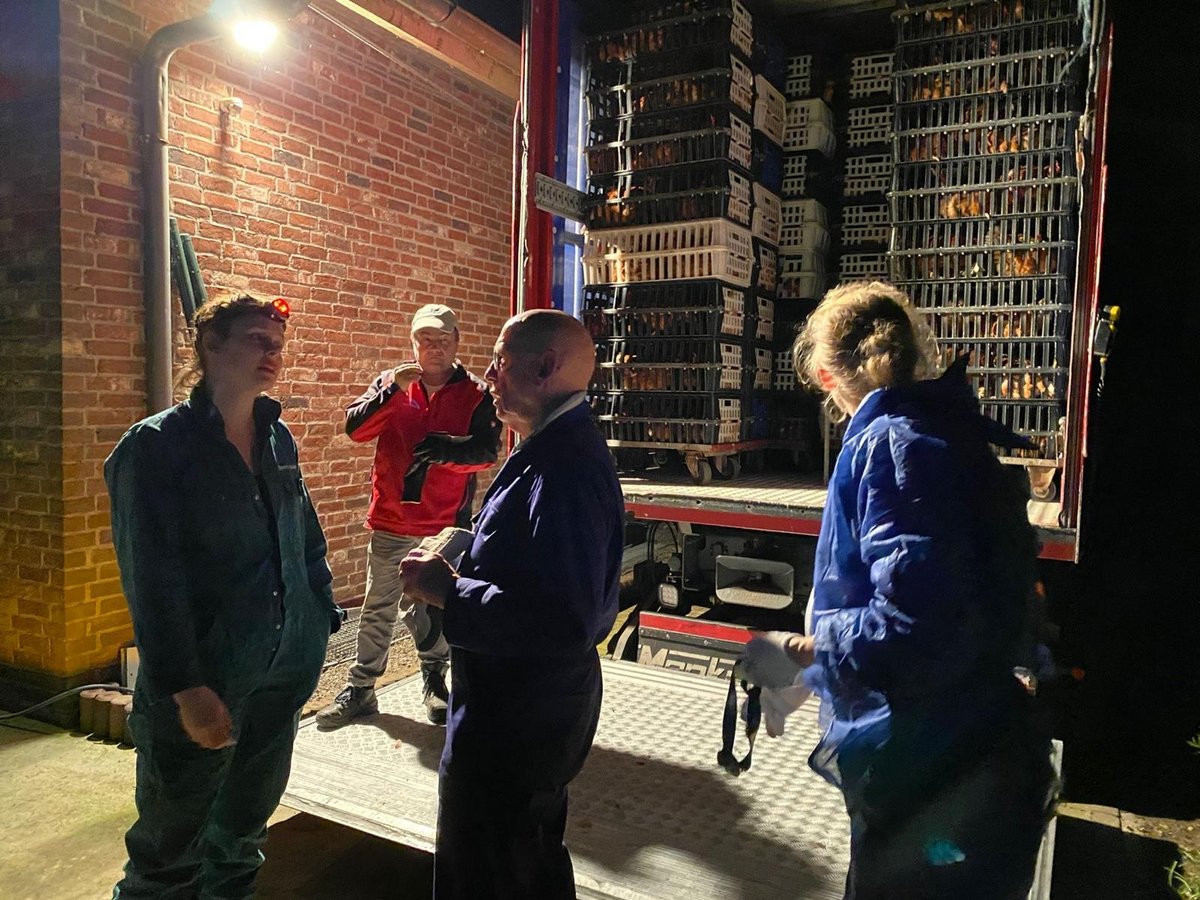
When laying hens reach the end of their production cycle after approximately 70 to 100 weeks of life, they are loaded into special transport crates (Fig. 1) by loading companies using so-called "catching teams" or by persons associated with the farm and then transported to the slaughterhouse.
If the animals are caught by external companies, it must be ensured that the crew leaders are qualified, trained and certified. In particular, this includes the animal keeper requesting the person responsible for the loading crew (the crew leader) or their deputy to present their certificate of competence. In addition, the catchers must have been instructed in the humane handling of animals during catching and loading (for Lower Saxony, see G8flSKRdErl [Poultry Expertise Circular] RdErl. d. ML v. 27. 9. 2022 - VIS 204-2642/2022). The name of the column leader and the names of all catchers must be recorded in writing. In addition, the column leader and the catchers must confirm their expertise before the start of the catch by signing, e.g. in the loading protocol (cf. loading protocol - Annex 7 of the GflSK8RdErl). Animal owners who carry out the catching and loading with their own workers are responsible for ensuring that these persons treat the animals in an appropriate manner that is humane to the animals. Section 2 No. 1 of the TSchG stipulates responsibility for the animals as long as they are on the farm. This also results in an obligation to be present during loading.

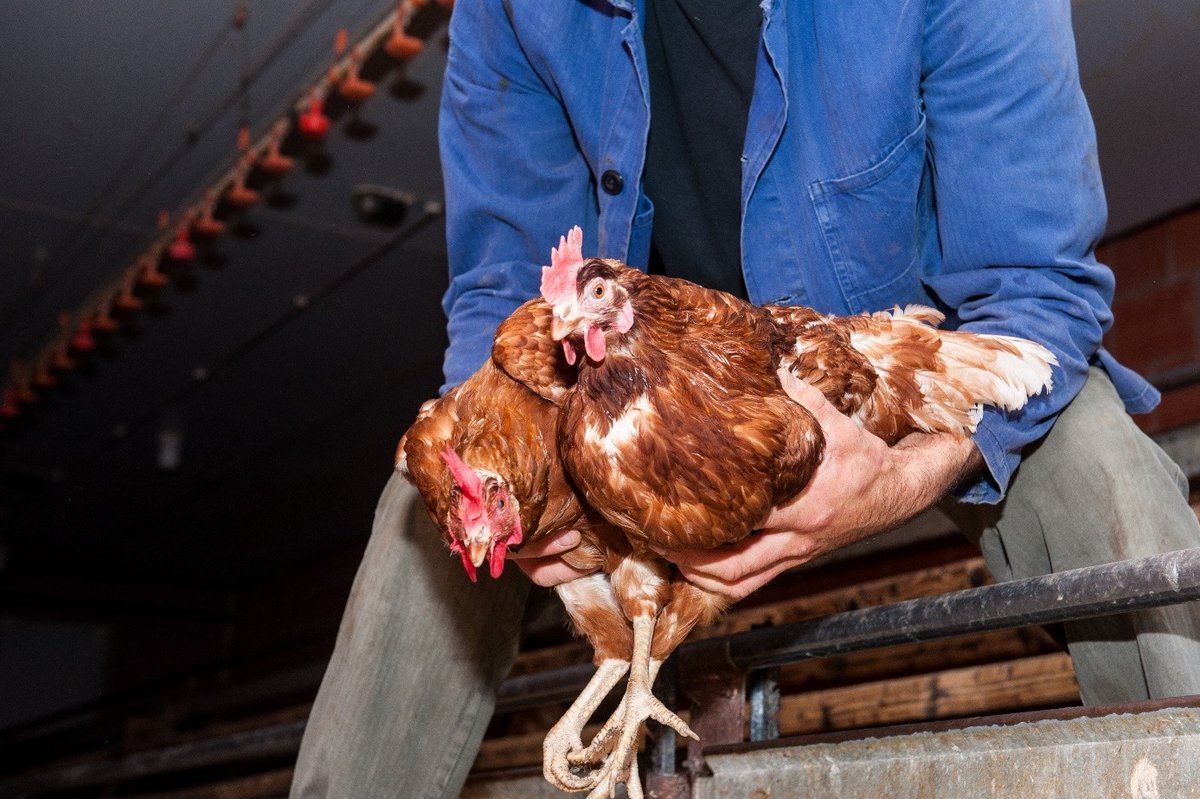
Laying hens are usually kept in aviaries, which is beneficial for animal welfare as it provides elevated levels for the hens to express their natural behaviours (Fig. 2). However, this housing system poses a challenge during removal from the coop due to the perforated levels in the coop and the limited space for humans to move freely. Catching, loading and transporting the animals causes16 them stress and physical strain. In order to cause the animals as little additional stress as possible, the so-called "removal" ideally takes place at night when the hens are in the housing system of the barn, or at least in a darkened barn. The catchers wear headlamps with blue lights to disturb the animals as little as possible while still being able to see.

In practice, the animals are currently usually pulled out of the aviary by one leg and placed upside down in pairs of 2 to 3 animals per hand (Fig. 3) into the transport crates, which can hold a varying number of animals depending on their weight and in consultation with the slaughterhouse. During hot spells, especially when transport times are long (over 8 hours), removal from the coop and transport should be13 postponed until the cooler night hours. If this is not possible, the loading density should be reduced by 10–20%. Close coordination with the receiving farm/slaughterhouse is necessary in this regard. Downtime and the resulting heat build-up for the animals must be avoided. If the collection lorry has its own fans, these should be used to cool the animals that have already been loaded; if necessary, additional fans belonging to the farm should be set8,9 up during loading.
As a rule, the animals are handed over by one catcher, who catches the animals from the individual levels of the aviary system, to another catcher, who in turn places the animals in the transport crates. In the case of laying hens, these can usually be filled from above and from the side (Fig. 1). Ideally, the crates should be placed close to the animals to keep the carrying distance short. However, due to the narrow design of many aviaries currently in use, this is often not possible in practice, so that the animals have to be carried overhead to the crates outside the animal area. After the animals have been caught, in the UK up to 10 filled crates are usually stacked on top of each other and loaded onto the lorry.
This established method is currently the subject of controversial debate, as it causes4,16 increased stress and a higher risk of injury to the animals. It is also argued that, due to the lack of a diaphragm in birds, the organs in the animals' abdominal cavity can shift into the chest cavity when they are carried upside down, which can4,5,6,12 compress the air sacs and thus impede breathing. This is currently still the subject of further research.
In addition, the natural grasping reflex of chickens makes it difficult to lift them up and remove them from the perches. When the animals sit on the perches, they reflexively grip the perch with their toes and only release it by straightening and stretching their legs. If this sitting position is released incorrectly, injuries can occur11. Conventionally caught animals also have a higher risk of injury to their legs16.
The aim of this article is therefore to provide an overview of the various methods of catching laying hens, taking into account animal welfare, economics and occupational safety. Although the article mainly refers to older hens, the same challenges apply to the loading and transport of young hens.

EU Regulation (EC) No 1/2005 defines the transport of animals as “the entire transport operation from the place of departure to the place of destination, including unloading, staging and loading at intermediate stops” (Chapter I, Article 2(j) of Regulation (EC) No 1/2005). Furthermore, the transport process includes “any movement of animals in one or more means of transport, as well as all related operations, including loading, unloading, transhipment and rest periods, until the animals have been unloaded at their destination” (Chapter I, Article 2(w) of Regulation (EC) No 1/2005). Pursuant to Article 3(1), first sentence, of Regulation (EC) No 1/2005, ‘no person shall carry out or cause to be carried out the transport of animals if such transport is likely to cause injury or unnecessary suffering to the animals’. Since, according to EU Regulation (EC) No 1/2005, transport includes loading and related operations, transport must not take place if suffering or injury could already occur at this stage. Furthermore, the Regulation is even more specific in this regard in Annex I, Chapter III, No 1.8(d), stating: “It is prohibited to hoist or pull animals by (…) … or to treat them in such a way as to cause them unnecessary pain or suffering.”
Catching animals in an upright position is likely to result in a longer catching time if staffing levels cannot be adequately increased. This would correspondingly increase the time the animals spend in the transport crates7. Unlike cattle and pigs, which may only be transported for eight hours or, in temperatures above 30 degrees, 4.5 hours respectively (“Farm animals (may) not be transported for longer than eight hours during domestic transport to a slaughterhouse. Notwithstanding the first sentence, transport must not exceed four and a half hours unless it is ensured that the outside temperature does not exceed 30 degrees Celsius at any time during transport.” (Animal Transport Ordinance § 10(1)), a period of 12 hours applies to poultry (“Poultry, domestic birds and domestic rabbits must be provided with suitable feed and fresh water in adequate quantities, unless the journey lasts less than a) 12 hours, not including loading and unloading time.” (EU Regulation (EC) No 1/2005, Annex I, Chapter V, Section 2.1a)). However, these 12 hours only begin when the loaded lorry leaves the farmyard and not, as with other farm animals, when the first animal is loaded onto the lorry, and end accordingly when the last animal leaves it. If the catching and loading of the hens using the upright catching method takes longer, the time spent in the transport crates and the associated restrictions are extended by the corresponding factor. At moderate temperatures, this can already lead to problems, as the animals have no access to water during this time and the period without feed is also extended accordingly. At extreme temperatures, such as those expected to occur more frequently in future due to climate change, the risk of heat and cold stress9 also increases.
Scientific classification
The AHAW (Scientific Panel on Animal Health and Welfare) of the EFSA (European Food Safety Authority) states the following regarding the current practice of overhead catching: “Turning birds upside down and carrying them by their legs increases the severity of handling stress with 90–100 per cent certainty and the risk of injury (dislocated joints, broken legs or wings, or bruising) compared to carrying birds in an upright position”.5
Presentation of various fishing methods in studies
Study from Switzerland
After Eyes on Animals (EoA) had introduced the Swiss Animal Protection Association (STS) to the concept of upright catching in 2023, the Research Institute of Organic Agriculture (FiBL), in collaboration with KAGfreiland, launched a project in the field of poultry slaughter in early 2024. The project, ‘Animal welfare until the last wingbeat’, aims to reduce stress in poultry from the time they are removed from the house until slaughter. Among other things, work is being done to optimise the removal of laying hens from the house by developing and testing gentler removal methods in practice, in collaboration with farmers. The results show that catching using the EoA method in houses with space for 2,000 birds takes 1.2–1.3 times longer than conventional overhead10 catching. To achieve this timeframe, the researchers note that the transport crates must be delivered by the abattoir the evening before and the aisles cleared of litter so that the crates, stacked on trolleys, can be wheeled directly to the aviaries. During catching, two catchers sat on the aviaries, grabbed the birds and handed them to the packers, who placed the adult hens upright in the crates. It should also be noted that the additional time mentioned above does not include the time required to fetch the crates in this trial. In the Swiss study, the farmer in question had already brought the crates into the barn the evening before, and the time required for this was not included14 in the additional time for catching.
Study from Belgium
In a study from Belgium, catching 1,000 hens using the upright catching method took around 1.72 times as long as overhead catching. Consequently, this catching method would be 1.8 times more expensive than overhead catching, which in the Belgian study would mean an additional cost of 0.05 ct per egg. For the birds, this also extended the time spent in the transport crates by the corresponding factor7.
Experiences from the Netherlands
Following a lawsuit brought by the Dutch animal welfare organisation ‘Wakker Dier’ at the Rotterdam District Court in 2022, the court ruled that poultry must henceforth be caught in an upright position and taken to the transport crates (ROT 22/2933, 22/2935, 22/12936). The animal welfare organisation “Eyes on Animals” is already training loading companies and farm-based catching staff in the upright catching method. In this method, a maximum of two hens are lifted simultaneously by grasping their wings and breast and carried upright into the side opening of the transport crate (Fig. 4).
To reduce the time required for upright catching, various methods are currently being investigated to bring the time taken as close as possible to that of overhead catching.
Case studies on various fishing methods
Capturing the birds using a cold pen and overhead transport to the lorry
Two to four days before the planned removal from the house, the hens are fed increased amounts of wheat grains in the cold pen to increase the number of birds there. On the day of slaughter, in free-range systems, the flaps to the outdoor run are kept closed so that the birds can only remain in the cold-weather pen and the aviary system. Due to the requirement for fasting prior to loading for slaughter14, the birds have no access to feed, but must have access to water until shortly before removal from the house (§13(5)(3) TierSchNuztV).
With this method, the older hens are easier to locate in the cold-scratching area, where there are no hiding places, allowing for a calmer handling of the animals during capture. Furthermore, the risk of injury to the animals in the cold-scratching area is reduced as the grasping reflex does not activate, since the older hens sit on the floor rather than on the perches in the aviary.
However, as some hens remain in the cold-weather room for an extended period, the stocking density per square metre (sq m) of barn floor space is usually significantly higher and exceeds the legally prescribed limits. This also applies to the watering and feeding situation, particularly during the waiting period in the cold-scratching area prior to loading, meaning that the requirements of the Animal Welfare Ordinance (TierSchNutztV) to ensure all hens have permanent free access to water (and feed) cannot be met. Furthermore, with this method too, hens are housed in the aviary system, so they must be caught using conventional methods.
If it is not yet completely dark when loading begins, e.g. in summer, it is advisable to artificially darken the house or catching area. However, this poses challenges for farms when catching in the cold-weather pen, as a very large area of the house’s outer wall would need to be darkened. In addition, the full crates must be transported to the lorry, which would require the gate or door to be darkened. Furthermore, the birds must be herded into small groups with solid, dark walls, made of, for example, joined multiplex panels, to facilitate catching. Particularly if the barn cannot be darkened, this can quickly lead to restlessness and escape attempts by the animals. It should also be noted that not all herds can be caught equally well in this manner. In as yet unpublished trials conducted by the Lower Saxony Chamber of Agriculture, it was found that, for example, brown herds are significantly easier to catch in the cold pen than white herds.
If the crates are not brought directly to the animal, this method still presents the problem that the animals must be caught at two or just one post and carried to the crates.
Capturing animals in the cold storage room using crates attached to the animals
In principle, the same points apply to this method as described above. To make the capture of animals in the cold storage room more animal-friendly by avoiding overhead capture, it is advisable to unload the transport crates from the lorry and place them in the immediate vicinity of the animals to be captured. On the one hand, this reduces transport distances, meaning that the capture team has to walk less and their working hours can be shortened. Secondly, this makes it easier for a single person to catch the animals in an upright position and place them upright into the crates in the next step. Studies show7,10,11,15 that when caught in an upright position, the animals flap their wings less and appear calmer overall. As the crates are positioned in the immediate vicinity of the capture site, there is no need to hand the animals over to a second trapper or transfer them to the lorry.
Catching the birds in the aviary with the upper and lower levels cordoned off
To keep the birds in their familiar surroundings, the upper and lower levels are cordoned off in some aviaries as an alternative trapping method. The birds are then caught in the aviaries as usual. Cordoning off the upper level of the aviary significantly improves occupational safety for the trapping staff, as there is no need to climb onto the aviary. However, it is not possible to block off the upper level in all aviaries. Furthermore, it is easier to catch the animals upright using both hands, as one hand is not needed to hold onto the aviary. Blocking off the lower level, on the other hand, is also widely practised in Germany.
In Germany, when both levels are blocked off, the problem arises of the maximum stocking density permitted under the Animal Welfare Ordinance (TierSchNutztV) being temporarily exceeded due to the reduction in usable housing space, including perches, as well as the required number of feeding and drinking stations falling short. Although the hens largely remain in their familiar surroundings, this method can also cause stress due to the blocked access to the regular perching areas.
Capturing the animals whilst they are standing upright in the aviary
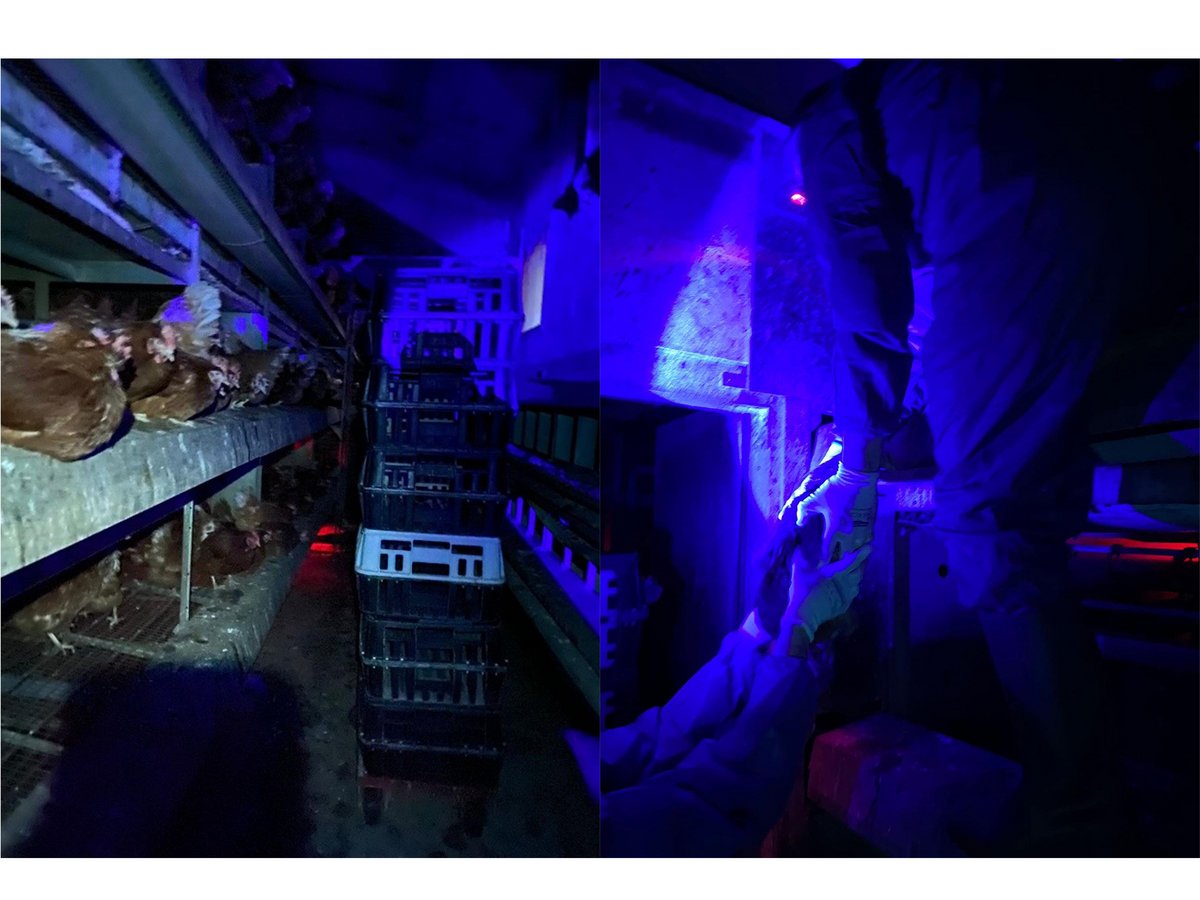
With this trapping method, the animals remain in their familiar surroundings and, as all perches remain permanently accessible, there is no conflict with the Animal Welfare Ordinance due to excessive stocking densities. If it is logistically feasible and the crates can be placed close to the animals (Fig. 4, left), this reduces the time during which the animals have direct contact with the trapping staff. The birds also appear to be6,10,11,15 calmer during capture. However, in very deep aviaries, it is not always possible to grasp all hens upright from the front if they are at the back of the aviaries. Consequently, an additional person must be positioned between the front of the aviary and the nests to catch the birds and pass them forwards whilst turned sideways. This increases the risk of injury, for example, from hens or staff becoming caught in the mesh. Furthermore, there is a risk of crushing injuries due to passing the birds forwards within the confined systems. The upper level is also sometimes too narrow to catch the birds completely upright. As described earlier in the Swiss study, with this method of manual catching, at least one catcher climbs to the top level of the aviary and passes the birds downwards (Fig. 4, right). Whilst technical systems with lifting platforms are available here too, these are rarely used for structural or economic reasons.
With conventional catching, it is possible to hold onto the aviaries with one hand; however, this is not possible when catching birds in an upright position with both hands, which can pose a problem for occupational safety.
Economic context
Due to the hens’ agility and the structural limitations of the winter runs, hens are placed in their pens by hand rather than using catching machines, as is common in broiler and turkey rearing.
Whilst the descriptions of the methods presented focused primarily on animal welfare and occupational safety, a frequent argument against upright catching is that it is too expensive. The Belgian study estimated the additional cost per egg at 0.05 cents7, which would be negligible. However, as this study was conducted in Belgium, the results may not be directly applicable to conditions in Germany. Furthermore, in this calculation method, the additional costs of upright catching – comparable to the rearing of male chicks or sex determination in the egg – are again passed on to the egg price. Currently, a mature hen yields around 25–38 cents per kg live weight (LWK Lower Saxony, Market Division). Conventional catching currently costs around 25 cents per bird, whilst upright catching costs up to 50 cents per bird. Prices for catching and loading vary considerably. Depending on staffing requirements and staff experience, the type of aviary, the size of the flock and any associated staff fatigue, catching and loading can take varying lengths of time, which influences the catching costs.
Conclusion
It should be noted that the conventional overhead catching method is currently the subject of controversy following the Rotterdam ruling (ROT 22/2933, 22/2935, 22/12936) and the 20224 EFSA study. As described, there are various animal welfare concerns regarding current catching and loading practices for older ewes. For many farms, the question also arises as to how upright catching can be financially implemented, given the usual flock sizes, the high time and cost pressures, the low value of older hens, and the aviaries and other housing systems, some of which are heavily built-up and vary greatly, whilst also taking occupational safety into account.
Furthermore, the expected increase in the time spent by the old hens in the cr7ates (Swiss study) must be critically questioned, at least if the number of catching staff remains the same, given the already sometimes very long journeys to the slaughterhouse, particularly in extreme weather. Increasing the number of catching staff to reduce this time would further increase the costs of catching, but could reduce the time factor.
With all known catching methods, the physical strain on loading staff is significant and must also be factored into the calculation of staffing levels.
A look to the future
All these issues must be given greater consideration in future when planning new aviary facilities. One possible approach for the future would be to position the crates as close as possible to the animal in every case and to deploy more staff for catching. All animals that can be easily caught in an upright position should be caught in this way. For animals that cannot be caught in an upright position, they are grasped by two legs above the tarsal joint and, where possible, supported at the sternum. This automatically results in a reduction in the number of animals to be caught per hand. For all catching methods, the top priority should be on catching at night and within the system, as well as adequate training of staff: It is necessary to raise awareness among support staff and ensure the barn is properly prepared. Manure and bedding must be removed from the barn and the cold-weather pen cleared so that the crates can be pushed on trolleys through the passageways to the animals in the enclosure and then transported away again from there. Good preparation and organisation of the catching process ultimately benefit both humans and animals.
Bibliography
- Rotterdam District Court (24 November 2022) ROT 22/2933, 22/2935, 22/2936
- Calistri P, Canali E, Drewe JA, Garin-Bastuji B, Gonzales Rojas JL, Gortázar Schmidt C, Herskin M, Michel V, Miranda Chueca MA, Padalino B, Roberts HC, Spoolder H, Stahl K, Viltrop A, Winckler C, Mitchell M, James Vinco L, Voslarova E, Candiani D, Mosbach-Schulz O, Van der Stede Y and Velarde A, 2022. Scientific Opinion on the welfare of domestic birds and rabbits transported in containers. EFSA Journal 2022; 20(9):7441, 188 pp. https://doi.org/10.2903/j.efsa.2022.7441
- German Animal Welfare Association (Deutscher Tierschutzbund e.V.), c/o Academy for Animal Welfare. Catching chickens during depopulation: Legal assessment and areas of action for veterinary authorities https://www.tierschutzbund.de/fileadmin/Seiten/tierschutzbund.de/Downloads/Sonstiges/Fangen_von_Huehnervoegeln_juristische_Ausarbeitung_Deutscher_Tierschutzbund.pdf
https://www.gefluegelnews.de/article/aufrecht-statt-kopfuber-fangen - EFSA AHAW Panel (EFSA Panel on Animal Health and Animal Welfare), Nielsen SS, Alvarez J, Bicout DJ, Calistri P, Canali E, Drewe JA, Garin-Bastuji B, Gonzales Rojas JL, Gortázar Schmidt C, Herskin M, Miranda Chueca MA, Padalino B, Pasquali P, Roberts HC, Spoolder H, Stahl K, Velarde A, Viltrop A, Winckler C, Estevez I, Guinebretière M, Rodenburg B, Schrader L, Tiemann I, Van Niekerk T, Ardizzone M, Ashe S, Hempen M, Mosbach-Schulz O, Gimeno Rojo C, Van der Stede Y, Vitali M and Michel V, 2023. Scientific Opinion on the welfare of laying hens on farm. EFSA Journal 2023; 21(2):7789, 188 pp. https://doi.org/10.2903/j.efsa.2023.7789
- EFSA AHAW Panel (EFSA Panel on Animal Health and Welfare), Nielsen SS, Alvarez J, Bicout DJ, Calistri P, Canali E, Drewe JA, Garin-Bastuji B, Gonzales Rojas JL, Gortázar Schmidt C, Herskin M, Michel V, Miranda Chueca MA, Padalino B, Roberts HC, Spoolder H, Stahl K, Viltrop A, Winckler C, Mitchell M, James Vinco L, Voslarova E, Candiani D, Mosbach-Schulz O, Van der Stede Y and Velarde A, 2022. Scientific Opinion on the welfare of domestic birds and rabbits transported in containers. EFSA Journal 2022; 20(9):7441, 188 pp. https://doi.org/10.2903/j.efsa.2022.7441
- Eyes on Animals (website) https://www.eyesonanimals.com/wp-content/uploads/pdf/Huhner-einfangen.pdf
- F. Delanglez, A. Watteyn, B. Ampe, V. Segers, A. Garmyn, E. Delezie, N. Sleeckx, I. Kempen, N. Demaître, H. Van Meirhaeghe, G. Antonissen, F.A.M. Tuyttens, Upright versus inverted catching and crating end-of-lay hens: a trade-off between animal welfare, ergonomic and financial concerns, Poultry Science, Volume 103, Issue 10, 2024, 104118, ISSN 0032-5791, https://doi.org/10.1016/j.psj.2024.104118
- GflSKRdErl [Circular on Poultry Expertise] Circular of the Ministry of Agriculture dated 27 September 2022 - VIS 204-2642/2022 (GflSKRdErl,NI - Circular on Poultry Expertise | Lower Saxony Regulatory Information System (NI-VORIS)
- Gickel, J.; Visscher, C.; Kemper, N.; Spindler, B. Analysis of the Broiler Chicken Dead-on-Arrival (DOA) Rate in Relation to Normal Transport Conditions in Practice in Germany. Animals 2024, 14, 1947. https://doi.org/10.3390/ani14131947
- Haug, Sarah (2024). HUMANE DE-STALLING OF LAYING HENS. kagMagazin (4). 3-5. gzdk_kag2411_magazin_04-24.pdf
- STS Farm Animal Competence Centre, STS Swiss Animal Welfare Inspection Service (2020) Culling laying hens: practice and alternatives. https://kontrolldienst-sts.ch/images/Dokumente/Schulunterlagen/Merkblaetter/mb_ausstallen_legehennen.pdf
- Maisack, Dr Christoph (02.2024) Remarks on the panel discussion organised by the German Animal Welfare Association (Deutscher Tierschutzbund e. V.) as part of Green Week 2024 on 24 January 2024: Approaches to more animal-welfare-friendly methods of catching broiler chickens and laying hens https://djgt.de/wp-content/uploads/2024/02/24_01_25_Maisack_DTB_Podiumsdiskussion_Tragen_v_Gefluegel_ueberkopf.pdf
- Lower Saxony Ministry of Food, Agriculture and Consumer Protection (2019). Information sheet on preventing heat stress in laying hens and pullets. https://www.laves.niedersachsen.de/startseite/tiere/tierschutz/tierhaltung/geflugel/vermeidung-von-hitzestress-bei-gefluegel-144675.html#:~:text=The%20following%20guidance%20notes%20have%20been%20updated%20to%20prevent%20heat%20stress,in%20line%20with%20the%20Lower%20Saxony%20Animal%20Welfare%20Plan.%20Guidelines%20from%20the%20Lower%20 Saxony
- Lower Saxony Ministry of Food, Agriculture and Consumer Protection (2016). Guidelines on the loading of laying hens, parent stock and pullets. Guidelines on the loading of laying hens, parent stock and pullets_as_of_21_06_2016 (not fully accessible) - Download (PDF, 0.04 MB)
- Project description “Poultry slaughter – Stress reduction from removal from the house to death” (https://www.fibl.org/de/themen/projektdatenbank/projektitem/project/2519)
- Smith, K. C., & Pierdon, M. K. (2023). Impact of mechanical vs. manual catching on stress, fear, and carcass quality in slower growing broilers. Journal of Applied Animal Welfare Science, 1–8. doi.org/10.1080/10888705.2023.2254226
- Animal Welfare and Livestock Husbandry Ordinance (TierSchNutztV), as amended by Order of 22 August 2006, Federal Law Gazette I, p. 2043; last amended by Article 1a of the Order of 29 January 2021, Federal Law Gazette I, p. 146
- Council Regulation (EC) No 1/2005 of 22 December 2004 on the protection of animals during transport and related operations and amending Directives 64/432/EEC and 93/119/EC and Regulation (EC) No 1255/97
https://eur-lex.europa.eu/legal-content/DE/TXT/PDF/?uri=CELEX:32005R0001 - Regulation on the protection of animals during transport and implementing Council Regulation (EC) No 1/2005 (Animal Welfare Transport Regulation – TierSchTrV) l_00320050105de00010044.pdf