

With increasing weather extremes and high temperatures in summer, it is becoming increasingly important to implement the right measures in poultry houses to protect the health and welfare of the animals. This involves not only taking immediate action when critical temperatures are reached, but also taking the right precautions in advance, for example by installing suitable technical equipment.
Animal signals and consequences
Poultry do not have sweat glands and are therefore only able to cool themselves down to a limited extent in summer when temperatures are high. Animals suffering from heat stress can be recognised by panting, a reddened scalp and spreading their wings to achieve better air circulation around the body. The animals react by becoming less active, increasing their water consumption and reducing their feed intake. In turkeys, for example, this can mean a reduction in feed intake of up to 30%. This can lead to a cessation of egg-laying in laying hens and reduced growth performance in broilers and turkeys. Heat stress can also lead to outbreaks of feather pecking and cannibalism, particularly in young and laying hens. In broilers, severe heat stress also results in increased losses due to circulatory failure. Characteristic signs of this include blue-coloured combs and fluid or regurgitated feed oozing from the beak.
Key parameters
In addition to direct animal signals, measured values such as outdoor and house temperatures, humidity and the enthalpy value are important parameters for assessing heat stress. The enthalpy value is of particular importance in this context, as it describes the thermal load of the air and thus combines temperature and humidity. Farmers can, for example, check the enthalpy values for the coming days on the German Weather Service website (Weather and Climate – German Weather Service – Services – Heat Stress in Poultry (dwd.de)). Furthermore, specific management apps for poultry now also offer this service with an additional alert function for high enthalpy values.
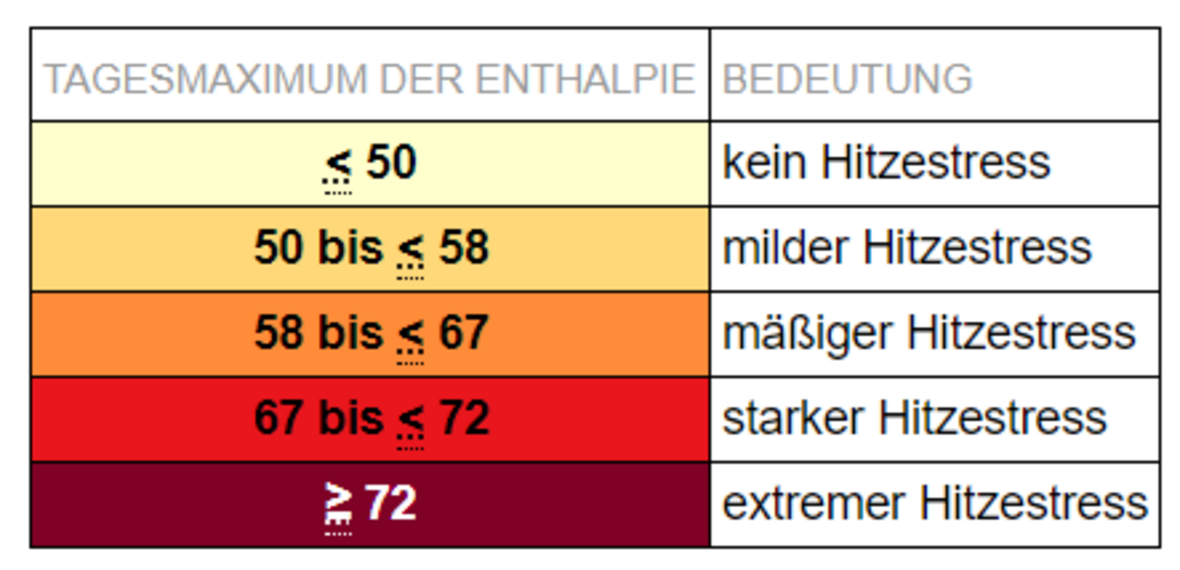
From an enthalpy value >50 kJ/kg, mild heat stress occurs in poultry (Figure 2). At 70% humidity, this corresponds to a temperature of just 22 °C. Severe heat stress is defined as an enthalpy value exceeding 67 kJ/kg (e.g. 70% humidity, 27°C).
Various measures can be taken to prevent the adverse effects of heat stress in poultry. These include, amongst other things, cooling the house, lowering the temperature of the drinking water and adjusting the feeding regime.
Measures for the house climate
Particularly during the summer months, key components of the ventilation system must be checked regularly. These include, for example, the alarm system, the fans, the air inlets and other cooling systems.
Automated systems adjust the air velocity in the house when temperatures rise. As the house temperature increases, the air velocity is also increased to achieve a higher air exchange rate. For poultry, an increase in the air exchange rate of up to 4.50 m³/h/kg live weight is recommended. Examples of rates depending on live weight can be found in the following table:
| Animal weight | Air exchange rate |
|---|---|
| Laying hen weighing 1.8 kg | 8.1 m³/h |
| Broiler chicken weighing 1.5 kg | 6.75 m³/h |
| Turkey weighing 21.0 kg | 32.4 m³/h |
| Duck weighing 13.2 kg | 14.4 m³/h |
<figcaption>Table 1: Examples of air exchange rates depending on live weight</figcaption>
During periods of extreme heat, the air exchange rates for turkeys can be increased to up to 6 (hens) or 7 (cocks) m³/h/kg live weight. Alternatively, stocking densities can be reduced to improve air exchange in the house.
In the event of significant fluctuations between day and night temperatures in summer, the ventilation control range should be adjusted. This is because, in the event of a rapid drop in temperature in the evening, the ventilation must also be adjusted promptly to avoid supplying cold air to the house for prolonged periods. This can result in diseases such as E. coli infections. The inertia with which the ventilation system operates must therefore be reduced in summer. However, it is recommended not to set the control range below 3°C, as slight temperature fluctuations could otherwise lead to unstable airflow.
In addition to the air exchange rate, cooling effects can also be achieved by directly increasing the air velocity in the animal area (see Table 2). An air velocity of >3.0 m/s at animal level must be avoided. Easy-to-use and cost-effective anemometers or flow meters can assist in determining the air velocity.
| Air velocity in m/s | Cooling effect in °C |
|---|---|
| 1.25 | 3.33 |
| 2.50 | 5.56 |
<figcaption>Table 2: Example of the cooling effect when air velocity is increased</figcaption>
In addition to regulating ventilation, a cooling effect can also be achieved by humidifying the barn air. This can be achieved by directly humidifying the barn using a spray system or by humidifying the supply air (e.g. with pad cooling systems). To avoid creating tropical conditions, air humidification should be avoided when relative humidity is high (> 80% RH). Mobile housing systems rarely have an automated ventilation system and must resort to other methods. Here, for example, the internal temperature can be lowered by humidifying the barn roof using sprinkler systems or manual watering with a hose. To create a draught in the barn, the barn windows or hatches can be opened on two opposite sides. However, care must be taken to avoid the development of excessive air speeds or draughts at the animals’ level.
Management measures for watering
As temperatures rise, water intake in poultry increases significantly. Access to fresh and cool water (10–15°C) should be guaranteed at all times and can be achieved by regularly flushing the drinking water pipes. Particularly when spray cooling is in operation at the same time, sufficient pressure in the drinking water pipes must be ensured. Water consumption can be easily monitored using built-in water meters. Deviating values are an important indication of problems in the house. During heatwaves, additives such as vitamin C, vitamin E, selenium and yeast can be added to the drinking water in consultation with the vet. The animals’ panting causes increased CO₂ release. This can lead to respiratory alkalosis with an electrolyte imbalance. The addition of electrolytes (containing table salt, bicarbonate and glucose) can help to remedy this.
Management measures for feeding
In addition to reduced feed intake, the digestibility of important nutrients such as amino acids, calcium, sodium and phosphorus also decreases. Furthermore, less energy can be obtained from the feed. For successful growth, the supply of amino acids must above all be ensured. However, this should not be achieved by increasing the crude protein content in the feed, as the breakdown of excess nitrogen requires energy expenditure on the part of the animal. Instead, the aim is to provide a supply tailored to the animals’ needs through the targeted supplementation of individual amino acids. To ensure an adequate energy supply during hot spells, a higher proportion of fat can be added to the feed instead of carbohydrates. Compared to the breakdown of carbohydrates, the breakdown of fat generates less heat and therefore places less strain on the animals.
Various additives can also be administered to the birds via the feed to support growth at high temperatures and stabilise their circulation. Vitamins A, D, E, C and B-complexes, as well as selenium, sodium bicarbonate and/or potassium chloride, can be used.
| Additives | Amount per kg/DM |
|---|---|
| Vitamin C | 250–500 mg |
| Vitamin E | 500 mg |
| Selenium | 0.3–0.5 mg |
<figcaption>Table 3: Recommendations for the dosage of selected additives in laying hens</figcaption>
Adjusting feeding times on hot days can be particularly helpful for broiler poultry. Shifting feeding times to the cooler morning or evening hours can ease the strain on circulation and metabolism.
The following fact sheets and specialist articles provide further information and practical tips on preventing heat stress in pullets, laying hens, broilers, turkeys and Peking ducks:
Factsheets from the Lower Saxony Ministry of Food, Agriculture and Consumer Protection
Heat stress in poultry, Rural Service Centre
Preventing heat-related damage in farm animals (poultry, pigs, cattle) Information sheet No. 100