
(Image: Prof. Dr Robby Andersson, Osnabrück University of Applied Sciences)
(Image: Prof. Dr Robby Andersson, Osnabrück University of Applied Sciences)
Animal-friendly lighting in poultry houses
Birds have a very different visual perception to us humans. But how do chickens, turkeys and other poultry perceive their surroundings? And what sort of lighting should there be in the barn to ensure the animals feel comfortable? An event organised by the Fokus Tierwohl network shed some light on this topic.
To answer this question, we first need to clarify what light actually is, say Prof. Dr Robby Andersson and Louisa Reimers from Osnabrück University of Applied Sciences as they begin the webinar. For all living beings, light is the part of the electromagnetic spectrum that can be perceived by the eye. However, the structure of the eye determines which wavelengths a living being can perceive. The rods and cones in the eye are responsible for this. The cones are responsible for colour vision, whilst the rods are responsible for black-and-white or brightness vision.
“Birds see the world differently from us,” explains Mr Andersson. But how does the perception of birds differ from that of humans? A key difference can already be found in the structure of the eye.
For humans, the visible wavelengths of light range from 380 to 780 nm. This part, which is visible to us, is called the light spectrum. The light visible to us is composed of the three primary colours: red, green and blue.
Birds can perceive a wider light spectrum
Unlike humans, birds have 5 types of cones instead of 3. As a result, the light spectrum visible to birds ranges from 320 nm to 780 nm, and in addition to red, blue and green, they can also perceive the UV range and iridescent colours. Another difference is that humans can only perceive around 50 Hz (frames per second), whereas for birds this is well over 120 Hz. Depending on which colour is more prominent, the light appears to us as either warm or cool. The light colour is often specified in Kelvin (K) for luminaires. In terms of light colour, light between 3300 and 5000 K is considered neutral white, 2000 to 3300 K as warm white and > 5000 K as cool white or daylight white. However, this perception of light properties does not apply to poultry.
The many differences in perception between humans and poultry are reflected in the animals’ requirements for artificial light in the barn, explains the expert. Whilst we, for example, can still read well in semi-darkness, poultry may no longer be able to see anything because the parts of the light that are important for them, such as UV-A, are no longer present. This is because if the UV component is missing from the light, it appears much darker to birds than it does to humans. The opposite is true when the light contains a UV component. In that case, it is much brighter for birds than for us humans, as we cannot perceive UV light. Consequently, colour specifications and brightness in standard units of measurement are meaningful only for humans, but not for poultry.
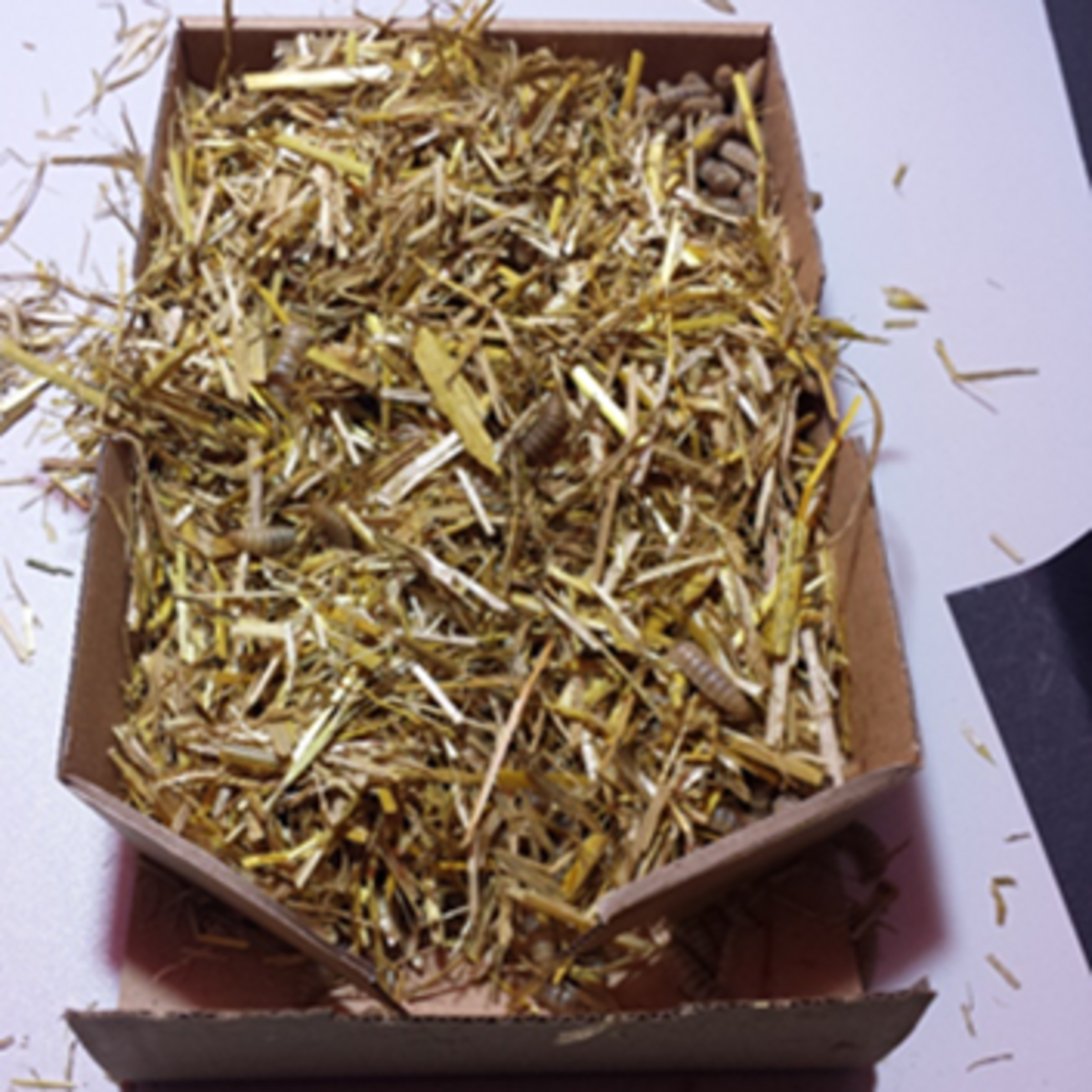
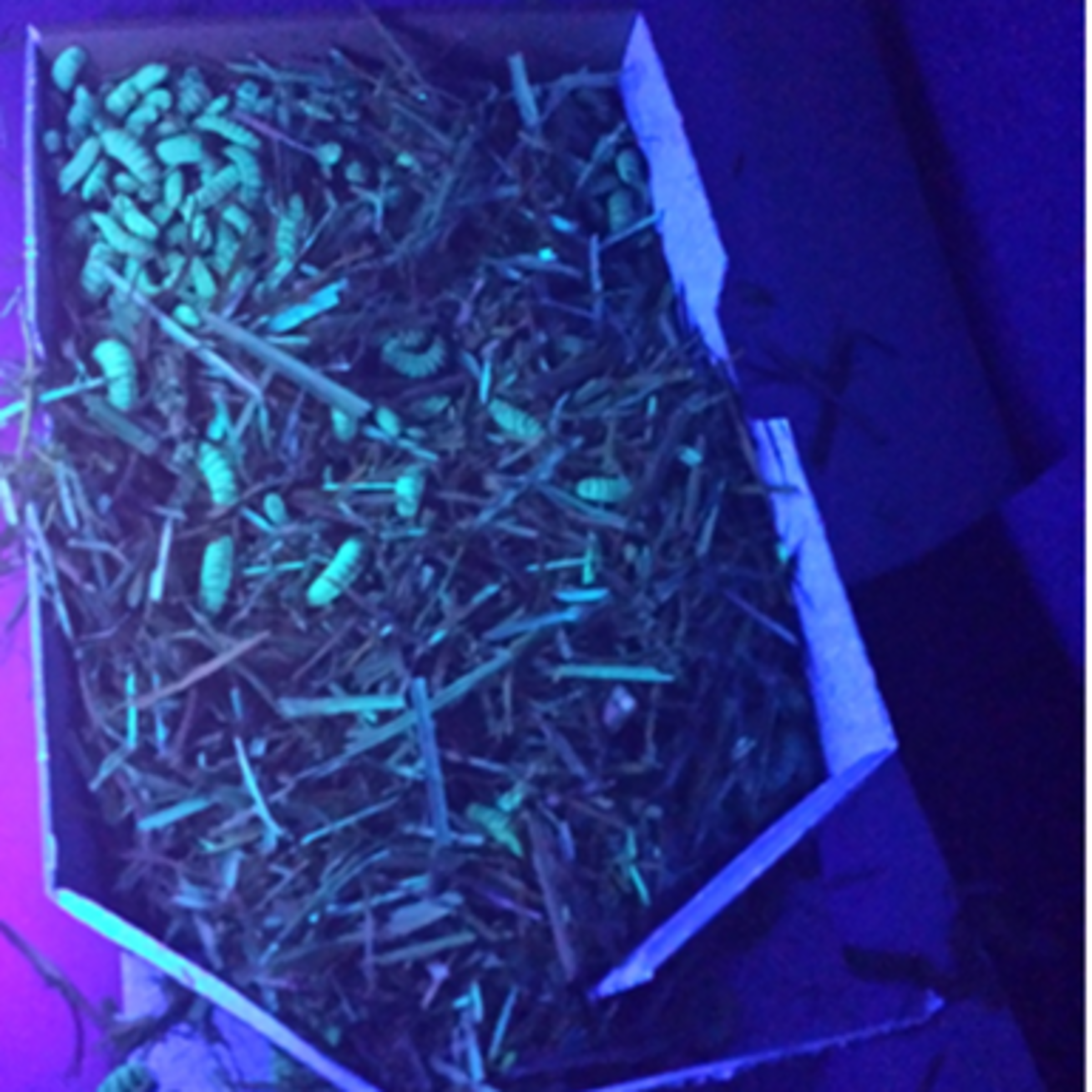
The UV-A component in the light also helps poultry to detect moisture more effectively. Consequently, worms in straw, for example, stand out much more clearly than they do to us humans (see illustrations).
Composition of light
Prof. Dr Andersson has conducted site studies, amongst other things, on the composition of natural light. We perceive things differently at every location and at every time of day. If you look at the same location at midday and in the evening, for example, the colours appear quite different in each case. The same applies when the sun is shining or it is cloudy, or when you are standing in the open air or in the forest beneath a canopy of leaves. This is because different colours are reflected, filtered and thus perceived in each case. As an example, consider a yellow pen under coloured light. When viewed under green light, it appears rather greenish, whereas under red light it appears rather reddish.
To investigate the UV-A content of the natural habitats of various poultry species, measurements were carried out in thicket and under the open sky. The former is intended to represent the habitat of chickens in the jungle, and the latter the steppe as the habitat of turkeys. These measurements revealed that the UV-A component in thicket is around 2.5%. In open air, however, it is 6.5%. Thus, light requirements differ not only generally between humans and birds, but also between different bird species.
Further studies measured how different types of windows filter light. For humans, it makes little difference whether we look through a window pane or through an open window. However, every window pane filters light in a different way, allowing some colour components to pass through more easily than others. With plastic windows in particular, the UV component is almost completely filtered out, making the room appear much darker to birds than to humans.
Consequently, an environment appears completely different when the birds are moved to a shed with new windows that filter different colours. This effect also occurs when the lights are replaced in a passageway.
Unfortunately, light sources that correspond to natural daylight are currently so expensive that they are not a viable option in practice. Consequently, the problem remains that the environment appears different to birds from window to window and from light source to light source. However, it is expected that this will change in the near future, as light source manufacturers worldwide are working on this issue. The next EuroTier will also be exciting in this respect.
Light Index for Poultry
Among other things, the Animal Welfare and Livestock Management Ordinance specifies certain key parameters, such as the brightness required for lighting in poultry houses. Brightness is measured in lux. However, a lux meter only measures the wavelengths that are perceptible to humans. Consequently, this measurement has limited relevance for poultry’s perception of brightness; for example, standard lux meters do not measure the UV spectrum.
Furthermore, a lamp does not emit light uniformly in all directions; instead, it becomes progressively dimmer as the distance from the lamp increases. This can also be measured using a lux meter. It is clear that for poultry, the environment directly beneath the lamp looks different from that further away from the lamp. To carry out light measurements for poultry, the Light Index for Poultry (LIG) should be used instead. This takes into account the UV range and the poultry’s perception of brightness in relation to individual colours.
Flicker index
Another aspect is the flickering of light. This is because lamps that appear to us to be constantly lit are often perceived by poultry as flickering. We are familiar with this effect from strobe lights at parties. This effect can be explained by the fact that birds see significantly more images per second. However, the flickering can be counteracted with appropriate technology. Flickering is specified in hertz (Hz) and its intensity using the so-called Flicker Index (Fi). If the Fi is less than 0.1, the lamp is considered flicker-free. However, the Fi should ideally be measured directly in the poultry house, as the installation and the current strength also influence the flicker. When selecting the light source, only lamps with a frequency of at least 160 Hz should be used. Here, however, the rule is: the higher the Hz, the better.
In conclusion, Prof. Dr Andersson summarises that if a colour range is missing from the light spectrum, the bird perceives false colours and the familiar environment appears completely alien.
The lighting in the barn can only be assessed using the correct measurement technology and methods. However, this measurement technology is very expensive and not yet widely used. Finally, Mr Andersson points out that it is not only the light sources that determine the lighting in the barn, but also the barn itself, the windows, etc. The lighting concept in the barn should generally be better tailored to the poultry and not merely designed to please humans.
Author: Regine Revermann, Lower Saxony Chamber of Agriculture