
Promoting animal welfare: the Focus on Animal Welfare network accompanies an excursion organised by the LLH Working Group on Laying Hen Management
In July, a delegation from the Hesse State Agricultural Agency (LLH), as part of the nationwide ‘Netzwerk Fokus Tierwohl’ project, visited the member farms of the association mein-ei.nrw e. V. in the Bergisches Land and Münsterland regions, together with the Working Group on Laying Hen Farming.
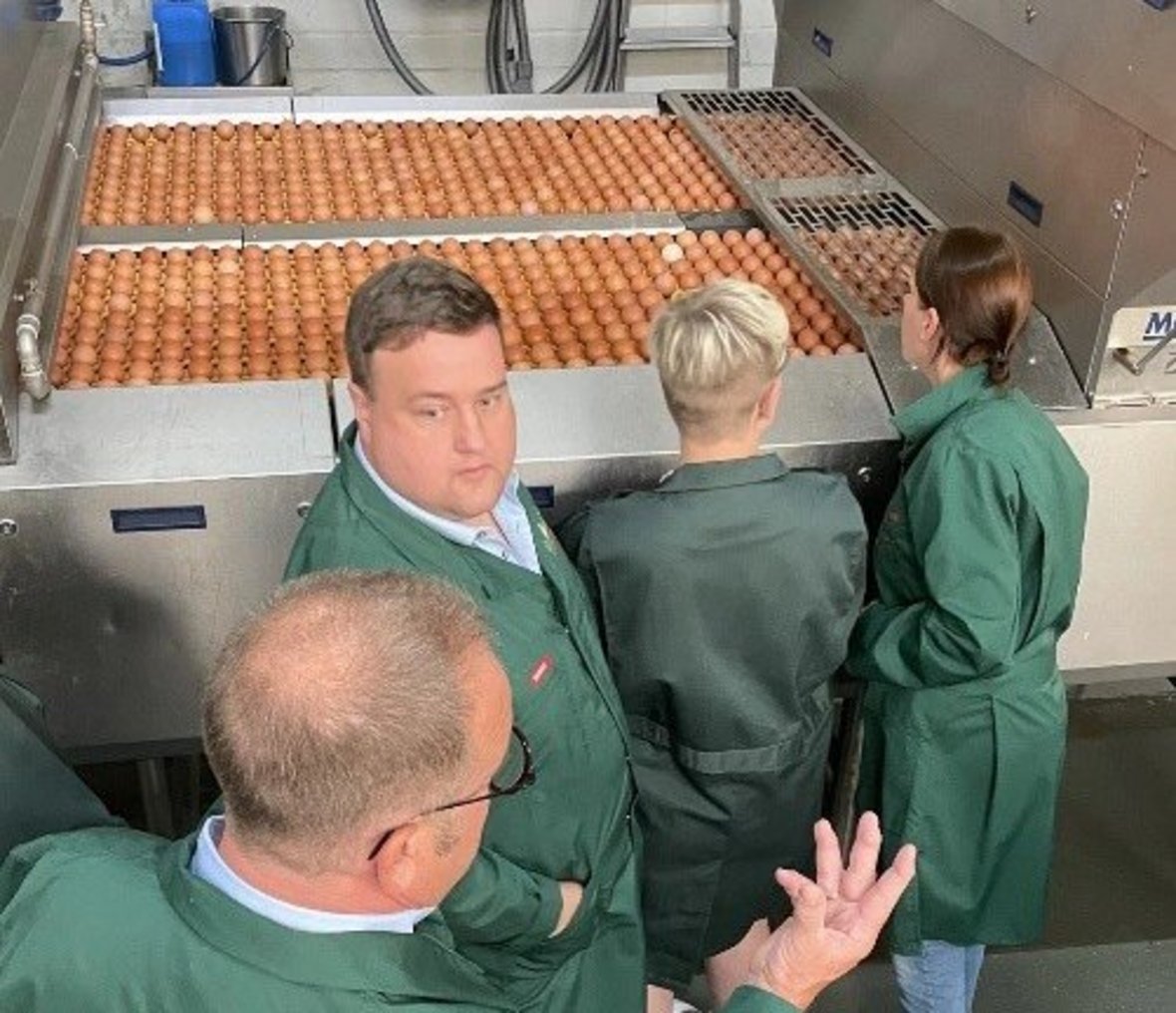
The excursion began at the Bio-Gut Rosenthal in Bergneustadt. What was once a small family-run farm has now developed into a state-of-the-art production site. Managing Director Jonathan Gauer guided the guests from Hesse through the egg packing station, which came into operation in 2023. Over 600,000 eggs from organic farming are sorted here every week. A small proportion of these come from the farm’s own, separately operated organic laying hen house. The majority of the organic eggs come from 22 independent and certified partner farms across North Rhine-Westphalia and neighbouring regions. The partnerships with the farms and with retailers are based on long-term contracts. They form the basis for an efficient, transparent and sustainable value chain that is regionally rooted and ecologically oriented.
The second stop was in western Münsterland: Mein-Ei.NRW board member Johannes-Bernhard Amshoff and his family welcomed the group of visitors to B. Amshoff GmbH in Ahaus.
The family-run business has been supplying the market for over 100 years with fresh eggs from all farming systems, as well as coloured and shelled eggs. The sorting plant and packing station are equipped with the latest technology and are among the most modern in Germany. Around six million eggs are sorted and packed there every week. The company sources these from contract farms in North Rhine-Westphalia, Lower Saxony and the neighbouring Netherlands.
In neighbouring Heek, the importance of securing the future of local businesses and ensuring their sustainability was subsequently discussed with further members of mein-ei.nrw e. V.
First, Dr Eckard Meyer from Haneberg & Leusing GmbH & Co. KG gave a presentation on feed for laying hens, explaining how stress factors can be addressed through a finely balanced feed formulation and high-quality raw materials.
Carina Führer, an animal welfare ambassador for the “Netzwerk Fokus Tierwohl” (Animal Welfare Focus Network) from the LLH Animal Husbandry Advisory Team, then presented the nationwide collaborative project. The aim is to improve the transfer of knowledge into practice and to make pig, poultry and cattle farms in Germany fit for the future in terms of animal-welfare-friendly, environmentally sound and sustainable livestock farming. In this, they are supported by pilot farms in Hesse and North Rhine-Westphalia.
To conclude the series of presentations, chairman Dietrich Vriesen introduced the association mein-ei.nrw e. V. Drawing on the association’s history spanning over 15 years, he was able to present numerous examples of effective and goal-oriented association work. These were entirely new to the guests and at the same time provided ample topics for discussion during the subsequent informal exchange over a Westphalian dinner.
The final leg of the journey took the Hessian group to Senden near Münster. At the Gut Averfeld hatchery, Burkhard Brinkschulte presented a new method for sexing eggs, based on AI-assisted absorption spectroscopy. A hatchery and a start-up joined forces in 2023 in a unique collaboration to develop an alternative sexing method for determining the sex of hatching eggs. This is based, on the one hand, on the legal requirements in force since 2022 and, on the other hand, on their own objectives: the method must be non-invasive, feasible at an early stage of incubation and, furthermore, cost-effective. As part of the process, the hatching eggs are regularly scanned spectroscopically in the incubator. The resulting data is collected in the cloud and evaluated using machine learning on the basis of various time-dependent indicators. By the 7th day of incubation, this already yields a reliable indication of the sex of the chick in the egg. Male and non-viable eggs can thus be removed from the incubation process at an early stage.
Author: Hannah Kanwischer, Office of the Poultry Animal Welfare Competence Centre; Jörg Meyer, mein-ei.nrw