
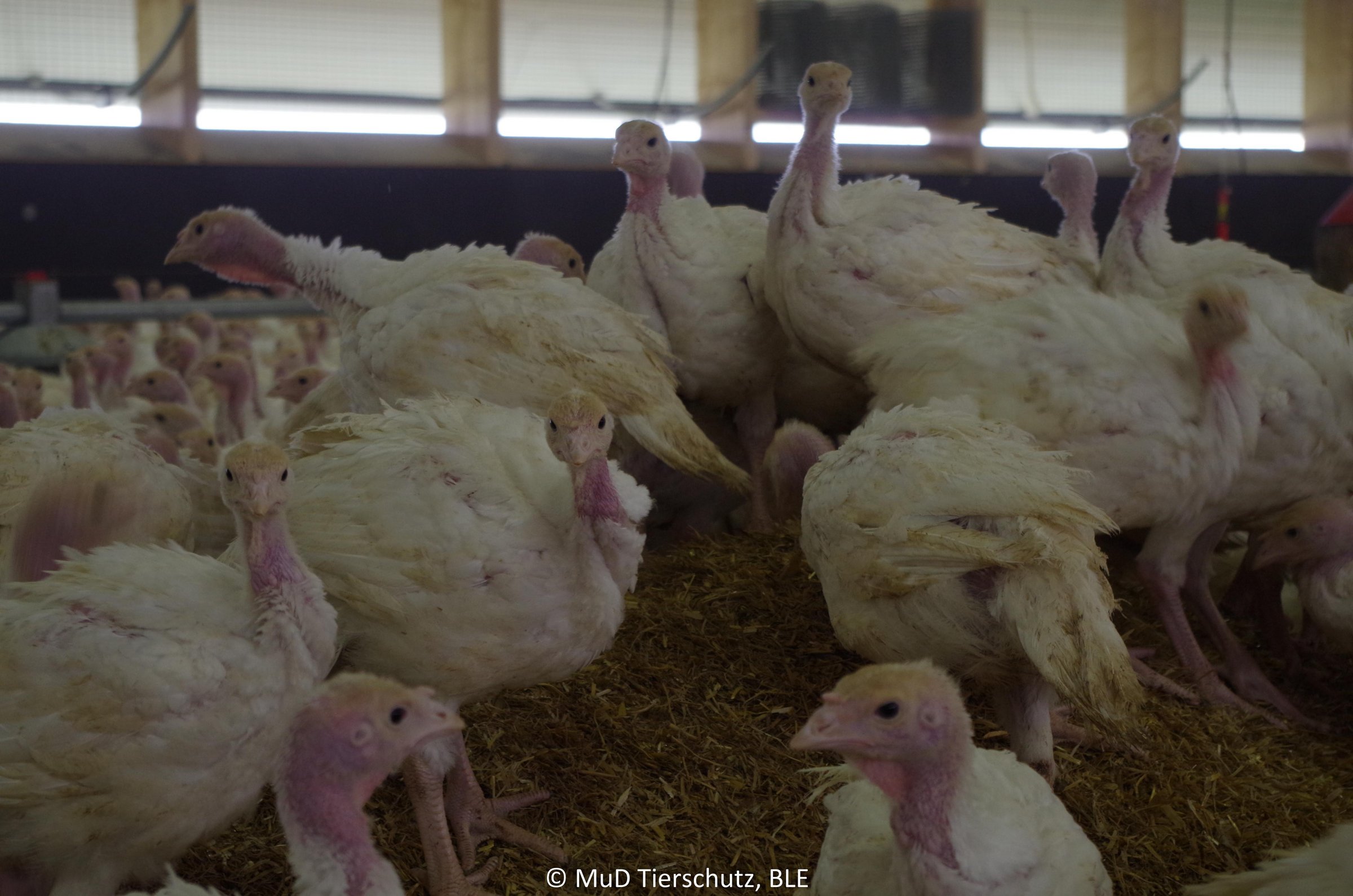
Feather pecking and cannibalism are key issues not only in the rearing of laying hens but also in turkey farming. Long-term studies have shown that these behavioural disorders are triggered by multiple factors, and that the optimal use of enrichment materials and good housing design offer a potential solution to counteract them. The move away from beak trimming is being discussed in both laying hen and turkey farming. Since 2017, beak trimming has been phased out for laying hens. For turkeys, the objective regarding the phasing out of beak trimming was formulated even more cautiously in 2017, as the understanding of the causes of feather pecking and cannibalism in turkeys was still significantly less complete than for laying hens. Furthermore, phasing out beak trimming appeared more feasible for female turkeys than for males. Consequently, a feasibility study was conducted in 2017 to examine the phasing out of beak trimming in turkey fattening. Led by Dr Jutta Berk (Friedrich Loeffler Institute), the feasibility study was completed in 2018 and concluded that the widespread implementation of the ban could not be recommended at that time. As feather pecking and cannibalism continue to pose a challenge for turkey farming, current research projects are focusing on enrichment opportunities and spatial design.
As part of the Animal Welfare Focus Network, the eastern German federal states organised an online seminar on enrichment opportunities and spatial design in turkey farming, providing an update on the current state of play from both scientific and practical perspectives.
Dr Jutta Berk (Friedrich Loeffler Institute) spoke about her many years of experience in both science and practice, drawing on several research projects on the topic of enrichment and spatial design.
Suitable enrichment materials for turkeys
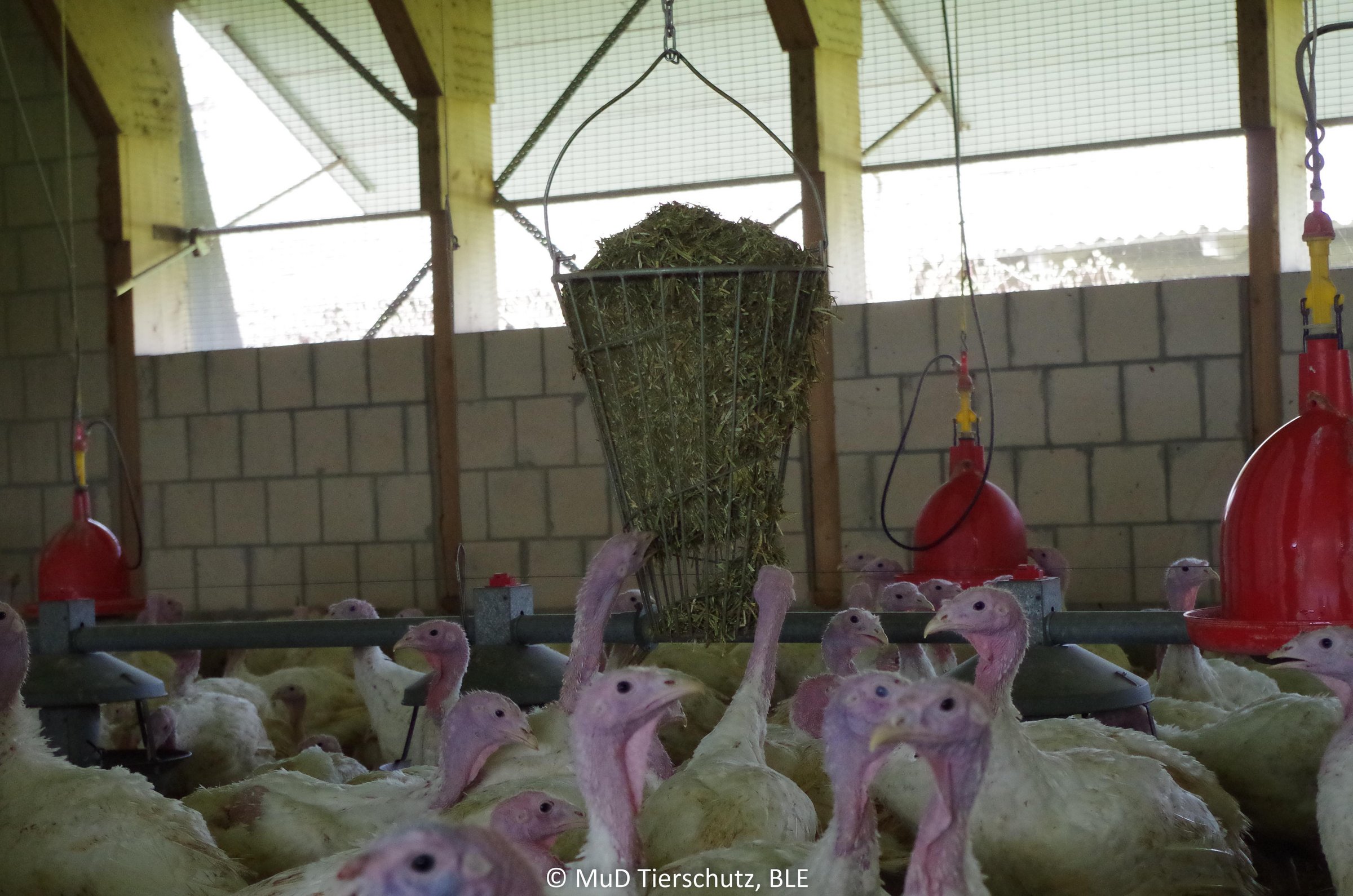
Turkeys can engage with their housing environment for long periods but can also lose interest in certain enrichment materials very quickly. According to Dr Berk, enrichment materials should therefore ideally not only provide a long duration of engagement but also enable a sense of achievement through manipulation of the material. Suitable enrichment materials include, for example, hay or silage baskets, pecking blocks or metal objects.
In addition to enrichment materials, the structure of the housing is equally important for a balanced flock. Straw bales and raised platforms within the housing, as well as the provision of an outdoor climate area, have proven to be effective structural elements. ‘Perching’, i.e. sitting in an elevated position, is important for turkeys. This is a natural behaviour and serves as a protective response against predators in the wild. This perching behaviour is evidently still genetically ingrained even in turkeys that have long been bred for commercial purposes, meaning they still exhibit this behaviour when provided with suitable facilities. The elevated perches should be designed so that they are easily accessible to animals of all ages and do not cause injury when they leave them.
Dr Berk’s research has shown that the use of enrichment materials and structural elements decreases with age, particularly in male turkeys as they reach sexual maturity. Dr Berk tends to advise against the use of perches, such as those used in laying hen systems, due to the increased pressure on the chest area and the associated animal welfare concerns. Larger elevated areas, such as perching platforms or straw bales, are more suitable for the birds. Finally, Dr Berk discussed light as a structural element in the house. Following several studies, it is now known that light management, light colour and brightness also play a major role in the occurrence of feather pecking and cannibalism in turkeys. Dr Berk is therefore currently working with Dr Ronald Günther and Prof. Silke Rautenschlein, Head of the Poultry Clinic at the University of Veterinary Medicine Hannover Foundation, on the MuD project ‘PuLi’, which aims to minimise feather pecking and cannibalism in turkeys through optimal light management and to identify ways of rearing turkeys with intact beaks. The findings from this recently launched project will be shared with livestock farmers at future events, ensuring that the latest scientific insights are applied in widespread practice.
Experiences with different enrichment materials
Ms Jennifer Gonzalez (State Office for Rural Development, Agriculture and Land Consolidation) gave a second presentation on her experiences from an experiment measuring pecking behaviour in turkeys and outlined approaches taken by other research institutions. Depending on the project, very different approaches were adopted.
One unusual project tested the provision of live black soldier fly larvae to male turkeys as enrichment material. The live larvae were placed in the litter and were very well accepted by the animals. It was striking that almost 100% of the birds engaged with the larvae, albeit only for a short time after they were introduced. Once the birds reached sexual maturity, their interest in the larvae declined significantly. A significant challenge, both organisationally and financially, was the transport of the live larvae, as they had to be kept refrigerated throughout.
As part of the second project, presented by Ms Gonzalez, various automatic enrichment systems were developed and tested for their practical suitability. Two of the systems were designed to encourage foraging behaviour as a form of enrichment. Depending on the system design, cereals, legumes or silage were automatically dispensed via conveyor systems into feed troughs and feed tubes. Maize silage was particularly well received. A sub-trial showed that turkeys with beaks trimmed had more difficulty pecking the material out of the openings than untrimmed birds. Due to a lack of success, they lost interest in the enrichment activity more quickly. Another automated solution could be a litter and enrichment system within a facility. In this system, fine litter, such as straw meal, as well as additional enrichment material such as oat flakes and calf muesli, was dispensed at regular intervals via chutes. The regular provision of loose bedding material was intended both to provide the animals with enrichment through scratching and dust bathing, and to help automate the bedding process. The alternative enrichment materials were primarily accepted before sexual maturity, whilst interest declined significantly in older animals. The animals also showed little interest in the bedding material that was continuously introduced.
Finally, Ms Gonzalez presented a project in which pecking activity was investigated as an indicator of increasing restlessness and the associated onset of feather pecking and cannibalism. The number of pecking strikes was continuously recorded via a pecking object fitted with a microphone. The result showed that the number of pecking strikes on the pecking object decreased over the course of the day and with increasing age. Although all the concepts presented by Ms Gonzalez require further optimisation, the need for a variety of solutions to prevent cannibalism is clear.
The importance of litter as enrichment material
Dr Ronald Günther (veterinary specialist in poultry) rounded off the information session with his extensive practical knowledge of turkey husbandry. In Dr Günther’s experience, litter in particular is an enrichment material that should not be underestimated. The litter should always be loose and dry. In addition to straw, other materials can also be used as litter, such as wood shavings, straw pellets, wood flour pellets, lignocellulose, spelt or rice husks, and much more. Straw bales provide additional enrichment material whilst also serving as a structural element. They are very popular with the birds and are used persistently. In his presentation, Dr Günther was able to demonstrate, through numerous practical observations, that there is a certain difference between human intention and animal interest when it comes to enrichment materials. For instance, the drinking and feeding facilities in the barn or the building structure itself can arouse the turkeys’ interest, causing the animals to engage with these instead of the actual enrichment materials. Dr Günther advised participants to always have an ‘emergency kit’ to hand. In other words, to keep a stock of enrichment materials that can be deployed immediately in the event of restless flocks or increased pecking behaviour. In doing so, the farmer should use the materials that, based on experience, work best with the flock. However, according to Dr Günther, more important than the materials themselves are observing the animals, intervening in good time, and giving the animals a choice between different enrichment materials. For Dr Günther, the presence of an outdoor climate area is a key aspect of barn design, alongside various functional areas such as retreat areas or feeding and watering areas. The outdoor climate area not only provides structure for the animals but also allows them to choose between different temperature and light zones. The associated movement also serves as an activity. Although outdoor climate areas can be highly effective in reducing feather pecking and cannibalism, animal welfare considerations clash with building and environmental protection regulations on this point. Consequently, it can happen that planning permission for extensions to existing barns is not granted due to environmental protection requirements.
Following the presentations, there were lively and lengthy discussions among the more than 30 participants. The organisers and speakers were delighted by the large number of interested attendees and see a continued need for research on this topic, as well as a need for knowledge transfer into broader practice. Thus, this event was a good start in the right direction!
Authors:
Anne Helene Ahrend, State Institute for Agriculture and Horticulture Saxony-Anhalt
Patricia Lößner, State Research Institute for Agriculture and Fisheries of Mecklenburg-Western Pomerania
Svenja Reich, Saxon State Office for the Environment, Agriculture and Geology
Natalie Wagner, State Office for Rural Development, Agriculture and Land Consolidation, Brandenburg