


Source: DLG
Avian influenza: insights and strategies from research and practice
EuroTier Digital: Reports from the field and academia on avian influenza (AI)
At the DLG Poultry Spotlight at “EuroTier digital”, there was high demand for information and discussion on the topic of avian influenza (AI). Five online events were held to discuss current developments, practical experiences and new scientific approaches. The Animal Welfare Focus network was also represented with three events on the topic.
Mandatory housing for mobile housing systems
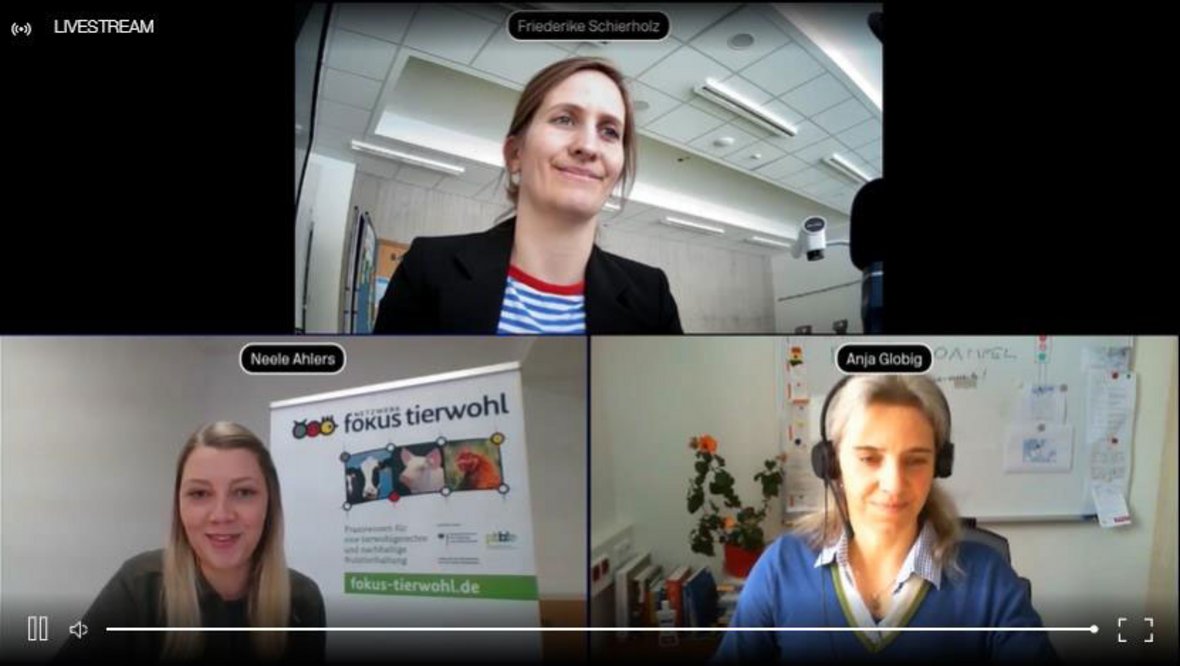
What measures can be taken to maintain animal welfare during outbreaks of avian influenza? Farmer Friederike Schierholz’s presentation focused on practical tips. The mobile housing operator shared her experiences with the mandatory housing requirement. Shortly before the 2016/2017 outbreak, the first laying hens were housed in the then-new mobile housing on her farm: “We hadn’t given mandatory housing a second thought at all when we purchased the housing,” the farmer noted. She advises newcomers in particular to make sure they factor this into their considerations when buying housing. Her own experience has shown that a winter garden provides the birds with extra space during the housing-in phase, thereby reducing stress. Her aim is to offer the laying hens sufficient opportunities to scratch and peck even whilst they are housed. To this end, she uses loose straw, straw pellets and a wide variety of enrichment materials. It is important to note that the enrichment materials must remain attractive to the birds over the long term, and that the associated labour and costs must be reasonable. Based on her positive experiences, Friederike Schierholz currently uses, amongst other things, pecking blocks and alfalfa bales, as well as maize silage from time to time. In addition, her birds are fed oats or wheat four to five times a day via an automated grain dispenser.
Safety check with AI risk traffic light system
Under the title “Prevention is better than culling”, Dr Anja Globig from the Institute for International Animal Health at the Friedrich Loeffler Institute informed the audience about the importance of consistently adhering to biosecurity measures in poultry farming with regard to the spread of avian influenza (bird flu). In the current epidemic alone, losses of over 600,000 birds due to avian influenza had already been recorded by mid-February. According to Dr Globig, a key factor in preventing the spread of the virus is understanding its characteristics. In addition to direct transmission from animal to animal, particular attention must also be paid to indirect routes of transmission. The key question is: “Does my farm have a biosecurity gap?”. To answer this question, the AI Risk Traffic Light was developed in 2018 by the University of Vechta in collaboration with the FLI. This comprises a questionnaire consisting of 100 individual questions, which livestock farmers can answer anonymously for their farm using a multiple-choice format. The aim is to identify potential risk factors relating to the security of the farm, the security of the barn and also work processes. At the end, the results are categorised into three risk groups: ‘green’, ‘orange’ and ‘red’. In addition, each livestock farmer receives optimisation tips along with a checklist of specific measures to be implemented. With the help of the AI risk traffic light system, farm operations can thus be made safer in terms of hygiene standards. The tool is available free of charge to all interested parties at https://risikoampel.uni-vechta.de.
Measures in goose farming
In an interview with Dr Christian Lambertz from the Research Institute of Organic Agriculture (FiBL), Iris Tapphorn, a farmer in the Animal Welfare Pilot Farms Network, outlined her experiences in dealing with the requirements relating to avian influenza. The Tapphorn Goose Farm in Lower Saxony has several branches of operation, including a goose parent stock breeding programme with an EU-certified hatchery. Goose rearing and fattening are further key areas of the farm’s operations. The farm manager has implemented numerous biosecurity measures on the farm to protect against the introduction of the AI pathogen. The risk-mitigating measures include providing feed and water exclusively in the shed, as well as regular random testing for the H5N8 virus using PCR analysis. In addition, stocking density has been reduced to minimise stress.