
The rearing of laying hens in mobile housing systems is currently experiencing a resurgence. Many consumers also regard this rearing method as highly conducive to animal welfare, as the hens usually have access to plenty of fresh green space. This often leads to greater appreciation of the food produced and, consequently, a greater willingness to pay for it. However, meeting the requirements for species-appropriate rearing of laying hens remains just as important with this rearing method. How best to meet the basic needs of laying hens is also a key question for many who are currently transitioning to mobile housing. For example, how should animal-welfare-friendly outdoor access be managed in mobile housing, and what needs to be taken into account? To provide some initial answers to this question, the animal welfare multipliers from the federal states of Brandenburg, Saxony-Anhalt, Saxony and Mecklenburg-Western Pomerania organised an online seminar.
Space requirements for species-appropriate outdoor access
Jutta van der Linde, mobile housing expert at the North Rhine-Westphalia Chamber of Agriculture and advisor to the Federal Association for Mobile Poultry Farming, provided information on options for species-appropriate outdoor run design in mobile housing. Approximately 15 square metres of outdoor run area should be allowed for per laying hen to ensure a solid grass cover. It is also advisable to move the mobile poultry house every 14 days and to fill in the holes caused by the laying hens when scratching. Afterwards, the used outdoor run requires sufficient time for regeneration and re-vegetation, possibly also through reseeding with a suitable seed mixture. Both the space requirements and the suitability of the area must be assessed prior to purchasing a mobile house due to the heavy wear and tear involved, and these factors should be included as decision-making criteria when selecting a suitable mobile house. As an additional design element for a species-appropriate outdoor run, laying hens prefer coverings through which they can observe the sky in silhouette. Thus, the animals prefer artificially created shelters – such as a structural steel mesh covered with windbreak netting – to opaque materials. Even under natural conditions, they frequently use shrubbery at the edge of the forest to seek out protection and shelter. Walnut, poplar or miscanthus plantations can help the birds to express their natural behaviours. It should be noted, however, that these row-planted elements often do not provide sufficient protection against predators such as foxes or hawks and can therefore also become a source of danger for the laying hens.
Plant-related aspects of the outdoor run
The second part of the seminar focused on the horticultural aspects to be considered when designing an outdoor run for laying hens. Andreas Titze, a researcher at the State Research Institute for Agriculture and Fisheries in Mecklenburg-Western Pomerania, reported on trials he had conducted himself in Mecklenburg-Western Pomerania. On a farm with 6,000 laying hens in six mobile houses and on arable land with a soil rating of 45, various seed mixtures were tested. With an annual rainfall of 790 mm and an average temperature of 9.8 degrees Celsius in the trial year of 2017, growth conditions were particularly favourable for German ryegrass and white clover. This allowed these species to regenerate well and quickly close gaps even under intensive use. In contrast, with annual rainfall the following year of just 360 mm and an average temperature of 10.8 degrees Celsius, a significant decline in German ryegrass was observed and the legumes virtually disappeared from the stand. As drought conditions intensified, tall fescue and red fescue, as well as meadow grass, accounted for a higher proportion of the stand. Consequently, in the absence of water and/or under intensive use with short rest periods, mixtures with high proportions of tall fescue or red fescue achieved significantly higher cover. It was also observed that, due to their pronounced selective ability, the chickens pecked at and consumed fine-leaved plants in particular with great intensity. It also became clear that unavoidable partial nutrient accumulation must be mitigated through timely rotation of grazing areas and suitable crop rotations.
Practical experience with mobile housing in agroforestry systems
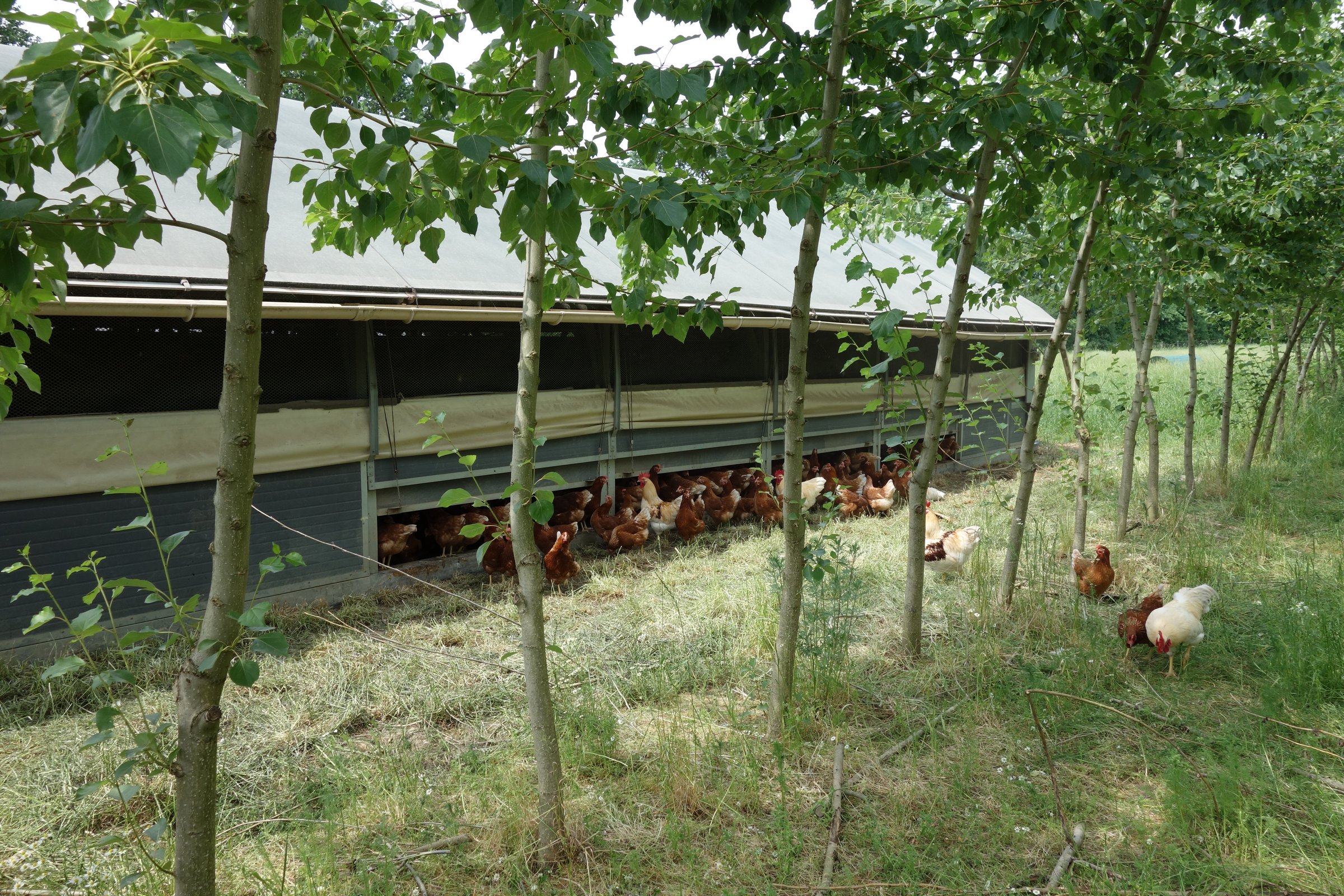
Finally, Sebastian Frey spoke about the problems with outdoor run design that can arise in day-to-day operations on a working farm. He and his family keep 4,000 laying hens in three mobile houses in northern Bavaria. In the past, there were often difficulties with bare patches where the vegetation near the house was damaged by the hens’ intense pecking and scratching, leading to high nitrogen input. This was not an easy problem to solve, given that his 1,000- or 2,000-hen mobile houses cannot be moved easily and always require a water and electricity supply. Uneven or waterlogged areas make relocating the mobile houses even more difficult. The Frey family farm has solved these problems with an agroforestry system, in which hedges and fruit trees are planted across the entire available land, thereby attracting the animals to areas further away from the barns. This farming method has solved many problems for the farm, but also involves increased labour costs, which ultimately need to be offset by higher prices for the eggs. It should be noted, however, that this farming method is not permitted in every federal state, and interested livestock farmers should consult the relevant authorities or advisors in advance. To achieve higher added value, the Frey family is focusing on public relations, aiming to engage with consumers and communicate the importance of this rearing system, which is very close to nature for the laying hens.
Author: Patricia Lößner, State Research Institute for Agriculture and Fisheries, Mecklenburg-Western Pomerania