
The cattle farms in the Focus on Animal Welfare network are always very interested in current issues. The legal changes to the Animal Welfare Transport Ordinance announced in June 2021 were therefore one of the topics discussed with Dr Kemmerling as a representative of the BMEL.
She is a consultant in the Future of Livestock Farming department, where she is responsible for technical issues and exchanges with various interest groups, among other things. In addition, she is an active dairy farmer and knows very well where the shoe pinches. Although the autumn holidays and the maize campaign meant that the number of farms participating in the online exchange in mid-October remained manageable, the questions and comments on the speaker's remarks were all the more numerous.
Requirements for the transport age of calves are being tightened
The 14-day rule for the transport ban on calves in the Animal Welfare Transport Ordinance has been increased to 28 days. A proposal from Lower Saxony seems to have set the ball rolling and led to the increase in the age limit being included in the draft. The reason given is the immunological gap. This means that very young calves can suffer serious health problems due to the waning protection of colostrum and their own immune system still being insufficiently developed if they are transported or moved during this period. The main focus here is on the transport of male calves from dairy farms, some of which are transported long distances to fattening farms. As numerous laws and regulations were to be passed within a few sessions before the summer break and the new elections in September, it had to be done quickly. The amendment to the Animal Welfare Transport Regulation presented in May did not include the increase in the age limit; it appears for the first time in the recommendation of the Committee on Agricultural Policy and Consumer Protection of 11 June 2021. The background to this is that an increase in the minimum age for the transport of calves is also being discussed at EU level. The recommendation was adopted by the Federal Council despite the known far-reaching consequences. The explanatory memorandum explicitly referred to the considerable impact on agricultural businesses and structures and recommended a transition period of one year. In view of the lack of stable capacity for the extended holding period at the farm of origin and the associated problems, the end of the transition period for practical implementation on farms was set for 1 January 2023.
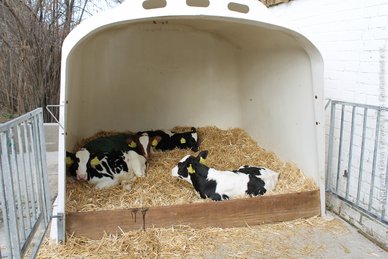
It is not yet clear whether the federal states will submit applications for possible special regulations (e.g. lowering the age for shorter distances). In addition, the Thünen Institute is currently working on an impact assessment. However, work is being done in the background to set up appropriate support programmes to facilitate the creation of additional housing capacity for the longer stay of calves on the farm. For example, AFP funding is conceivable, which could then come into play for the upcoming 2022 funding period. The use of mobile systems, such as group igloos or tent solutions, is a conceivable transitional solution for farms that cannot afford new construction or conversion. In fact, however, questions arise here as well if no paved ground is available as a location.
It can be said that there will be no turning back on the age issue and that only the funding options and practical implementation on farms are still open.
Author: Gudrun Plesch, FiBL Deutschland e.V.